Join us on a literary world trip!
Add this book to bookshelf
Grey
Write a new comment Default profile 50px
Grey
Subscribe to read the full book or read the first pages for free!
All characters reduced
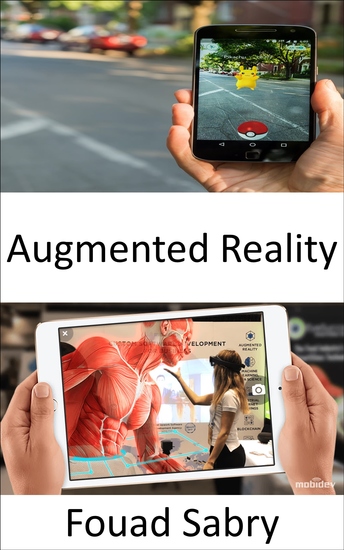
Augmented Reality - Is it possible for augmented reality to succeed where virtual reality has failed? - cover

Augmented Reality - Is it possible for augmented reality to succeed where virtual reality has failed?

Fouad Sabry

Publisher: One Billion Knowledgeable

  • 0
  • 0
  • 0

Summary

What Is Augmented Reality
 
Augmented reality (AR) is an interactive experience of a real-world environment in which the objects that reside in the real world are enhanced by computer-generated perceptual information. This enhancement can sometimes take place across multiple sensory modalities, including visual, auditory, haptic, somatosensory, and olfactory. Augmented reality (AR) is also known as mixed reality (MR). The term "augmented reality" (AR) refers to a system that combines real and virtual worlds, allows for interaction in real time, and accurately registers virtual and real things in three dimensions. The information that is superimposed on the sensory experience may either be useful or detrimental. This experience is so expertly integrated into the fabric of the actual world that it gives the impression of being an immersive component of the setting in which it is taking place. To put it another way, augmented reality modifies an individual's continuing perception of a real-world environment, while virtual reality totally replaces an individual's real-world environment with a simulated one. Mixed reality and computer-mediated reality are similar to augmented reality, although the concepts have essentially become synonymous with one another.
 
How You Will Benefit
 
(I) Insights, and validations about the following topics:
 
Chapter 1: Augmented reality
 
Chapter 2: Virtual reality
 
Chapter 3: Wearable computer
 
Chapter 4: Mixed reality
 
Chapter 5: Head-mounted display
 
Chapter 6: Immersion (virtual reality)
 
Chapter 7: Projection augmented model
 
Chapter 8: 3D user interaction
 
Chapter 9: Augmented learning
 
Chapter 10: Wikitude
 
Chapter 11: Virtual touch screen
 
Chapter 12: Nokia Point and Find
 
Chapter 13: Optical head-mounted display
 
Chapter 14: Tango (platform)
 
Chapter 15: Smartglasses
 
Chapter 16: Windows Mixed Reality
 
Chapter 17: Microsoft HoloLens
 
Chapter 18: Industrial augmented reality
 
Chapter 19: VR positional tracking
 
Chapter 20: Virtual reality in primary education
 
Chapter 21: Commercial augmented reality
 
(II) Answering the public top questions about augmented reality.
 
(III) Real world examples for the usage of augmented reality in many fields.
 
(IV) 17 appendices to explain, briefly, 266 emerging technologies in each industry to have 360-degree full understanding of augmented reality' technologies.
 
Who This Book Is For
 
Professionals, undergraduate and graduate students, enthusiasts, hobbyists, and those who want to go beyond basic knowledge or information for any kind of augmented reality.
Available since: 07/10/2022.
Print length: 341 pages.


Other books that might interest you

  • AI in a Nutshell: A Guide for Business and Government Leaders - Dr Fernando De La Peña Llaca - cover

    AI in a Nutshell: A Guide for...

    Fernando De La Pena Llaca

    • 0
    • 0
    • 0
    🌐 AI in a Nutshell is your fast-track guide to understanding and leveraging the most powerful force shaping our world today—Artificial Intelligence. 
    From decoding complex concepts like neural networks, machine learning, and natural language processing to uncovering real-world applications in business and government, this book delivers cutting-edge insights with simplicity and clarity. 
    🚀 Whether you're a business executive, public sector leader, startup founder, or just AI-curious, Dr. Fernando De La Peña Llaca—renowned NASA contractor and pioneer of holographic communication—takes you on a journey through the past, present, and future of AI. 
    You’ll learn:What AI really is (without the jargon)How AI is already transforming healthcare, law enforcement, customer service, and logisticsThe truth behind AI myths—and how to avoid common trapsPractical ways to implement AI in your organization (even with no tech background)The ethical questions no one’s asking—but everyone shouldHow AI will shape jobs, economies, and societies in the decades to come 
    Packed with easy-to-follow “cheat sheets,” compelling case studies, and unforgettable storytelling, AI in a Nutshell makes artificial intelligence accessible, actionable, and impossible to ignore. 
    ✨ The future is not waiting. Understand it. Build it. Lead it.
    Show book
  • CMA Secrets Unveiled: Transform Your Path to Success Today - "Elevate your CMA exam prep! Discover dynamic audio lessons that pave your path to success today" - cover

    CMA Secrets Unveiled: Transform...

    Felix Ardenwood

    • 0
    • 0
    • 0
    CMA Secrets Unveiled: Transform Your Path to Success Today 
    ⭐⭐ Simplified Guide & Explanations Included ⭐⭐  
    Are you eager to advance in your career and enhance your knowledge with effective study techniques?  
    Searching for an all-encompassing guide that equips you with everything you need to achieve your career goals?  
    Your quest ends here!  
    This guide acts as your ultimate companion for deepening your understanding, applying your skills, and participating in practical exercises. With this resource, you're on the fast track to success. 
    Updated for the latest exam structure for 2024-2025.  
    Key Features of This Comprehensive Guide:  
    - In-depth insights on effective study techniques 
    - Clear and thorough explanations to aid comprehension 
    - Proven strategies for exam preparation and successful navigation 
    Our guide sets itself apart through its extensive coverage, essential for your exam triumph. Concepts are explored in detail, ensuring a solid grasp of the material.  
    Please note, this guide is an independent resource and is not affiliated with any official exam entity.  
    Crafted with a clear layout and straightforward language, our guide guarantees smooth transitions between topics. Say farewell to confusing jargon and welcome content that is clear, precise, and technically accurate. 
    So, why wait? Click the BUY NOW button, secure your guide, and embark on your journey to success with effective study techniques!  
    Get ready to take control of your success!
    Show book
  • From 1960 to 2060 The History Of The Internet Bits and Bobs and Beyond - cover

    From 1960 to 2060 The History Of...

    Gustavo Morale

    • 0
    • 0
    • 0
    Embark on an enlightening journey through the digital age with Gustavo Morale's "The History of the Internet, bits and bobs and beyond." Born under the vibrant skies of São Paulo, Brazil, in 1981, Gustavo, affectionately known as Gut, has lived parallel to the rapid evolution of the Internet. This book is his first, blending a deep-rooted fascination with digital technology with personal anecdotes and historical facts, offering readers a unique perspective on the Internet's transformative journey from 1960 to a speculative 2060. 
    Gustavo's narrative weaves through the dawn of connectivity, the digital revolutions of successive decades, and ventures into the future with forecasts on augmented reality, brain-computer interfaces, and beyond. Through 31 meticulously crafted chapters, readers are treated to a comprehensive chronicle that spans a full century, marked by in-depth research, personal insights, and a seamless integration of technological, cultural, and economic narratives. 
    This book targets tech enthusiasts, historians, cultural analysts, futurists, and general readers alike, promising educational insights, inspirational stories, and a glimpse into future technological advancements. Gustavo offers a narrative rich in analytical depth and warmth, bridging the gap between technical intricacies and the personal stories that give the Internet life. "The History of the Internet, bits and bobs and beyond" is an essential read for anyone seeking to understand the forces that have shaped our digital world and those that will continue to define our future. 
    Join Gustavo Morale on this immersive journey through time, exploring the intricate tapestry of the digital age.
    Show book
  • Timeline of Stars - cover

    Timeline of Stars

    Joe Adcock

    • 0
    • 0
    • 0
    Where do you place in the Timeline of Stars? Does it matter? 
    A story uncovered by a single star Bible verse led to more stars. Previously unknown within a ten-thousand-year span are planetary alignments or convergencies. What do the stars unlock? Turning points dated to authenticate history that were, until now, undetected.  
    Only in our recent history has it been possible to explore the stars. And why should it matter? Does it make a difference for you? Perhaps! 
    You can discover in much the same way as I did. Here, take my keys to the stars.
    Show book
  • The Essence of Christianity - cover

    The Essence of Christianity

    Ludwig Feuerbach

    • 0
    • 0
    • 0
    In this, one of the most influential works of the post-Hegelian era, Feuerbach captures the synthesis that emerges from the dialectical process of a transcending Godhead & the rational & material world. In understanding the true nature of what it means to be fully human, he contends that we come face to face with the essence of Xian theology: human beings investing ordinary concepts with divine meaning & significance. The true danger to humanity occurs when theology is given the force of dogma & doctrine. Losing sight of its anthropological underpinnings & dependence upon or emergence from human nature, it then acquires an existence separate from that of humankind. He leaves nothing untouched: miracles, the Trinity, Creation, prayer, resurrection, immortality, faith & much more.The essential nature of manThe essence of religion considered generallyGod as a being of the understandingGod as a moral being or lawThe mystery of the incarnation; or, God as love, as a being of the heartThe mystery of the suffering GodThe mystery of the Trinity & the mother of GodThe mystery of the Logos & divine imageThe mystery of the cosmogonical principle in GodThe mystery of mysticism, or of nature in GodThe mystery of providence & creation out of nothingThe significance of the creation in JudaismThe omnipotence of feeling, or the mystery of prayerThe mystery of faith, the mystery of miracleThe mystery of the resurrection and of the miraculous conceptionThe mystery of the Christian Christ, or the personal GodThe distinction between Christianity & heathenismThe significance of voluntary celibacy & monachismThe Christian heaven, or personal immortalityThe essential standpoint of religionThe contradiction in the existence of GodThe contradiction in the revelation of GodThe contradiction in the nature of God in generalThe contradiction in the speculative doctrine of GodThe contradiction in the TrinityThe contradiction in the sacramentsThe contradiction of faith & loveConcluding application
    Show book
  • Why Science Does Not Disprove God - cover

    Why Science Does Not Disprove God

    Amir Aczel

    • 0
    • 0
    • 0
    The renowned science writer, mathematician, and bestselling author of Fermat's Last Theorem masterfully refutes the overreaching claims the "New Atheists," providing millions of educated believers with a clear, engaging explanation of what science really says, how there's still much space for the Divine in the universe, and why faith in both God and empirical science are not mutually exclusive. 
    A highly publicized coterie of scientists and thinkers, including Richard Dawkins, the late Christopher Hitchens, and Lawrence Krauss, have vehemently contended that breakthroughs in modern science have disproven the existence of God, asserting that we must accept that the creation of the universe came out of nothing, that religion is evil, that evolution fully explains the dazzling complexity of life, and more. In this much-needed book, science journalist Amir Aczel profoundly disagrees and conclusively demonstrates that science has not, as yet, provided any definitive proof refuting the existence of God. 
    Why Science Does Not Disprove God is his brilliant and incisive analyses of the theories and findings of such titans as Albert Einstein, Roger Penrose, Alan Guth, and Charles Darwin, all of whose major breakthroughs leave open the possibility— and even the strong likelihood—of a Creator. Bolstering his argument, Aczel lucidly discourses on arcane aspects of physics to reveal how quantum theory, the anthropic principle, the fine-tuned dance of protons and quarks, the existence of anti-matter and the theory of parallel universes, also fail to disprove God.
    Show book