Join us on a literary world trip!
Add this book to bookshelf
Grey
Write a new comment Default profile 50px
Grey
Subscribe to read the full book or read the first pages for free!
All characters reduced
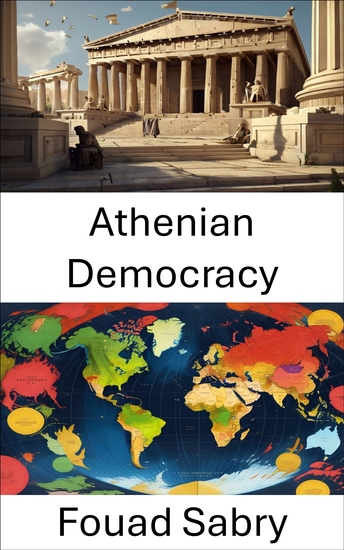
Athenian Democracy - Exploring the Roots of Democratic Governance in Ancient Greece - cover

Athenian Democracy - Exploring the Roots of Democratic Governance in Ancient Greece

Fouad Sabry

Publisher: One Billion Knowledgeable

  • 0
  • 0
  • 0

Summary

Athenian Democracy offers a deep dive into the origins and impact of Athens' pioneering direct democracy. This essential read for professionals, students, and enthusiasts explores how ancient Athens shaped modern democratic principles.
 
Chapters Highlights:
 
1. Athenian Democracy - Origins and structure of Athenian democracy, and its influence on political thought.
 
2. Draco (Lawgiver) - Draco's legal reforms and their role in advancing democracy.
 
3. Solon - Solon’s reforms and their foundational impact on Athenian democracy.
 
4. Cleisthenes - Cleisthenes’ political reforms and reorganization of Athens.
 
5. Boule (Ancient Greece) - The Boule's role and impact on Athenian governance.
 
6. Areopagus - The Areopagus Council’s judicial and political significance.
 
7. Ecclesia (Ancient Greece) - The Ecclesia's role in direct democratic decision-making.
 
8. Classical Athens - The peak of Athenian democracy and its achievements.
 
9. Pnyx - The Pnyx’s importance in democratic deliberation.
 
10. Athenian Revolution - Shifts leading to true democracy in Athens.
 
11. Metic - The role of Metics in Athenian democracy.
 
12. Solonian Constitution - The impact and legacy of Solonian reforms.
 
13. Alcmaeonidae - The Alcmaeonidae family's influence on democracy.
 
14. History of Democracy - Athenian democracy’s broader historical context.
 
15. Law Court (Ancient Athens) - The function of Athenian law courts in maintaining democracy.
 
16. Archon Basileus - The role of the Archon Basileus in religious and judicial matters.
 
17. Ephialtes - Ephialtes’ reforms and their effects on aristocratic power.
 
18. Heliaia - The Heliaia court system’s impact on democratic participation.
 
19. Outline of Ancient Greece - Overview of Ancient Greece’s political landscape.
 
20. Draconian Constitution - The Draconian Constitution’s influence on legal reforms.
 
21. Outline of Democracy - Connections between ancient and modern democratic practices.
 
Athenian Democracy is a crucial resource for understanding democracy’s roots and ongoing relevance.
Available since: 08/08/2024.
Print length: 220 pages.

Other books that might interest you

  • The Tragic Mind - Fear Fate and the Burden of Power - cover

    The Tragic Mind - Fear Fate and...

    Robert D. Kaplan

    • 0
    • 0
    • 0
    A moving meditation on recent geopolitical crises, viewed through the lens of ancient and modern tragedy 
     
    Some books emerge from a lifetime of hard-won knowledge. Robert D. Kaplan has learned, from a career spent reporting on wars, revolutions, and international politics in Europe, the Middle East, and East Asia, that the essence of geopolitics is tragedy. In The Tragic Mind, he employs the works of ancient Greek dramatists, Shakespeare, German philosophers, and the modern classics to explore the central subjects of international politics: order, disorder, rebellion, ambition, loyalty to family and state, violence, and the mistakes of power. The great dilemmas of international politics, he argues, are not posed by good versus evil—a clear and easy choice—but by contests of good versus good, where the choices are often searing, incompatible, and fraught with consequences. A deeply learned and deeply felt meditation on the importance of lived experience in conducting international relations, this is a book for everyone who wants a profound understanding of the tragic politics of our time.
    Show book
  • Rights of Man The: Book Summary & Analysis - cover

    Rights of Man The: Book Summary...

    Briefly Summaries

    • 0
    • 0
    • 0
    This is a concise summary and analysis of The Rights of Man, by Thomas Paine.
    It is not the original book and is not affiliated with or endorsed by 
    Thomas Paine.
    Ideal those seeking a quick and insightful overview.
     
    "The Rights of Man" is a groundbreaking treatise that passionately defends the ideals of liberty, equality, and democracy. Written in response to the political turbulence of the 18th century, it presents a compelling argument for the natural rights of individuals and the necessity of government as a social contract derived from the consent of the governed. The book boldly critiques hereditary monarchy and aristocracy, championing revolution as a legitimate means to achieve justice. With its incisive reasoning and universal appeal, this work remains a cornerstone of political philosophy and a rallying cry for human rights.
    Show book
  • Trade-Offs - An Introduction to Economic Reasoning Third Edition - cover

    Trade-Offs - An Introduction to...

    Harold Winter

    • 0
    • 0
    • 0
    The highly engaging introduction to thinking like an economist, updated for a new generation of readers. 
     
    When economists wrestle with any social issue—be it unemployment, inflation, healthcare, or crime and punishment—they do so impersonally. The big question for them is: what are the costs and benefits, or trade-offs, of the solutions to such matters? These trade-offs constitute the core of how economists see the world—and make the policies that govern it. 
     
    Trade-Offs is an introduction to the economic approach of analyzing controversial policy issues. A useful introduction to the various factors that inform public opinion and policymaking, Trade-Offs is composed of case studies on topics drawn from across contemporary law and society. 
     
    Intellectually stimulating yet accessible and entertaining, Trade-Offs will be appreciated by students of economics, public policy, health administration, political science, and law, as well as by anyone following current social policy debates.
    Show book
  • Political Economy - cover

    Political Economy

    John Ruskin

    • 0
    • 0
    • 0
    John Ruskin was a Victorian-era writer, art critic, and social thinker who wrote extensively on political economy. He was critical of the industrialization and capitalism that were taking hold in Britain during his time, and he believed that these developments were causing great harm to both the natural environment and human society. 
    Ruskin believed that the capitalist system was inherently flawed because it focused solely on maximizing profits and disregarded the well-being of workers, the environment, and society as a whole. He argued that the pursuit of wealth at all costs led to the exploitation of labor, the destruction of natural resources, and the degradation of art and culture. 
    In response to these problems, Ruskin advocated for a different economic system that was more in tune with the needs of people and the environment. He believed that the economy should be organized around the principles of social justice, sustainability, and community. 
    Ruskin's ideas were influential in the development of the Arts and Crafts movement, which sought to promote traditional crafts and design in opposition to the mass-produced goods of industrial capitalism. His critique of the capitalist system also influenced later socialist and environmental movements.
    Show book
  • The Prince - cover

    The Prince

    Niccolò Machiavelli

    • 0
    • 0
    • 0
    The Prince 
    By Niccolò Machiavelli 
    A timeless masterpiece on power, strategy, and statecraft, The Prince is one of the most influential political treatises ever written. First penned in 1513, Niccolò Machiavelli offers a bold and unapologetic guide on how rulers can acquire and maintain power, often advocating for pragmatism over morality. 
    With razor-sharp insights into human nature, deception, and governance, Machiavelli argues that a successful leader must be cunning, adaptable, and, when necessary, ruthless. From the necessity of fear over love to the art of war and manipulation, The Prince remains a vital read for politicians, strategists, and anyone seeking to understand the complex dynamics of power. 
    Whether admired as a manual for leadership or criticized as a blueprint for tyranny, The Prince continues to shape political thought centuries after its publication. This edition, translated by W.K. Marriott, preserves the clarity and brilliance of Machiavelli’s original work, making it accessible to modern readers."It is better to be feared than loved, if you cannot be both."
    Show book
  • Mamata - Beyond 2021 - cover

    Mamata - Beyond 2021

    Shubhankar, Jayanta Ghosal,...

    • 0
    • 0
    • 0
    In the West Bengal election of 2021, the longest state election in the history of India, Mamata Banerjee won the khela, and the BJP lost the plot. How did this happen? 
    The author, Jayanta Ghosal, travelled to all the districts of West Bengal and unearthed certain key factors that helped the Trinamool win the state. For instance, there was a massive gap in the BJP's understanding of Bengali identity, which Mamata was able to exploit. An 'overdose' of central intervention, ranging from paramilitary forces to intelligence agencies to target key TMC leaders, added to the BJP's disconnect with voters. Increasingly, the state felt the divide between New Delhi and Bengal grow. 
    The book details how Mamata was successfully able to portray herself as the 'daughter of Bengal' who worked tirelessly for the state's poor and disadvantaged. It also asks the question: with the state elections under her belt, what will be Mamata's path to the general elections of 2024? Does she consider herself a candidate for the prime minister's post?
    Show book