Join us on a literary world trip!
Add this book to bookshelf
Grey
Write a new comment Default profile 50px
Grey
Subscribe to read the full book or read the first pages for free!
All characters reduced
Approval Voting - A Modern Approach to Electoral Reform and Democratic Representation - cover

Approval Voting - A Modern Approach to Electoral Reform and Democratic Representation

Fouad Sabry

Publisher: One Billion Knowledgeable

  • 0
  • 0
  • 0

Summary

Approval Voting-Enhancing Democratic Representation in Political Science
 
What is Approval Voting?This book explores approval voting systems and their impact on democratic representation, voter satisfaction, and efficiency. It offers a deep dive into the benefits and challenges of using this system in elections.
 
Chapters Overview1-Approval Voting-Introduction to the core concepts and principles of approval voting.
 
2-Score Voting-Compares score voting and its outcomes with approval voting.
 
3-Condorcet Method-Discusses the Condorcet method and its differences from approval voting.
 
4-Strategic Voting-Analyzes strategic voting and how approval voting interacts with it.
 
5-Borda Count-Reviews the Borda count system and its comparative advantages.
 
6-Condorcet Winner Criterion-Evaluates approval voting against the Condorcet winner criterion.
 
7-Condorcet Loser Criterion-Investigates how approval voting handles the Condorcet loser criterion.
 
8-Participation Criterion-Examines approval voting's impact on voter participation.
 
9-Comparison of Electoral Systems-A detailed comparison of approval voting with other systems.
 
10-Multiwinner Voting-Explores approval voting’s application in multiwinner elections.
 
11-Two-Round System-Compares the two-round system with approval voting.
 
12-Bucklin Voting-Introduction to Bucklin voting and its mechanisms.
 
13-Majority Criterion-Evaluates approval voting against the majority criterion.
 
14-Nanson’s Method-Analyzes Nanson’s method and its relevance to approval voting.
 
15-Later-No-Harm Criterion-Discusses this criterion and its role in voter behavior.
 
16-Independence of Clones Criterion-Explores the criterion’s importance in approval voting.
 
17-Instant-Runoff Voting-Compares instant-runoff voting with approval voting.
 
18-Cardinal Voting-Analyzes cardinal voting systems and voter satisfaction.
 
19-Ranked Voting-Compares ranked voting systems with approval voting.
 
20-Later-No-Help Criterion-Investigates this criterion in the context of approval voting.
 
21-STAR Voting-Introduction to STAR voting and its comparison to approval voting.
 
Who is this book for?
 
This book is invaluable for students, professionals, and enthusiasts seeking a comprehensive understanding of electoral systems, providing essential insights into the nuances of approval voting.
Available since: 09/05/2024.
Print length: 298 pages.

Other books that might interest you

  • The New World Order - cover

    The New World Order

    H. G. Wells

    • 0
    • 0
    • 0
    "The New World Order" is a non-fiction book by British writer H.G. Wells, published in 1940. It is a work of political philosophy and social critique, in which Wells explores the idea of a unified world government as a means of preventing future global conflicts. Written during the early stages of World War II, the book addresses the failings of nationalism and proposes that only a world order based on justice and scientific understanding can sustain humanity's progress and survival. The book has been the subject of both criticism and acclaim for its utopian ideals and controversial viewpoints.
    Show book
  • Cross Purposes - Christianity's Broken Bargain with Democracy - cover

    Cross Purposes - Christianity's...

    Jonathan Rauch

    • 0
    • 0
    • 0
    What happens to American democracy if Christianity is no longer able, or no longer willing, to perform the functions on which our constitutional order depends? In this provocative book, the award-winning journalist Jonathan Rauch—a lifelong atheist—reckons candidly with both the shortcomings of secularism and the corrosion of Christianity. Thin Christianity, as Rauch calls the mainline church, has been unable to inspire and retain believers. Worse, a Church of Fear has distorted white evangelicalism in ways that violate the tenets of both Jesus and James Madison. What to do? For answers, Rauch looks to a new generation of religious thinkers, as well as to the Church of Jesus Christ of Latter-day Saints, which has placed the Constitution at the heart of its spiritual teachings. 


    In this timely critique Rauch addresses secular Americans who think Christianity can be abandoned, and Christian Americans who blame secular culture for their grievances. The two must work together to confront our present crisis. He calls on Christians to recommit to the teachings of their faith that align with Madison, not MAGA, and to understand that liberal democracy, far from being oppressive, is uniquely protective of religious freedom. At the same time, he calls on secular liberals to understand that healthy religious institutions are crucial to the survival of the liberal state.
    Show book
  • The Power of Our Supreme Court - How Supreme Court Cases Shape Democracy - cover

    The Power of Our Supreme Court -...

    Matt Beat

    • 0
    • 0
    • 0
    Mr. Beat Connects the Supreme Court History Right to You!Mr. Beat’s The Power of Our Supreme Court is the Supreme Court book of decisions that affect the everyday lives of Americans everywhere.The real democracy of America unveiled. What does the supreme court do? Sure, people care when the court makes a big ruling, but most don’t pay attention to the court’s day-to-day decisions. In this law book, Mr. Beat takes you on a journey through our Supreme Court system, what it is, who is in it and how they got to be there while foreshadowing how it shapes our very future.
     
    A tour of the most influential cases in history. Inspired by Mr. Beat’s court series, The Power of Our Supreme Court walks through many Supreme Court history cases from landmark cases to the more obscure. Matt Beat explains how each case affects us to this day in a way that is engaging, applicable, and easy to understand, even for beginners.
     
    Inside, you’ll find:
     
    Detailed explanations of the Supreme Court, how it works, and how it affects youA Supreme Court cases book perfect for anyone interested in social science, political science, activism, or lawInteresting visuals, charts, and graphs to help contextualize and breakdown the historical significance of big and small casesIf you like courtroom books, legal books for lawyers, or books on politics for beginners like How Civil Wars Start, The Color of Law, or The Flip Side of History, you’ll love Mr. Beat’s The Power of Our Supreme Court.
    Show book
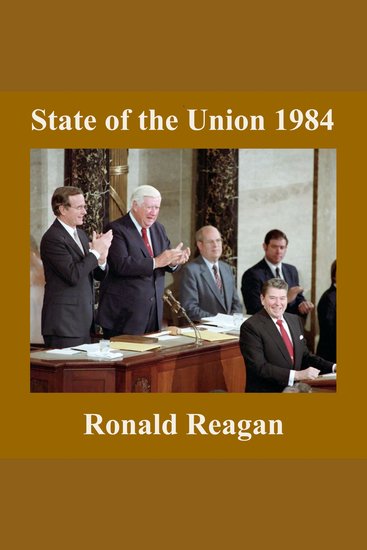
  • State of the Union 1984 - cover

    State of the Union 1984

    Ronald Reagan

    • 0
    • 0
    • 0
    The 1984 State of the Union address, delivered January 25, 1984, praises “bipartisan cooperation” and says: “For a time we forgot the American dream isn't one of making government bigger; it's keeping faith with the mighty spirit of free people under God.” “Inflation has been beaten down from 12.4 to 3.2 percent…” “Real after-tax income increased 5 percent last year.” “We're seeing rededication to bedrock values of faith, family, work, neighborhood, peace, and freedom…” 
    Let us agree on goals to keep America free and secure. Our first goal is vigorous economic growth. “We can begin by limiting the size and scope of government.” The Grace Commission has 2500 recommendations to reduce wasteful spending. Also, the line-item veto which 43 of the 50 States, including California, grant their Governors is a powerful tool against wasteful spending. 
    Additional programs are proposed including a permanently manned space station. Tuition tax credits are recommended for parents who pay private school tuition to improve education by increasing competition among schools. School prayer and a law to protect unborn children from abortion are advocated, as are enterprise zones for high-unemployment areas. 
    Finally, peace is our great goal and highest aspiration. “The future is best decided by ballots, not bullets.” We will seek concerted action to combat terrorism, and work for “freer world trade, greater competition, and more open markets.” “A nuclear war cannot be won and must never be fought.”  
    Carl Sandburg said, “I see America in the crimson light of a rising sun fresh from the burning, creative hand of God… I see great days ahead for men and women of will and vision.'' 
    Audio recording courtesy of the Ronald Reagan Presidential Library. 
    AspenLeafMedia.com
    Show book
  • One Bright Moon - cover

    One Bright Moon

    Andrew Kwong

    • 0
    • 0
    • 0
    Winner of the 2021 Michael Crouch Award, debut category of the National Biography Award: From famine to freedom, how a young boy fled Chairman Mao's China to a new life in Australia 
      
    Andrew Kwong was only seven when he witnessed his first execution. The grim scene left him sleepless, anxious and doubtful about his commitment as a revolutionary in Mao's New China. Yet he knew if he devoted himself to the Party and its Chairman he would be saved. That's what his teacher told him. 
    Months later, it was his own father on trial. This time the sentence was banishment to a re-education camp, not death. It left the family tainted, despised, and with few means of survival during the terrible years of persecution and famine known as the Great Leap Forward. Even after his father returned, things remained desperate. Escape seemed the only solution, and it would be twelve-year-old Andrew who undertook the perilous journey first. 
    This is the poignant, resonant story of a young boy's awakening – to survival, education, fulfilment, and eventually to a new life of freedom. 
    PRAISE 
    'An incredibly powerful book' Benjamin Law 
    '[A] moving family saga, shot through with yearning and hard-won joy' Fiona Capp, Sydney Morning Herald 
    'This book will live on in your heart long after you've read the last page' Vicki Laveau-Harvie, author of The Erratics 
    'Heart-breaking, honest, personal, Andrew Kwong's moving journey from oppression to freedom is inspiring' Susanne Gervay, OAM, author 
    'A work of startling clarity ... reminiscent of Angela's Ashes' South China Morning Post Magazine 
    'Deeply moving ... The unique perspective of a child ... places One Bright Moon in the vicinity of Night, Elie Wiesel's pathbreaking memoir of his early life prior to and of his time in German concentration camps' Meenakshi Bharat, IIC Quarterly 
    'A few pages into this compelling memoir proves it was written by a master storyteller' Sharon Rundle, Australian Book Review 
    'A profoundly moving and spellbinding story that perfectly illuminates the terror of the times and the irrepressible yearning for something better' Carol Major, author and writing mentor 
    'One Bright Moon is extraordinary writing that encapsulates long-term hunger as a background feature of daily life in Mao's New China. In the foreground are images of adults and children populating the world of the pre-teenage boy with a photographic memory who would later write of them. The book is rich archival material for the study of China's social history' Mabel Lee, PhD FAHA, writer and translator 
    'Reading this memoir is a healing experience' Devika Brendon, author and editor
    Show book
  • The Illusory Bargain - Liberty in the Aftermath of the 17th Amendment - cover

    The Illusory Bargain - Liberty...

    Ralph H. Lehman

    • 0
    • 0
    • 0
    Out-of-control debt. Populism. Political vitriol and corruption. Where did America go wrong? Or rather, when did America go wrong?
    
    1913. The Seventeenth Amendment is ratified, allowing the people of America to vote directly for their senators in the US senate. The same year, the Federal Reserve Act is passed, establishing a central bank to oversee monetary policy. In The Illusory Bargain, Ralph H. Lehman demonstrates that these seemingly empowering and people-serving pieces of legislature were just that-an illusion. Tracing the vision of the Founding Fathers as outlined in The Federalist Papers, Lehman reveals how the safety features of the original constitutional framework have eroded since and given way to rampant abuse of power and arbitrary, tyrannical law.
    
    Through fresh, historically informed insights and over twenty years of financial expertise, Lehman reexamines the nation's fundamental values and proposes what may be the only course of action left to restore our liberty.
    Show book