Join us on a literary world trip!
Add this book to bookshelf
Grey
Write a new comment Default profile 50px
Grey
Subscribe to read the full book or read the first pages for free!
All characters reduced
Power of Prayer - cover

Power of Prayer

Forest Mindscape

Translator A AI

Publisher: Publifye

  • 0
  • 0
  • 0

Summary

"Power of Prayer" explores the multifaceted nature of prayer across religions, its psychological effects, and personal spiritual significance. The book examines prayer's diverse expressions in Christianity, Islam, Judaism, Hinduism, and Buddhism, highlighting commonalities and unique aspects.

 
It also delves into the psychological impact of prayer, assessing its potential benefits for mental well-being, stress reduction, and emotional regulation, while distinguishing correlation from causation.

 
The book posits that prayer, regardless of religious affiliation, can be a tool for personal reflection and connection. It unfolds by first establishing a foundational understanding of prayer, then delving into religious, psychological, and spiritual dimensions with evidence-based research and case studies.

 
It uniquely addresses the psychological effects of prayer, using research from psychology and neuroscience, and acknowledges the complexities of intercessory prayer, offering practical insights for integrating prayer into one's life.
Available since: 02/14/2025.
Print length: 65 pages.


Other books that might interest you

  • Mandate for Mesopotamia and Mandate for Palestine The: The History of the Former Ottoman Territories Administered by the British after World War I - cover

    Mandate for Mesopotamia and...

    Editors Charles River

    • 0
    • 0
    • 0
    The United Nations is one of the most famous bodies in the world, and its predecessor, the League of Nations, might be equally notorious. In fact, President Woodrow Wilson’s pet project was controversial from nearly the minute it was conceived. While it would attempt to resolve some territorial disputes, it simply proved too weak to prevent international aggression, primarily among the Axis Powers in the buildup to World War II. Thus, the League’s greatest legacy ended up being its dismal failure to prevent World War II and ensure that World War I had truly been the “war to end all wars,” as originally intended. 
    Although the League of Nations was short-lived and clearly failed in its primary mission, it did essentially spawn the United Nations at the end of World War II, and many of the UN’s structures and organizations came straight from its predecessor, with the concepts of an International Court and a General Assembly coming straight from the League. More importantly, the failures of the League ensured that the UN was given stronger authority and enforcement mechanisms, most notably through the latter’s Security Council, and while the League dissolved after a generation, the UN has survived for over 70 years. 
    One of the League’s most lasting legacies was the manner in which it handed over administrative control of land in the Middle East to the victorious Allied Powers, namely France and Britain. The Ottoman Empire quickly collapsed after World War I, and its extensive lands were divvied up between the French and British. While the French gained control of the Levant, which would later become modern day nations like Syria and Lebanon, the British were given mandates for Mesopotamia and Palestine. The British Mandate for Palestine gave the British control over the lands that have since become Jordan, Israel, the West Bank, and the Gaza Strip, while Mesopotamia covered modern Iraq.
    Show book
  • The Inquisition - A History from Beginning to End - cover

    The Inquisition - A History from...

    Hourly History

    • 0
    • 0
    • 0
    The Roman Catholic Inquisition was one of the most controversial organizations in human history. Although it has been painted in a negative light, the Inquisition was too broad in scope to define as simply good or bad. It was a period where conflict and bloodshed were inevitable. It was a time where war, famine, plague, and poverty were common factors of human life. From the 1180s to the 1830s, the Inquisition was the judicial arm of the Catholic Church. Created to root out and punish heretics within the Catholic faith, the Inquisition became an institution that would carve its name into history. 
    Throughout its many variations, the Inquisition took hold in France, Spain, Portugal, and Italy and in the process, both hastened and stunted progress in Western society. The Inquisition was as multi-faceted in its failure as it was in its successes. Though it was responsible for the deaths of thousands, it was also responsible for the sparing of thousands more. The Inquisition put to death some of the brightest minds of the time, and yet their brutality quickened the pace of the Renaissance and the Enlightenment. In short, the Inquisition was many things—easy to define is not one of them. This concise, compressed guidebook reveals the history, failures, and successes of the Roman Catholic Inquisition from its birth to its final death rattle.
    Show book
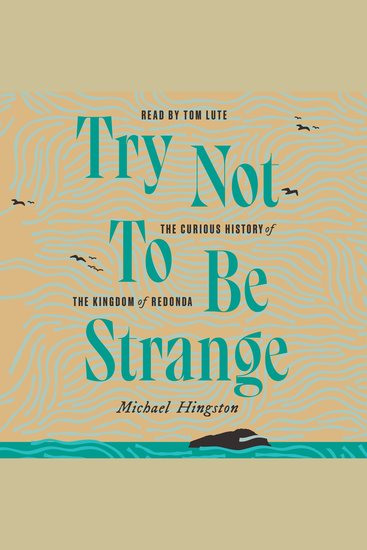
  • Try Not to Be Strange - The Curious History of the Kingdom of Redonda - cover

    Try Not to Be Strange - The...

    Michael Hingston

    • 0
    • 0
    • 0
    On his fifteenth birthday, in the summer of 1880, future science-fiction writer M.P. Shiel sailed with his father and the local bishop from their home in the Caribbean out to the nearby island of Redonda—where, with pomp and circumstance, he was declared the island’s king. A few years later, when Shiel set sail for a new life in London, his father gave him some advice: Try not to be strange. It was almost as if the elder Shiel knew what was coming. 
    Try Not to Be Strange: The Curious History of the Kingdom of Redonda tells, for the first time, the complete history of Redonda’s transformation from an uninhabited, guano-encrusted island into a fantastical and international kingdom of writers. With a cast of characters including forgotten sci-fi novelists, alcoholic poets, vegetarian publishers, Nobel Prize frontrunners, and the bartenders who kept them all lubricated while angling for the throne themselves, Michael Hingston details the friendships, feuds, and fantasies that fueled the creation of one of the oddest and most enduring micronations ever dreamt into being. Part literary history, part travelogue, part quest narrative, this cautionary tale about what happens when bibliomania escapes the shelves and stacks is as charming as it is peculiar—and blurs the line between reality and fantasy so thoroughly that it may never be entirely restored.
    Show book
  • Blame Not the Wind: A tragedy at sea A cover-up One mother’s search for justice - cover

    Blame Not the Wind: A tragedy at...

    Shirley Cooklin

    • 0
    • 0
    • 0
    "Very occasionally a tragedy turns into a triumph. This wonderful, searing book is such a moment. Rush to read it & be thankful." – Miriam Margolyes 
    Last night Ben phoned from Bermuda, collect as usual. I’d asked – though heaven knows why, as we avoid soppy talk – if he still loved me.  
    He had said, ‘Course I do.’ 
    He would be home for a visit once the race was over. He could not say exactly when but would keep in touch. 
    It is early June: the third day of June, to be precise, and a day I will never forget. Something feels wrong. Better get up. 
    Shirley’s sixth sense was all too real: tragedy had struck Ben’s ship, Marques. The government announced that it was a ‘freak accident’. 
    But something did not add up. 
    On 2 June 1984 the British-registered tall ship Marques left Bermuda Harbour, cheered on by watching crowds. With other sailing vessels from across the world, the barque was heading for Halifax, Nova Scotia, having won the first leg of the internationally famous Tall Ships Race. As they sailed out to sea, there was not a cloud in the sky. But by midnight the weather had changed and the seas became violent. 
    Just 80 miles from Bermuda, things took a turn for the worse – the ship lurched and water poured in through the wide-open hatches. In 40 seconds the Marques had vanished. Of the 28 people on board, 19 were lost: crew and passengers, hailing from Britain, Canada, the US and the Caribbean. Among the missing was Shirley Cooklin’s 18-year-old son Ben. 
    Driven to seek answers, Shirley finds only dead ends and denials. She begins to wonder – what if this was not a freak accident caused by the wind? What if the tragedy was the result of a gross act of negligence? And why is the Thatcher government so interested in the incident? 
    This is the riveting true story of one mother’s lifelong search for justice. 
    "Shirley Cooklin has a moving story to tell: and she tells it with a keen intelligence and warm heart." – Joan Bakewell 
    "A powerful and moving account." – Sasha Bates, author of The Languages of Loss 
    "A brilliant book" – Daily Mail 
    This moving non-fiction memoir and autobiography places one family’s loss within a wider maritime history that refuses to stay buried. As Shirley Cooklin presses for justice, she runs into misconduct, corruption and political obstruction—discovering how hard the law can be to move when power is at stake. 
    For fans of Antony Beevor (D-Day), and Fern Riddell (Death in Ten Minutes). 
    HarperCollins 2025
    Show book
  • The weather and its phenomena - cover

    The weather and its phenomena

    KidsChoice

    • 0
    • 0
    • 0
    KidsChoice: World knowledge for Children is an engaging audiobook series that takes young listeners on a fascinating journey to explore and understand the world around them. Aimed at curious children aged 7 to 99, this series dives into a variety of topics in science, society, and culture, making complex ideas accessible and exciting.  Each episode brings a unique theme to life—whether exploring the mysteries of space, uncovering the secrets of the human body, or discovering the diversity of cultures and traditions worldwide. With lively narration, interesting facts, and interactive elements, the series guides young listeners on an adventure full of discovery, encouraging them to ask questions and expand their understanding in a fun way.  In the scientific world of KidsChoice, children learn about the wonders of nature and the universe. Concepts like the solar system, animal behavior, the human body, and Earth's various ecosystems are explained in a way that is easy for kids to grasp and find fascinating. Exciting analogies and vivid examples help spark curiosity, turning learning into an adventure.  Societal topics also have a special place in the series. KidsChoice introduces young listeners to the basics of community, compassion, and making a positive impact. Children learn what it means to be a good citizen and how they can make small, meaningful contributions to their communities.  Additionally, KidsChoice opens a window to the vibrant world of global cultures. Through a virtual journey around the globe, children discover how people in other countries live, the customs and traditions they follow, the languages they speak, and the foods they enjoy. This fosters understanding and respect for diverse ways of life, celebrating the richness of human experience as a beautiful, valuable part of the world.  With its vivid language and captivating soundscapes, "KidsChoice: World knowledge for Children" turns learning into an exciting experience, sparking a lifelong curiosity and a deeper understanding of the world around them.
    Show book
  • Mastering Emotional Intelligence - Unraveling the Art of Understanding Navigating and Influencing Emotions in Yourself and Others - cover

    Mastering Emotional Intelligence...

    Vines Graener

    • 0
    • 0
    • 0
    Since the latter part of the twentieth century, breakthroughs in science, like advancements in brain imaging, have sparked a growing fascination with the intersection of emotions and neurobiology. Researchers have come to acknowledge the close connection between the brain and the immune system, the detrimental impact of chronic stress on the human body, and the significant correlation between emotions and health issues such as heart disease. 
    Before this scientific awakening, there was an undue emphasis on academic intelligence by researchers. This bias ignored the reality that intelligence is not a reliable predictor of success and happiness. Instead, emotional intelligence emerges as a more accurate indicator of life trajectory. It encompasses psychological resilience, the ability to persevere in the face of challenges, impulse control, and social skills like empathy. 
    Contrary to earlier beliefs that emotional intelligence was an inherent trait, recent research has revealed it to be a capacity rather than an absolute characteristic. Nevertheless, the formative stage for emotional intelligence is primarily in early childhood. A baby receiving nurturing care is more likely to develop a positive outlook, while a neglected baby may struggle with challenges later in life. Although tendencies toward optimism or pessimism take root early, they can still evolve later on, influenced by one's social network, as emotions tend to be contagious. 
    It's crucial to recognize that complete control over emotions is not feasible. Emotions are a result of the brain processing external feedback and are not consciously regulated. However, individuals can control how they respond to their emotions. The initial step in effective emotional management is being aware of one's emotions, forming the foundation for emotional intelligence.
    Show book