Join us on a literary world trip!
Add this book to bookshelf
Grey
Write a new comment Default profile 50px
Grey
Subscribe to read the full book or read the first pages for free!
All characters reduced
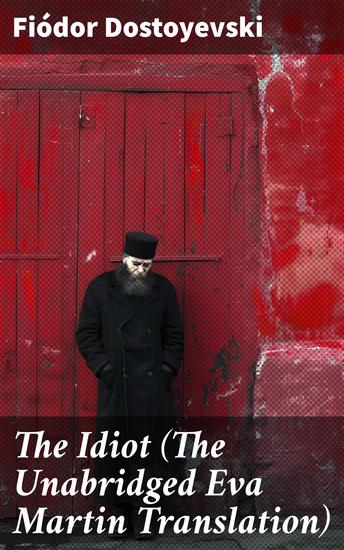
The Idiot (The Unabridged Eva Martin Translation) - Exploring morality spirituality and human nature in 19th-century Russia - cover

The Idiot (The Unabridged Eva Martin Translation) - Exploring morality spirituality and human nature in 19th-century Russia

Fiódor Dostoyevski

Publisher: Good Press

  • 0
  • 0
  • 0

Summary

In "The Idiot," Fi√≥dor Dostoyevski crafts a profound exploration of virtue and morality through the poignant character of Prince Myshkin, a man whose profound innocence and compassion starkly contrast with the corrupt society around him. This unabridged translation by Eva Martin preserves Dostoyevski'Äôs intricate narrative style, rich in psychological depth and philosophical discourse, immersing readers in the tumult of 19th-century Russian society. The novel is intricately woven with themes of faith, redemption, and the quest for authentic humanity, challenging the reader to ponder the complexities of goodness in a world rife with selfishness and ambition. Dostoyevski, a figure profoundly shaped by his own tumultuous experiences with poverty, exile, and existential despair, delves into the human psyche with startling insight. His interest in the dichotomy of moral ideals versus societal expectation resonates strongly in "The Idiot," as it mirrors his personal struggles with faith and human folly. This rich backdrop informs his portrayal of Myshkin's earnestness amidst the cynicism of those around him, making the work a reflective lens on Dostoyevski's own philosophical inquiries. "The Idiot" is essential reading for those seeking to understand the depths of human consciousness and moral complexity. Through its compelling character study and evocative prose, Dostoyevski invites readers to engage with timeless questions of love, sacrifice, and the essence of true nobility. This translation will captivate both newcomers and seasoned readers of Russian literature alike, making it a worthy addition to any literary collection.
Available since: 12/19/2023.
Print length: 709 pages.

Other books that might interest you

  • Love's Labour's Lost - cover

    Love's Labour's Lost

    William Shakespeare

    • 0
    • 0
    • 0
    King Ferdinand and his three friends, Biron, Longaville, and Dumain, plan to study philosophy for the next three years. During their academic pursuits, they must vow to sleep only three hours a night and not let any woman within a mile of court. These strict rules will prevent any distractions from their work - but their promises are soon put to the test when a princess and her three companions arrive for a state visit.
    Show book
  • Wonderful Wizard of Oz The [The Wizard of Oz series #1] - cover

    Wonderful Wizard of Oz The [The...

    L. Frank Baum

    • 0
    • 0
    • 0
    Dorothy and her canine pal Toto live a quiet life on a Kansas farm with Uncle Henry and Aunt Em. But one day, the little girl and her dog find themselves spirited away from the fields of Kansas, to the magical land of Oz! Dorothy and Toto meet many friends on the yellow-brick road to Emerald City, where she hopes to find a way home to Kansas - but when she arrives, the city's mysterious ruler, the Wizard of Oz, is not what she expects!
    Show book
  • A Horse's Tale - cover

    A Horse's Tale

    Mark Twain

    • 0
    • 0
    • 0
    "I am Buffalo Bill's horse. I have spent my life under his saddle - with him in it, too, and he is good for two hundred pounds, without his clothes; and there is no telling how much he does weigh when he is out on the war-path and has his batteries belted on."
    A Horse's Tale is a short novel written partially in the voice of Soldier Boy, Buffalo Bill's favorite horse, at a fictional frontier outpost with the U.S. 7th Cavalry.
    
    Harper's Magazine originally published the story in two installments in August and September 1906. Twain wrote the story after receiving a request from actress Minnie Maddern Fiske to assist in her drive against bullfighting.
    Show book
  • For the Blood is the Life - A renowned and influential early gothic vampire tale set in Italy - cover

    For the Blood is the Life - A...

    F. Marion Crawford

    • 0
    • 0
    • 0
    Francis Marion Crawford was born on August 2nd, 1854 at Bagni di Lucca, Italy. An only son and a nephew to Julia Ward Howe, the American poet and writer of ‘The Battle Hymn of the Republic’.  
     
    His education began at St Paul's School, Concord, New Hampshire, then to Cambridge University; University of Heidelberg; and the University of Rome.  
     
    In 1879 Crawford went to India, to study Sanskrit and then edited The Indian Herald. In 1881 he returned to America to continue his Sanskrit studies at Harvard University. 
     
    At this time in Boston he lived at his Aunt Julia house and in the company of his Uncle, Sam Ward. His family was concerned about his employment prospects.  After a singing career as a baritone was ruled out, he was encouraged to write.  
     
    In December 1882 his first novel, ‘Mr Isaacs’, was an immediate hit which was amplified by ‘Dr Claudius’ in 1883.  
     
    In October 1884 he married Elizabeth Berdan. They went on to have two sons and two daughters. 
     
    Encouraged by his excellent start to a literary career he returned to Italy with Elizabeth to make a permanent home, principally in Sant' Agnello, where he bought the Villa Renzi that then became Villa Crawford.  
     
    In the late 1890s, he began to write his historical works: ‘Ave Roma Immortalis’ (1898), ‘Rulers of the South’ (1900) and ‘Gleanings from Venetian History’ (1905). The Saracinesca series is perhaps his best work. ‘Saracinesca’ was followed by ‘Sant’ Ilario’ in 1889, ‘Don Orsino’ in 1892 and ‘Corleone’ in 1897, that being the first major treatment of the Mafia in literature.  
     
    Francis Marion Crawford died at Sorrento on Good Friday 1909 at Villa Crawford of a heart attack.  
     
    Set in Italy, ‘For Blood is the Life’ draws us into a world usually beyond our senses.  With Crawford’s pen the uneasy, horrific world of vampires is now upon us.
    Show book
  • Beowulf - The Original Manuscript - cover

    Beowulf - The Original Manuscript

    Unknown Unknown

    • 0
    • 0
    • 0
    Beowulf is an Old English epic poem in the tradition of Germanic heroic legend consisting of 3,182 alliterative lines. It is one of the most important and most often translated works of Old English literature. The date of composition is a matter of contention among scholars; the only certain dating is for the manuscript, which was produced between 975 and 1025. Scholars call the anonymous author the "Beowulf poet". The story is set in pagan Scandinavia in the 6th century. Beowulf, a hero of the Geats, comes to the aid of Hrothgar, the king of the Danes, whose mead hall in Heorot has been under attack by the monster Grendel. After Beowulf slays him, Grendel's mother attacks the hall and is then defeated. Victorious, Beowulf goes home to Geatland and becomes king of the Geats. Fifty years later, Beowulf defeats a dragon but is mortally wounded in the battle. After his death, his attendants cremate his body and erect a tower on a headland in his memory. Scholars have debated whether Beowulf was transmitted orally, affecting its interpretation: if it was composed early, in pagan times, then the paganism is central and the Christian elements were added later, whereas if it was composed later, in writing, by a Christian. Beowulf is written mostly in the West Saxon dialect of Old English, but many other dialectal forms are present, suggesting that the poem may have had a long and complex transmission throughout the dialect areas of England.No definite sources or analogs of the poem can be proven, but many suggestions have been made, including the Icelandic Grettis saga, the Norse story of Hrolf Kraki and his bear-shapeshifting servant Bodvar Bjarki, the international folktale the Bear's Son Tale, and the Irish folktale of the Hand and the Child. Persistent attempts have been made to link Beowulf to tales from Homer's Odyssey or Virgil's Aeneid. More definite are Biblical parallels, with clear allusions to the books of Genesis, Exodus, and Daniel. 
    Show book
  • King Lear | Shakespeare for kids - Shakespeare in a language kids will understand and love - cover

    King Lear | Shakespeare for kids...

    Jeanette Vigon

    • 0
    • 0
    • 0
    Dive into the stormy world of "King Lear," a brilliant adaptation of Shakespeare's tragic tale, transformed into an accessible and engaging narrative for young readers by Jeanette Vigon. This rendition captures the essence of the original story, focusing on themes of love, betrayal, and redemption, while simplifying its complex language and situations to suit a younger audience. 
    Highlights Include:Simplified Shakespeare: Jeanette Vigon skillfully adapts the challenging themes and language of "King Lear" into a story that's easy for children to understand and enjoy.Moral Lessons Galore: Through the tumultuous journey of King Lear and his daughters, young readers will explore important lessons about the consequences of our actions and the true meaning of loyalty and forgiveness.Adventure in Every Page: Set in the mystical landscapes of ancient Britain, children will be transported into a world where the lines between right and wrong are blurred, and the quest for understanding and reconciliation takes center stage. 
    "King Lear" is not just a storybook; it's a gateway to the world of classic literature, tailored to spark curiosity and empathy in young minds. Whether for home reading or classroom learning, this book promises to be a cherished addition to any child's library.
    Show book