Join us on a literary world trip!
Add this book to bookshelf
Grey
Write a new comment Default profile 50px
Grey
Subscribe to read the full book or read the first pages for free!
All characters reduced
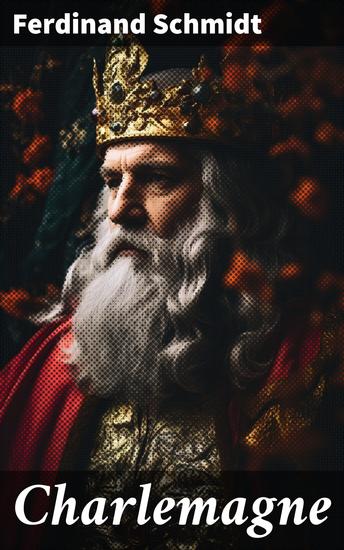
Charlemagne - The Legendary Legacy of a Medieval Monarch: Power Education and Empire in Charlemagne's Reign - cover

Charlemagne - The Legendary Legacy of a Medieval Monarch: Power Education and Empire in Charlemagne's Reign

Ferdinand Schmidt

Translator George P. Upton

Publisher: Good Press

  • 0
  • 0
  • 0

Summary

In "Charlemagne," Ferdinand Schmidt delivers an intricate exploration of the life and legacy of the iconic Frankish king, blending meticulous historical research with a lyrical prose style that evokes the grandeur of the Carolingian era. Schmidt deftly weaves together a narrative that not only chronicles Charlemagne's military conquests and administrative innovations but also delves into the cultural and religious transformations that defined his reign. The book is contextualized within the broader framework of medieval history, offering insights into the interplay of power, faith, and society during a pivotal juncture in European development. Ferdinand Schmidt, a distinguished historian with a specialized focus on medieval studies, draws from a wealth of primary sources and contemporary scholarship to inform his writing. His academic journey, marked by a profound fascination with the intersection of politics and culture in medieval Europe, illuminates the motivations behind Charlemagne's actions and decisions. Schmidt's insights are informed by years of research and teaching, contributing to a nuanced understanding of both Charlemagne as an individual and his monumental impact on Western civilization. For readers captivated by the intricacies of history and the emergence of modern Europe, Schmidt's "Charlemagne" is an essential addition to their literary collection. With its blend of narrative flair and scholarly rigor, this book not only educates but also inspires, inviting readers to reflect on the enduring legacy of one of history's most formidable leaders.
Available since: 11/15/2023.
Print length: 53 pages.
Other books that might interest you

  • The United States of English - The American Language from Colonial Times to the Twenty-First Century - cover

    The United States of English -...

    Rosemarie Ostler

    • 0
    • 0
    • 0
    The story of how English became American—and how it became Southern, Bostonian, Californian, African American, Chicano, elite, working-class, urban, rural, and everything in between 


    By the time of the Revolution, the English that Americans spoke was recognizably different from the British variety. Americans added dozens of new words to the language, either borrowed from Native Americans (raccoon, persimmon, caucus) or created from repurposed English (backwoods, cane brake, salt lick). Americans had their own pronunciations (bath rhymed with hat, not hot) and their own spelling (honor, not honour), not to mention a host of new expressions that grew out of the American landscape and culture (blaze a trail, back track, pull up stakes). Americans even invented their own slang, like stiff as a ringbolt to mean drunk. American English has continued to grow and change ever since. 


    The United States of English tells the engrossing tale of how the American language evolved over four hundred years, explaining both how and why it changed and which parts of the "mother tongue" it preserved (I guess was heard in the British countryside long before it became a typical Americanism). Plentiful examples of the American vernacular, past and present, bring the language to life and make for an engaging as well as enlightening listen.
    Show book
  • Embracing (Rather Than Fixing) Our Authentic Selves - cover

    Embracing (Rather Than Fixing)...

    JD David Bedrick

    • 0
    • 0
    • 0
    We are a society of armchair psychologists, who are constantly self-diagnosing. There are scores of books and television programs that suggest ways for us to reprogram and rid ourselves of disturbing feelings and behavior patterns. Bedrick is deepening the dialogue about the role and practice of psychology in today’s society. Much of mainstream or “pop” psychology give us plenty of labels, but does it go deep enough to motivate us to truly change destructive patterns? David Bedrick gives us a new vision of psychology where people are seen not as either functional or dysfunctional. It’s a psychology where awareness and dialogue are more important than labels. 
    Mainstream psychology often misses the range of diversity in people and tries to “normalize” them into a sea of sameness. In Process Oriented Psychology, for example, there are no 7 steps to a cure. This branch of psychology acknowledges that everyone is different. Bedrick is an awareness follower and says, “I’m using my awareness in watching all the communication a person gives me, much of which is not verbal.” He follows what they are showing him until the client reveals their own cure or medicine. He gives many exciting examples in this dynamic dialogue. (hosted by Justine Willis Toms)
    Show book
  • Texas Highways and the Genocide of the Wolf - cover

    Texas Highways and the Genocide...

    LAL

    • 0
    • 0
    • 0
    “Texas Highways” began as reflections and poems inspired by the Bastrop fires and Hurricane Harvey. It evolved with the Castizo narrator’s emotional states from desperate heartbreak to exhilaration all while driving across the state’s majestic landscapes on its imperial highways. In total there are 56 Texan sonnets in free verse that vary from whimsical questions to lyrical song verses. 
    The epic poem "The Genocide of the Wolf" explores the legends and prophecies of the three historic wolf families, from native and Mexican folklore, to their war with men over the plains and their current captivity. It reveals the underpinning moral lesson of the entire book.
    Show book
  • Christopher Columbus – Hero or Villain? - The Truth Behind the Man Who Changed the World - cover

    Christopher Columbus – Hero or...

    Alan Rogers

    • 0
    • 0
    • 0
    Christopher Columbus has been celebrated as a heroic explorer and condemned as a ruthless colonizer. But what is the real story? Did he truly discover the New World, or did he simply pave the way for conquest and destruction? 
    This audiobook takes you on a gripping journey through Columbus’s voyages, his encounters with Indigenous peoples, and the lasting effects of his expeditions. Uncover: 
    ✅ The true motivations behind Columbus’s voyage and who really funded it 
    ✅ How Columbus interacted with Native civilizations – and the lasting consequences 
    ✅ The controversial aspects of his rule over new territories 
    ✅ The debate: Should Columbus be celebrated or condemned? 
    Christopher Columbus – Hero or Villain? is a must-listen for history lovers, critical thinkers, and anyone fascinated by the truth behind legendary figures.
    Show book
  • Seduced by an Older Woman - First Time Lesbian Erotica - cover

    Seduced by an Older Woman -...

    Conner Hayden

    • 0
    • 1
    • 0
    A young woman has to stay at the home of one of her mother’s friends when her parents go out of town for the night. She finds that she has to sleep in the same bed as her mother's friend and gets excited being close to her. When she tries to touch her mother’s friend as she sleeps, it wakes her up. The young woman then finds out just how good a woman can make her feel as the older woman takes control. 
     
    This story is a work of fiction and contains sex scenes and is suitable for adults only. All characters are fictional and are over 18 years old.
    Show book
  • Actionable Ethics (With a Practical Guide to ESG) - cover

    Actionable Ethics (With a...

    Daniel Natal

    • 0
    • 0
    • 0
    Actionable Ethics is part of a larger regimen of ethics training, for the company (but, more broadly-speaking, for life). What makes it different is the fact that it shares techniques gleaned from neuroscience on how to make moral behavior habitual. As Aristotle said, “Excellence is not an act, but a habit." Almost every other ethics book or course available addresses itself to the front of the brain (where executive function takes place). Actionable Ethics, by contrast, addresses itself to the back of the brain, where habit-formation occurs, to create positive behaviors, or, as Cicero put it thousands of years ago, a “second nature”. Go to actionableethics.com to find out more.
    Show book