Join us on a literary world trip!
Add this book to bookshelf
Grey
Write a new comment Default profile 50px
Grey
Subscribe to read the full book or read the first pages for free!
All characters reduced
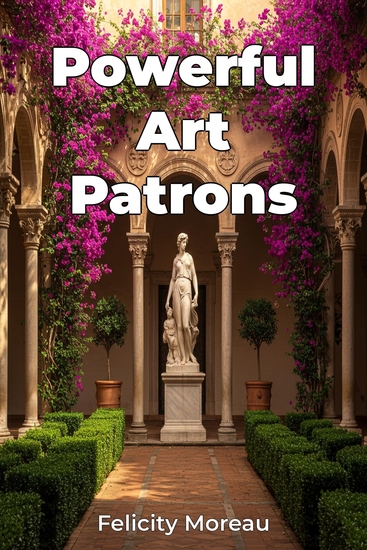
Powerful Art Patrons - cover

Powerful Art Patrons

Felicity Moreau

Translator A AI

Publisher: Publifye

  • 0
  • 0
  • 0

Summary

Powerful Art Patrons explores the significant influence of wealth and power on the creation and evolution of art throughout history. It examines how art patronage, from the Renaissance to today, has shaped not only what art is made but also who gets to see it. The book highlights the complex relationship between artists and their benefactors, demonstrating how patronage involves more than just financial support; it also involves power dynamics that can dictate artistic choices and trends.

 
Consider the Medici family, who commissioned groundbreaking works that defined the Renaissance, illustrating how personal fortunes can shape entire artistic movements. The book approaches this topic by tracing the evolution of art patronage across different eras. Beginning with foundational concepts, it then delves into specific historical periods and patrons, such as Peggy Guggenheim, analyzing their impact on artists and the art world.

 
Finally, it examines contemporary models of art funding, including corporate sponsorships and private philanthropy, and the ethical considerations involved. This approach provides a comprehensive understanding of how art patronage acts as both a catalyst for innovation and a potential constraint on artistic expression, offering valuable insights for art enthusiasts and those interested in the intersection of art, history, and economics.
Available since: 02/22/2025.
Print length: 74 pages.
Other books that might interest you

  • The Zong - A Massacre the Law & the End of Slavery - cover

    The Zong - A Massacre the Law &...

    James Walvin

    • 0
    • 0
    • 0
    The first full review of the mass murder by crew members on the slave ship Zong and the lasting repercussions of this horrifying event 


    On November 29, 1781, Captain Collingwood of the British ship Zong commanded his crew to throw overboard one-third of his cargo: a shipment of Africans bound for slavery in America. The captain believed his ship was off course, and he feared there was not enough drinking water to last until landfall. This book is the first to examine in detail the deplorable killings on the Zong, the lawsuit that ensued, how the murder of 132 slaves affected debates about slavery, and the way we remember the infamous Zong today. 


    Historian James Walvin explores all aspects of the Zong's voyage and the subsequent trial—a case brought to court not for the murder of the slaves but as a suit against the insurers who denied the owners' claim that their "cargo" had been necessarily jettisoned. The scandalous case prompted wide debate and fueled Britain's awakening abolition movement. Without the episode of the Zong, Walvin contends, the process of ending the slave trade would have taken an entirely different moral and political trajectory. He concludes with a fascinating discussion of how the case of the Zong, though unique in the history of slave ships, has come to be understood as typical of life on all such ships.
    Show book
  • Uncle Tom's Cabin: The Icon Black Lives Matter Series - cover

    Uncle Tom's Cabin: The Icon...

    Harriet Beecher Stowe

    • 0
    • 0
    • 0
    Uncle Tom's Cabin is an antislavery novel by American author Harriet Beecher Stowe. Published in two volumes in 1852, the novel had a profound effect on attitudes toward African Americans and slavery in the U.S., and is said to have "helped lay the groundwork for the [American] Civil War". 
      
    Stowe, a Connecticutborn woman of English descent, was part of the religious Beecher family and an active abolitionist. She wrote the sentimental novel to depict the reality of slavery while also asserting that Christian love could overcome slavery. The novel focuses on the character of Uncle Tom, a longsuffering black slave around whom the stories of the other characters revolve. 
      
    Uncle Tom's Cabin was the bestselling novel and the second bestselling book of the 19th century, following the Bible, and is credited with helping fuel the abolitionist cause in the 1850s. The impact attributed to the book was so great that a likely apocryphal story arose of Abraham Lincoln meeting Stowe at the start of the Civil War and declaring, "So this is the little lady who started this great war." 
      
    The book and the plays it inspired helped popularize a number of negative stereotypes about black people including that of the namesake character "Uncle Tom", with the term now used to describe an excessively subservient person. These associations with Uncle Tom's Cabin have, to an extent, overshadowed the historical impact of the book as a "vital antislavery tool". However, the novel stands as a "landmark" in protest literature with later books such as The Jungle by Upton Sinclair and Silent Spring by Rachel Carson owing a large debt to it A oneofakind audio encounter for lovers of history, literature, spiritual texts, and inspirational writing. 
      
     
    Show book
  • Politics vs Power - Why Facts Don't Win and How Strategy Does - cover

    Politics vs Power - Why Facts...

    Lorenzo L. Sellers

    • 0
    • 0
    • 0
    This audiobook is narrated by an AI Voice.   
    For seven years, Lorenzo Sellers debated MAGA supporters across dinner tables, social media threads, workplaces, and public forums. Not to win. To understand. 
    What he discovered is something most people never see. These debates were never about facts. They were about emotion, identity, belonging, and power. Facts don’t build movements. Strategy does. 
    Politics vs Power is a bold and unflinching guide to understanding why movements like MAGA grow so fiercely and why facts alone will never break their grip. Drawing from real conversations, psychological patterns, and cultural fault lines, Lorenzo reveals the emotional engines that power these movements and how to counter them with precision. 
    Inside you’ll learn: 
    *Why facts fall flat against emotional loyalty 
    *How belonging, power proximity, and rebellion keep people loyal 
    *How to recognize when someone is unreachable and when the real audience is watching 
    *Why outrage fuels movements and clarity dismantles them 
    *How to build spaces that meet emotional needs before extremism exploits them 
    This is not a partisan rant. It is a playbook for those tired of shouting into the void. Politics vs Power shows you how to stop reacting, start strategizing, and build influence that lasts long after the noise fades. 
    Whether you’re trying to reach someone who has fallen deep into the MAGA fold, protect your peace in conversations that go nowhere, or understand the real battlefield beneath the headlines, this book gives you the clarity and strategy you need to stand firm in the storm. 
    Politics is performance. Power is strategy. Learn the difference.
    Show book
  • Reckoning of Power - Oppenheimer the Atomic Bomb & World War 2 - cover

    Reckoning of Power - Oppenheimer...

    History Brought Alive

    • 0
    • 0
    • 0
    Discover the untold story of the most terrifying invention in human historyThis audiobook explores the history of the Atomic Bomb in World War II, and uncovers Robert Oppenheimer's mysterious role as its visionary leader.As the world plunged into war, Oppenheimer found himself at the centre of a moral and scientific dilemma. Could science save humanity, or would it be its downfall?With gripping narratives and meticulous research, this book takes you on a riveting journey from the Manhattan Project to the Atomic Bombings at Hiroshima and Nagasaka, traversing the landscapes of WWII, and the nuclear age aftermath.Here are some of the highlights: 
    J. Robert Oppenheimer, the brilliant, but troubled physicist who played a key role in the development of the Atomic Bomb 
    Explore the turbulent backdrop of World War II, where global conflict ignited scientific innovation 
    Step into the shoes of some of the greatest scientific minds in history—Albert Einstein, Edward Teller, Leslie Groves, Niels Bohr, and Leo Szilárd 
    Witness the crucial moments and decisions that led to the dropping of the "Little Boy" and "Fat Man" Atomic Bombs on Hiroshima and Nagasaki 
    Discover the Manhattan Project, a top secret mission that assembled the world's brightest minds in a race against the sinister, Nazi Atomic Project 
    E = mc²: Unravel the mysteries of Einstein's groundbreaking equation that laid the foundation for atomic science 
    Explore the Cold War and the arms race, followed by a glimpse into the future of nuclear energy 
    All of this and much, much more….Whether you're a history enthusiast or new to the subject, this book tells all about Oppenheimer, the Atomic Bomb, World War II, and the Nuclear Age Aftermath.Grab your copy of this book today!
    Show book
  • Person-Centered Therapy - Empowerment through Unconditional Positive Regard - cover

    Person-Centered Therapy -...

    Vivian Westlake

    • 0
    • 0
    • 0
    Person-Centered Therapy (PCT), also known as Client-Centered Therapy, was developed by Carl Rogers in the mid-20th century. It is one of the most influential and humanistic approaches to psychotherapy, focusing on the intrinsic potential for growth within each individual. At its core, PCT is rooted in the belief that every person has the capacity for self-understanding and self-direction, given the right environment. The therapeutic relationship is not one of authority or expertise; instead, it is based on mutual respect and understanding. This approach emphasizes the client's subjective experience as the most important aspect of therapy, with the therapist acting as a facilitator of the client's self-exploration and personal growth. 
    Carl Rogers was a pioneering figure in the field of psychology, advocating for a shift away from the more directive methods that were common at the time. His emphasis on empathy, genuineness, and unconditional positive regard—three foundational components of PCT—marks a departure from the idea that therapists should control the process of healing. Instead, Rogers proposed that when individuals feel truly heard, understood, and accepted by another person, they are able to engage in meaningful self-exploration that leads to change. This trust in the client’s own ability to navigate their struggles forms the bedrock of Person-Centered Therapy. 
    The essence of Person-Centered Therapy lies in the relationship between the client and therapist. Rather than focusing on diagnosing and treating specific problems, the therapy process is more holistic. It invites clients to explore their feelings, experiences, and sense of self in a supportive and nonjudgmental space.
    Show book
  • The Positivity Effect - Simple CBT Skills to Transform Anxiety and Negativity Into Optimism and Hope - cover

    The Positivity Effect - Simple...

    PhD Dan Tomasulo, PhD Lisa Miller

    • 0
    • 0
    • 0
    If you suffer from anxiety, you may feel stuck in a vicious cycle of rumination, worry, and avoidance—and ultimately miss out on all life has to offer. But what if you could shift your thinking and start living with more expansiveness, hope, and happiness? What if you could transform stress and anxiety, and find lasting balance, peace, and joy? 


    Based in proven-effective cognitive behavior therapy (CBT) and positive psychology, psychologist Dan Tomasulo offers powerful skills to help you overcome negative thinking and harness the power of positivity to reduce stress, boost confidence, and find instant calm and sustainable happiness. With this uplifting guide, you'll learn how to: 


    ● Replace anxiety and stress with learned hopefulness 


    ● Boost positivity, amplify joy, and awaken inspiration 


    ● Overcome self-limiting thoughts and beliefs 


    ● Build a solid support system and connect with your community 


    Not being anxious is not the same as thriving. Nor does worrying less mean that you are at peace. With this inspiring guide, you'll learn to do more than just stop worrying—you'll learn to completely transform your outlook for long lasting serenity and joy.
    Show book