Join us on a literary world trip!
Add this book to bookshelf
Grey
Write a new comment Default profile 50px
Grey
Subscribe to read the full book or read the first pages for free!
All characters reduced
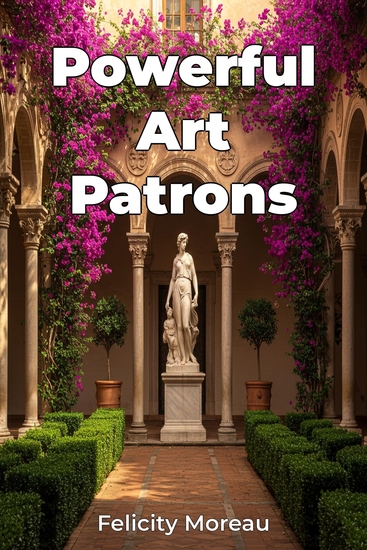
Powerful Art Patrons - cover

Powerful Art Patrons

Felicity Moreau

Translator A AI

Publisher: Publifye

  • 0
  • 0
  • 0

Summary

Powerful Art Patrons explores the significant influence of wealth and power on the creation and evolution of art throughout history. It examines how art patronage, from the Renaissance to today, has shaped not only what art is made but also who gets to see it. The book highlights the complex relationship between artists and their benefactors, demonstrating how patronage involves more than just financial support; it also involves power dynamics that can dictate artistic choices and trends.

 
Consider the Medici family, who commissioned groundbreaking works that defined the Renaissance, illustrating how personal fortunes can shape entire artistic movements. The book approaches this topic by tracing the evolution of art patronage across different eras. Beginning with foundational concepts, it then delves into specific historical periods and patrons, such as Peggy Guggenheim, analyzing their impact on artists and the art world.

 
Finally, it examines contemporary models of art funding, including corporate sponsorships and private philanthropy, and the ethical considerations involved. This approach provides a comprehensive understanding of how art patronage acts as both a catalyst for innovation and a potential constraint on artistic expression, offering valuable insights for art enthusiasts and those interested in the intersection of art, history, and economics.
Available since: 02/22/2025.
Print length: 74 pages.

Other books that might interest you

  • Swing Low volume 2 - An Anthology of Black Christianity in the United States - cover

    Swing Low volume 2 - An...

    Walter R. Strickland II, Walter...

    • 0
    • 0
    • 0
    A Groundbreaking Portrait of African American Christianity
    The history of African American Christianity is one of the determined faith of a people driven to pursue spiritual and social uplift for themselves and others to God's glory. Yet stories of faithful Black Christians have often been forgotten or minimized. The dynamic witness of the Black church in the United States is an essential part of Christian history that must be heard and dependably retold.
    In this groundbreaking two-volume work, Walter R. Strickland II does just that through a theological-intellectual history highlighting the ways theology has formed and motivated Black Christianity across the centuries. In this volume 2, an anthology of readings drawn from primary sources, Strickland and a team of editors uncover the breadth of these historical documents from throughout the centuries of Black history so that we can listen to Black Christianity in its own words.
    From a 1776 sermon by pastor Lemuel Haynes to podcasts and interviews with people like Christina Edmondson and Lecrae, these selections illustrate the diversity, creativity, and resilience of the Black church throughout American history. The anthology features familiar names such as Phillis Wheatley, Gardner C. Taylor, and Martin Luther King Jr., as well as authors and leaders who are largely unknown, revealing insights from the church, academy, and beyond.
    Swing Low offers a defining rubric under which to observe, understand, and learn from the diverse and living entity that is African American Christianity. Volume 1, a companion narrative history, tells the story of these themes from the 1600s to the present, exploring the crucial ecclesiastical, social, and theological developments.
    Show book
  • King Josiah The Untold Story - Wise Examples From The Ancient Kings To Help Us Live With Greater Purpose Today - cover

    King Josiah The Untold Story -...

    Gerard Troise

    • 0
    • 0
    • 0
    The History of Kings is vividly brought to life in this emotionally charged narrative of King Josiah and his contemporaries. Although the major portion of this novel centers upon the life and reign of King Josiah in particular, his grandfather King Manasseh, and father King Amon, are also vividly portrayed in the early chapters of this book to illustrate the conditions under which the child Prince Josiah matured and came of age along with many youthful life adventures and experiences that helped to mold him into the great King and leader of his people that he was. 
    While the Scriptural history of the Kings is honorably held to with nothing sugar-coated or glossed over, much of what history does not tell us is also realistically included in this account, (such as King Manasseh's prison sentence in Assyria), to create a seamlessly flowing storyline, complete with the customs and lifestyle of ancient Judah, the beauty of the land, and many unique surprises and gems of wisdom that you will surely find to be well worth your reading and or listening time. The uncompromising integrity and strength of character that King Josiah displayed during an age of vile corruption is a shining historical legacy that will encourage your faith to stand strong against the many challenges of our modern times.
    Show book
  • Earth Shapers - How We Mapped and Mastered the World from the Panama Canal to the Baltic Way - cover

    Earth Shapers - How We Mapped...

    Maxim Samson

    • 0
    • 0
    • 0
    The globetrotting story of how humans have harnessed the geographical landscape and written ourselves onto our surroundings.Mountains, meridians, rivers, and borders—these are some of the features that divide the world on our maps and in our minds. But geography is far less set in stone than we might believe, and, as Maxim Samson’s Earth Shapers contends, in our relatively short time on this planet, humans have become experts at fundamentally reshaping our surroundings.From the Qhapaq Ñan, the Inca’s “great road,” and Mozambique’s colonial railways to a Saudi Arabian smart city, and from Korea’s sacred Baekdu-daegan mountain range and the Great Green Wall in Africa to the streets of Chicago, Samson explores how we mold the world around us. And how, as we etch our needs onto the natural landscape, we alter the course of history. These fascinating stories of connectivity show that in our desire to make geographical connections, humans have broken through boundaries of all kinds, conquered treacherous terrain, and carved up landscapes. We crave linkages, and though we do not always pay attention to the in-between, these pathways—these ways of “earth shaping,” in Samson’s words—are key to understanding our relationship with the planet we call home.An immense work of cultural geography touching on ecology, sociology, history, and politics, Earth Shapers argues that, far from being constrained by geography, we are instead its creators.
    Show book
  • Mentor The: Game Animals of America - cover

    Mentor The: Game Animals of America

    William T. Hornaday

    • 0
    • 0
    • 0
    This is Vol. 4, No. 13, Serial No. 113 of The Mentor, published Aug 15, 1916.This edition of the Mentor Magazine is devoted to big game animals in North America.  There is an emphasis on preservation of these animals and opposition to big game hunting as a sport.  These include the Prong-Horned Antelope, Mountain Sheep, Mountain Goat, Caribou, Moose, Musk-Ox, Elk, and the American Bison. - Summary by Larry Wilson
    Show book
  • The Little Girl Who Could Not Cry - cover

    The Little Girl Who Could Not Cry

    Lidia Maksymowicz, Paolo Luigi...

    • 0
    • 0
    • 0
    The No. 1 international bestseller, with a foreword written by His Holiness Pope Francis, who made headlines in 2021 when he kissed Lidia's Auschwitz identification tattoo.The unforgettable, moving true story of the little girl who survived Auschwitz's 'Angel of Death', Dr Mengele. Lidia was just three years old when she arrived in Auschwitz-Birkenau with her mother, a member of the partisan resistance from Belarus. The bewildered little girl was picked out by Dr Josef Mengele for his sadistic experiments and sent to the infamous children’s block, where every day was a fight for survival. In eighteen months of hell she came close to death more than once.Her mother, who risked her life to visit Lidia, gave her strength. But when the camp was liberated, her mother was gone, presumed dead. Lidia, by now deeply traumatised, was adopted by a Polish woman. But then, in 1962, she discovered that her birth parents were still alive in the USSR, and Lidia was faced with an agonising choice . . .Lidia’s extraordinary story has touched hearts around the world, and she has made it her mission to bear witness to the Holocaust so that the truth may never be forgotten. This is a powerful and ultimately hopeful account by a remarkable woman who refuses to hate those who hurt her. She says, ‘Hate only brings more hate. Love, on the other hand, has the power to redeem.’'Unforgettable' - Daily MailThe Little Girl Who Could Not Cry is also published in paperback as A Little Girl in Auschwitz.
    Show book
  • Living into Death Dying into Life: A Christian Theology of Life Eternal - cover

    Living into Death Dying into...

    Peter C. Phan

    • 0
    • 0
    • 0
    At the end our lives, we look forward to eternal life. Now you can take a fascinating journey through eschatology, the theology of the Last Things.  In these twelve lectures, you will join renowned theologian Dr. Peter Phan in encountering De Novissimis—the “Last Things.” You will explore the realities that occur at the end of life (i.e., death and dying) as well as those that occur in the afterlife (i.e., judgment, purgatory, hell, heaven, the resurrection, and the consummation of the world).  You will address two basic questions: how do we know about these last realities, and how do we talk about them? Because of modern medicine, we can speak empirically about dying as a physical act. Death, however, extends beyond science—we do not have scientific information about what happens after death.  In this superb course, you will look first at the issues of our knowledge and language about death. You will examine the methods by which we can learn about the afterlife and the kind of language that must be used to speak about it. You will then the realities often discussed when dealing with the afterlife. Each lecture is framed as a question, inviting you to reflect upon and further explore the nature of the afterlife.  As you move through these lectures, you will tackle the most fundamental questions about life, death, and the world to come. Join Peter Phan on this insightful theological journey today. This course is part of the Learn25 collection and includes a free PDF study guide. *Photo by John Spade.
    Show book