Join us on a literary world trip!
Add this book to bookshelf
Grey
Write a new comment Default profile 50px
Grey
Subscribe to read the full book or read the first pages for free!
All characters reduced
Painter Scandals - cover

Painter Scandals

Felicity Moreau

Translator A AI

Publisher: Publifye

  • 0
  • 0
  • 0

Summary

"Painter Scandals" explores the ethical ambiguities and controversies surrounding artists throughout history, examining how personal failings and political entanglements have shaped their careers and legacies. The book investigates the idea that an artist’s life is inseparable from their art, providing historical and social context to understand the scandals, like instances of censorship or condemnation, that have impacted not only the artists but also public perception of art. It delves into the intersection of art, politics, and personal life, revealing how these elements combine to create lasting controversies. The book analyzes the underlying causes and lasting impacts of these scandals on art history and cultural discourse. It examines cases of political backlash, where art was banned, personal betrayals, such as plagiarism within artistic circles, and moral transgressions, exploring how an artist’s personal life affected their work and reputation. By drawing from historical documents, biographies, critical essays, and the artists' writings, the book progresses from introducing core concepts to presenting case studies, ultimately considering the ongoing debates surrounding artistic freedom and cultural appropriation. "Painter Scandals" distinguishes itself by offering a comprehensive approach to understanding artistic controversies. Rather than simply recounting scandalous events, it encourages readers to develop a more critical and nuanced understanding of art, considering the context in which it is created and questioning their own interpretations.
Available since: 02/25/2025.
Print length: 57 pages.

Other books that might interest you

  • One O'Clock - From their pens to your ears genius in every story - cover

    One O'Clock - From their pens to...

    Lady Eleanor Smith

    • 0
    • 0
    • 0
    Lady Eleanor Furneaux Smith was born in Birkenhead, Merseyside in England on the 7th August 1902 into a privileged family steeped in titles and politics. 
    Part of her education was at Miss Douglas's school at Queen's Gate.  Here she met and befriended several other young women that the British tabloid press would later call the ‘Bright Young Things’, a group of bohemian young aristocrats and socialites in 1920s London. 
    Smith's paternal great-grandmother, was said to have been a Gypsy, and this sparked an early and life-long interest with the Romani people, she even went so far as to learn to read and speak the language, which she called ‘musical and broken.’ 
    Her life was full of adventure and mishaps.  A mistaken encounter with a man she thought could help her into the film business turned out to be threats of marriage and death from a man wanted for the murder of his father.  She was even arrested twice.  Once for listing her career as a journalist and another, in Rome, for walking around in a sleeveless dress. 
    Smith began her career writing society gossip columns for various newspapers but later received an offer to write for the newly-formed Great Carmo Circus, with which she travelled for several years and was the source material for many of her books. 
    Her first novel, ‘Red Wagon’, was published when she was 28 and it was an immediate bestseller.  A prolific writer several of her works were also adapted for films. 
    Smith also wrote ghost stories and others flavoured with evil.  Her support for the Conservative party may be forgiven but her attributed quote to be a ‘warm adherent of General Franco’ less so. 
    Lady Eleanor Furneaux Smith died on the 20th October 1945 in Westminster after a long illness.  She was 43.
    Show book
  • A Survival Guide for Life - How to Achieve Your Goals Thrive in Adversity and Grow in Character - cover

    A Survival Guide for Life - How...

    Bear Grylls

    • 0
    • 0
    • 0
    From the world-famous survival expert, learn how to make every day an unforgettable adventure 
    Life in the outdoors teaches us invaluable lessons. Encountering the wild forces us to plan and execute goals, face danger, push our "limits," and sharpen our instincts. But our most important adventures don't always happen in nature's extremes. Living a purpose-driven, meaningful life can often be an even greater challenge. . . . 
    In A Survival Guide for Life, Bear Grylls, globally renowned adventurer and television host, shares the hard-earned wisdom he's gained in the harshest environments on earth, from the summit of Mt. Everest to the boot camps of the British Special Forces:  What are the most important skills to learn if you really want to achieve your maximum potential?  How do you keep going when all the odds are stacked against you?  How can you motivate a team to follow you in spite of apparent risks? 
    Filled with exclusive, never-before-told tales from Bear's globe-trekking expeditions, A Survival Guide for Life teaches every reader—no matter your age or experience—that we're all capable of living life more boldly, of achieving our most daring dreams, and of having more fun along the way. Here's to your own great adventure!
    Show book
  • Mansa Musa and and Timbuktu: The History of the West African Emperor and Medieval Africa’s Most Fabled City - cover

    Mansa Musa and and Timbuktu: The...

    Charles River Editors

    • 0
    • 0
    • 0
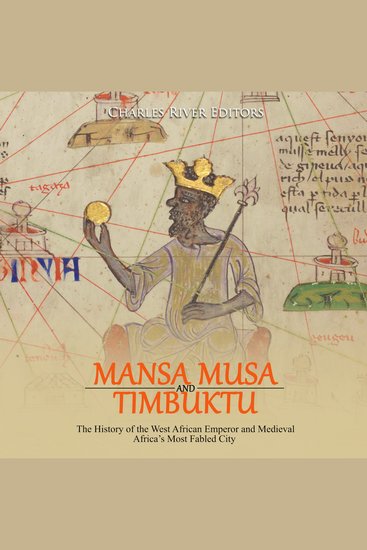
    Recent research has revealed that the richest person of all time lived in the 14th century in West Africa and went by many names, including Kankan Musa Keita, Emir of Melle, Lord of the Mines of Wangara, Conqueror of Ghanata and the Lion of Mali II, but today he is usually referred to as Mansa Musa. Adjusting his wealth to modern values, he was worth about an estimated $400 billion as the Sultan of ancient Mali, which controlled the trade routes across the Sahara Desert.  
    	About 6,000 years ago, the ancient Sahara was a tropical jungle with lush grasslands and substantial rivers until it moved north of the Equator as a result of tectonic plate movements. The seismic activity changed the location of land and the composition of the atmosphere. The African Humid Period seems to have ended relatively quickly, taking a couple of thousand years before being replaced by a much drier climate, and this started a process of desertification that forced many animals and human inhabitants to the outer edges of the immense desert. There would have been passages through the area that vanished as the harsh climate inexorably clawed at the mountains and hills, turning them into the sand that obliterated all traces of their ever having been there. By about 600 BCE, the terrain and habitat had become much less hospitable, so much so that it was no longer possible to use horses and oxen to carry commodities. As a result, trading became difficult and sporadic and slowly disappeared. 
    	This all changed when camels were introduced to the Sahara, initially via Roman invaders and then with the Berber traders from Arabia moving across North Africa in search of gold and salt. As they reached the southern Sahel, they encountered the old established trading system and routes of the Garamantes, the people who handled the trade in and out of the Sahara from West Africa. The combination of the use of camels with the already re-established West African trade routes brought about rapid economic progress that resulted in the area supplying more than half the world’s gold for more than 1,000 years, beginning around 400 CE. 
    	Of course, this timing coincided with the rise of global trade routes such as the Silk Road and the beginning of Europe’s Age of Discovery. By the 12th century, it was believed that far to the east, beyond the lands controlled by the Muslim armies, lived a powerful Christian king named Prester John in the land of India. While he was a king, he was also a priest (“Prester” means Priest and was supposedly the only title he took). His kingdom was believed to be grand and contained many wonders. Marco Polo looked for Prester John, and the Crusaders wanted to reach out to Prester John. Portugal’s Henry the Navigator sent his ships out with explicit instructions of what they should do if they met Prester John, and on his historic voyages, Columbus carried two books, The Travels of Marco Polo and The Travels of Sir John Mandeville, both of which have long passages on Prester John. 
    	The belief in the existence of fabled African kingdoms and kings ensured that real African kings were also shrouded in lore, and few would become as legendary as Mansa Musa. Mansa Mansa Musa and Timbuktu: The History of the West African Emperor and Medieval Africa’s Most Fabled City looks at one of the most famous rulers of the Middle Ages and the development of the city. Along with pictures and a bibliography, you will learn about Mansa Musa and Timbuktu like never before.
    Show book

  • Trust Yourself Anyway - Designing a Life That Fits - cover

    Trust Yourself Anyway -...

    Sally Miller

    • 0
    • 0
    • 0
    You are not broken. You are not late. You are right on time. 
    Trusting yourself in a noisy world can feel like standing in a fitting room under bad lighting, trying on versions of yourself that never quite feel like you. 
    Trust Yourself Anyway is your permission to stop squeezing into lives that aren’t made for you and start listening to the quiet inner voice that already knows what fits. 
    Sally Miller has spent more than three decades designing clothes for girls and women. She knows what it means to watch someone light up when they finally see themselves clearly. And in this book, she brings that same magic to the inner world. 
    Through story, humor, and lived experience, Sally shares the moments that reshaped her life.  
    The risks and the reinventions.  
    The surprising clarity that comes from paying attention and letting go.  
    Woven through these stories is a simple framework rooted in the four pillars that have supported her own evolution. Trust, Awareness, Curiosity, and Letting Go. Together, they offer a way of growing peace, creativity, and the confidence to take more risks. 
    This isn’t a “fix yourself” book. 
    It’s a “remember who you are” book. 
    And it will remind you of what’s been true all along: 
    You’re not lost. You just stopped trusting yourself.
    Show book
  • This Was Toscanini - The Maestro My Father and Me (2nd Edition) - cover

    This Was Toscanini - The Maestro...

    Samuel Antek, Lucy Antek Johnson

    • 0
    • 0
    • 0
    This audio edition includes excerpts from NBC Symphony performances conducted by Maestro Toscanini!  
    “Music lovers will find this book irresistible ... the writing is gorgeous, the characters are well-sculpted, the scenes are focused, and the author brings to life moments that music aficionados will savor for a long time. The book itself is a symphony that arrests the edges of the hearts of readers.” —The Book Commentary 
    Explore with renewed wonder the thorough, touching, and inspiring firsthand account of performing with and learning from Arturo Toscanini. In this expanded second edition of This Was Toscanini, original author Samuel Antek's reflections on The Maestro gain new insights as his daughter Lucy Antek Johnson enlightens readers of what her father himself was like, and shares her fond and intimate reflections on a musical partnership. 
    Arturo Toscanini is widely considered the greatest conductor of the modern age and remains a towering figure in the world of classical music. His explosive passions, dynamic music making, and legendary leadership continue to inspire and influence today's musicians while still captivating new generations of enthusiastic fans as well. This Was Toscanini is an intimate, firsthand, behind-the-scenes musical portrait of the Maestro, told from the unique perspective of first violinist Samuel Antek, who was fortunate to play under Toscanini's baton for seventeen years in the famed NBC Symphony Orchestra. In this expanded second edition of This Was Toscanini: The Maestro, My Father, and Me, Samuel Antek's reflections on playing with the Maestro gain sparkling new facets of insight from his daughter, Lucy Antek Johnson, as she enlightens readers with vivid recollections about her father and his most memorable musical partnership. With a foreword from acclaimed author and music historian Harvey Sachs. This audio edition features over 20 minutes of music.
    Show book
  • Ginger Baker of Cream - In Conversation 1 - cover

    Ginger Baker of Cream - In...

    Geoffrey Giuliano

    • 0
    • 0
    • 0
    Ginger Baker is, without question, one of the foremost drummers of his generation, having formed supergroups Cream and Blind Faith. In the early 1990s, Geoffrey Giuliano received a call from Baker asking if he would be interested in writing his autobiography. From there a turbulent, yet fruitful relationship ensued between the two men. While the book they wrote has yet to be published, here, at last, are the in-depth, upfront, and personal conversations the two unlikely friends recorded in a Western New York studio all those years ago. Ginger speaks his mind holding forth on the particulars of his amazing life and work and in doing so reveals something he has always ardently tried to hide - that he is really a lovely, caring, sensitive man. For everyone interested in the history, art, and cultural significance of the popular music of the 20th century, this series is a once in a lifetime, must-have audio event. Perfect for universities and all educational media. Contains adult language and mature themes. Not recommended for children. Produced by Fred Betschen. Edited by Macc Kay. Project Coordinator Alex Franchi.
    Show book