Rejoignez-nous pour un voyage dans le monde des livres!
Ajouter ce livre à l'électronique
Grey
Ecrivez un nouveau commentaire Default profile 50px
Grey
Abonnez-vous pour lire le livre complet ou lisez les premières pages gratuitement!
All characters reduced
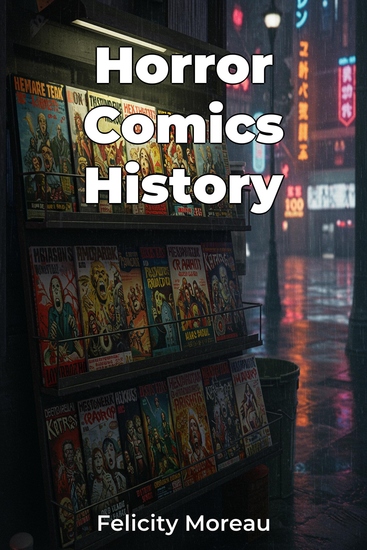
Horror Comics History - cover

Horror Comics History

Felicity Moreau

Traducteur A AI

Maison d'édition: Publifye

  • 0
  • 0
  • 0

Synopsis

Horror Comics History explores the rise and fall of a controversial art form in post-war America. Delving into the graphic world of horror comics, the book examines their popularity, the social anxieties they mirrored, and the censorship that ultimately curtailed their artistic freedom.

 
The book highlights how these comics, filled with gore and the supernatural, became a focal point in a moral panic fueled by concerns about juvenile delinquency, even leading to the establishment of the Comics Code Authority, which significantly sanitized the industry.

 
The book charts the ascent of horror comics, dissects the moral panic they ignited, and analyzes the lasting impact of censorship. It begins with the pioneers of the genre, moves through the thematic elements that defined these comics, and culminates in the establishment of the Comics Code Authority.

 
This exploration reveals how anxieties about the Cold War and changing social norms found expression in these often disturbing narratives, offering a unique lens through which to view mid-20th century American culture and the ongoing tension between artistic expression and societal control.
Disponible depuis: 10/03/2025.
Longueur d'impression: 57 pages.

D'autres livres qui pourraient vous intéresser

  • Cartel Bands On - Changing American Culture Through Migration Legal and Not So Much - cover

    Cartel Bands On - Changing...

    Troy Eugene Bobbitt

    • 0
    • 0
    • 0
    The American immigration system is often described as broken, with calls for Congress to completely rewrite the laws. Many believe that foreign gangs are taking over the streets, drug cartels control the border, taxpayers are funding the lives of migrants, and American workers are being replaced by those willing to work for less. But are these claims true? Cartel Bands On takes a deep dive into the realities of the American immigration system. Written by a retired Border Patrol Agent, this book combines factual analysis with firsthand experiences from the author's career. With a clear and accessible approach, it explores the history and laws governing immigration while providing a closer look at what both legal and illegal migrants encounter upon entering the country. Readers are invited to challenge their assumptions and critically assess whether the system is truly broken. If it is, how should it be fixed?
    Voir livre
  • The Golden Years - The Many Joys of Living a Good Long Life - cover

    The Golden Years - The Many Joys...

    Ruskin Bond

    • 0
    • 0
    • 0
    Ruskin Bond is eighty-nine years old: long past sixty, the age at which one becomes a senior citizen; also the age around which it is said one should think of retiring from active life. As the years go by, his contentment with living the life he has chosen--keeping to himself, with his family and his books, in Landour--has only grown stronger. He takes great joy in the world outside his window: the changing shades of nature, interesting people, good food, nice walks. Inside his room there are thoughts and memories, and the journal and letters he writes every day. 
    All of it makes for a wonderful life--and that is what this book is about. In his trademark warm, witty, whimsical style and his marvellously simple prose, Ruskin tells us how to enjoy the advancing years some of us are blessed with, and how to make the most of the amazing gift called life.
    Voir livre
  • A Brief Global History of the Left - cover

    A Brief Global History of the Left

    Shlomo Sand

    • 0
    • 0
    • 0
    The Left seems to be dying a slow death. While many commenters have predicted its demise, the Left has always defied these bleak prognoses and risen from the ashes in the most unexpected ways. Nevertheless, we are witnessing today a global decline in organized movements on the Left, and while social struggles and rebellious citizens continue to challenge dominant political regimes, these efforts do not translate into support for traditional left parties or into the creation of dynamic movements on the left. 


    Bestselling historian Shlomo Sand argues that the global decline of the Left is linked to the waning of the idea of equality that has united citizens in the past and inspired them to engage in collective action. Sand retraces the evolution of this idea in a wide-ranging account that includes seventeenth-century England, the French Revolution, the birth of anarchism and Marxism, the decolonial, feminist, and civil rights revolts, and the left populism of our time. In piecing together the thinkers and movements that built the Left, Sand illuminates the global and transnational dynamics which pushed them forward, often picking up the gauntlets their predecessors had laid down. He outlines how they shaped the notion of equality, while also analyzing how they were confronted by its material reality, and the lessons that they did—or did not—draw from this.
    Voir livre
  • Chernobyl and Kyshtym: The History of the Soviet Union’s Biggest Nuclear Disasters - cover

    Chernobyl and Kyshtym: The...

    Charles River Editors

    • 0
    • 0
    • 0
    Uranium is best known for the destructive power of the atom bombs, which ushered in the nuclear era at the end of World War II, but given the effectiveness of nuclear power, nuclear power plants were constructed around the developed world during the second half of the 20th century. While nuclear power plants were previously not an option and thus opened the door to new, more efficient, and more affordable forms of energy for domestic consumption, the use of nuclear energy understandably unnerved people living during the Cold War and amidst ongoing nuclear detonations. After all, the damage wrought on Hiroshima and Nagasaki made clear to everyone what nuclear energy was capable of inflicting, and the health problems encountered by people exposed to the radiation also demonstrated the horrific side effects that could come with the use of nuclear weapons or the inability to harness the technology properly. 
    For decades, it was believed that the first major accident at a nuclear power plant took place at Three Mile Island in Pennsylvania in 1979, which took nearly 15 years and $1 billion to fully clean up after that disaster. However, Three Mile Island paled in comparison to Chernobyl, which to this day remains the most notorious nuclear accident in history. Located in the Ukraine, the Chernobyl power plant was undergoing experiments in the early morning hours of April 26, 1986 when it suffered a series of explosions in one of its nuclear reactors, killing over 30 people at the plant and spread radioactive fallout across a wide swath of the Soviet Union. Although the Soviets would try to cover up just how disastrous the accident at Chernobyl was, it was impossible to hide the full extent of the damage given that radioactive material was affecting Western Europe as well. All told, the accident caused an estimated $18 billion in damages.
    Voir livre
  • Start of the Vietnam War The: The History and Legacy of the Events that Began America’s Most Controversial War - cover

    Start of the Vietnam War The:...

    Editors Charles River

    • 0
    • 0
    • 0
    The Vietnam War could have been called a comedy of errors if the consequences weren’t so deadly and tragic. In 1951, while war was raging in Korea, the United States began signing defense pacts with nations in the Pacific, intending to create alliances that would contain the spread of Communism. As the Korean War was winding down, America joined the Southeast Asia Treaty Organization, pledging to defend several nations in the region from Communist aggression. One of those nations was South Vietnam.  
    	Before the Vietnam War, most Americans would have been hard pressed to locate Vietnam on a map. South Vietnamese President Diệm’s regime was extremely unpopular, and war broke out between Communist North Vietnam and South Vietnam around the end of the 1950s. Kennedy’s administration tried to prop up the South Vietnamese with training and assistance, but the South Vietnamese military was feeble. A month before his death, Kennedy signed a presidential directive withdrawing 1,000 American personnel, and shortly after Kennedy’s assassination, new President Lyndon B. Johnson reversed course, instead opting to expand American assistance to South Vietnam. 
    	The post-analysis of war is a complicated and process that benefits from hindsight, and the involvement of the United States in Vietnam over about a decade was no exception. Never formally declared as a “war,” the Vietnam War was not fought in clean lines or with clear missions. Viewers of the evening news listening to the “box score” of killed and wounded each night had at best a hazy notion of what was happening a world away in Southeast Asia. If anything, their leaders were both attentive to reelection and on a certain level were themselves unsure of what was truly taking place. A military draft that sent over 50,000 American soldiers to their deaths was triggered by a resolution sought by President Lyndon B. Johnson in a decision to contain communism in a distant Asian land. 
    Voir livre
  • Finding Folkshore - cover

    Finding Folkshore

    Rachel Faturoti

    • 0
    • 0
    • 0
    16-year-old Fola Oduwole is scared. She's scared of disappointing her parents, she's scared of not being able to follow her dreams, but most of all she's scared for her brother. He has cancer and his surgery's coming up soon, it could leave him paralysed, or worse. Fola deserves a break, and she gets her wish when she takes the Victoria line one stop too far and is transported to Folkshore, a magical, hidden part of London.
    Now she's scared of the talking animals, the mythical Shriekers and not being there when her brother wakes up. Fola wants to go back, but a thunderstorm destroys Folkshore station. As she looks for another way out, Fola stumbles on the local Assembly's nefarious plans. She realises that the only way back to her brother is to help her new friends as they resist the pugnacious police pigs and the authoritarian assembly.
    If she fails, the community she's come to love could be destroyed forever and she may never find her way home.
    Voir livre