Join us on a literary world trip!
Add this book to bookshelf
Grey
Write a new comment Default profile 50px
Grey
Subscribe to read the full book or read the first pages for free!
All characters reduced
Professional Oath Meaning - cover

Professional Oath Meaning

Felicia Dunbar

Translator A AI

Publisher: Publifye

  • 0
  • 0
  • 0

Summary

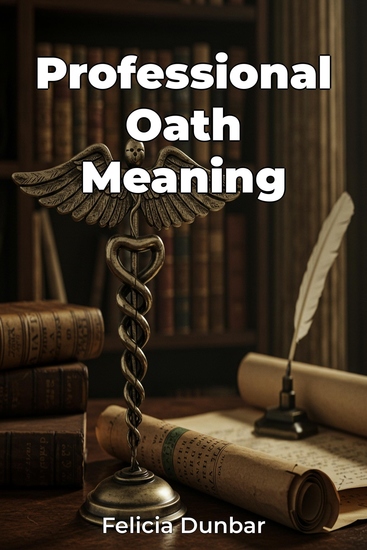
"Professional Oath Meaning" explores the crucial role of professional oaths in upholding public trust within the legal and medical fields. It examines how these oaths, formal commitments to ethical principles, shape professional identity, influence decision-making, and foster public confidence. The book highlights the historical significance and contemporary relevance of oaths, tracing their evolution from ancient traditions to modern practices, emphasizing their connection to duty, responsibility, and moral obligation.

 
The book navigates through the specific oaths used in the legal profession, analyzing their historical context and practical implications for lawyers and judges. Similarly, it explores medical oaths, focusing on the Hippocratic Oath and its modern variations, illustrating how these oaths contribute to societal welfare. Through case studies and real-world examples, the book demonstrates the impact of oath-taking on professional conduct and public perception.

 
The book's approach involves introducing core concepts, exploring historical roots, and analyzing contemporary interpretations. It progresses by examining oaths in the legal and medical professions, providing case studies, and discussing strategies for reinforcing the value of oaths in professional education and practice. This comprehensive analysis offers a renewed understanding of the meaning, purpose, and implications of professional oaths for maintaining integrity in law and medicine.
Available since: 02/20/2025.
Print length: 75 pages.

Other books that might interest you

  • Everything is an Emergency - An OCD Story - cover

    Everything is an Emergency - An...

    Jason Adam Katzenstein

    • 0
    • 0
    • 0
    “This book undid me in all the best ways. Everything is an Emergency is a brilliant, honest, necessary book that exposes the intricacies of the human brain while showing us the way creativity and friendship can anchor us. This is a must-read for anyone who has ever wondered if they see the world a little differently.” –Ada Limón 
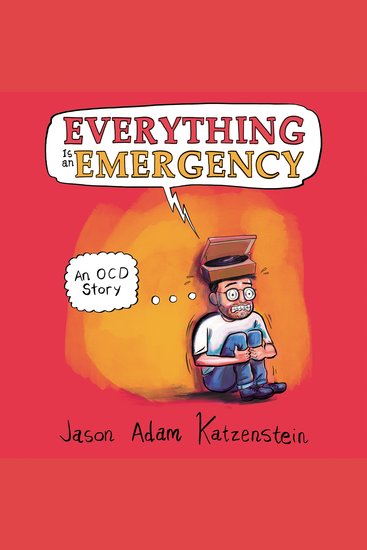
    A New Yorker cartoonist illustrates his lifelong struggle with OCD 
    Jason Adam Katzenstein is just trying to live his life, but he keeps getting sidetracked by his over-active, anxious brain. Mundane events like shaking hands or sharing a drink snowball into absolute catastrophes. Jason has Obsessive Compulsive Disorder, a mental illness that compels him to perform rituals in order to protect himself from dangers that don’t really exist. He checks, washes, over-thinks, rinse, repeat.  
    He does his best to hide his embarrassing compulsions, and sometimes this even works. He grows up, worries about his first kiss, falls in love with making cartoons, moves to New York City — which is magical and gross, etc. All the while, half his energy goes into living his life, while the other half is devoted to the increasingly ridiculous rituals he’s decided to maintain to keep himself from fully short-circuiting,  
    Then, he fully short-circuits.  
    At his absolute lowest, Jason finally decides to do the things he’s always been told to do to get better: exposure therapy and medication. These are the things that have always freaked him out, and they continue to freak him out. Also, they help him recover.  
    Everything is an Emergency is about all the self-destructive stories someone tells himself, over and over, until they start to seem true. In images surreal, witty, and confessional, Jason shows us that OCD can be funny, even when it feels like it’s ruining your life.
    Show book
  • History of Marathas EP07 - Escape from Agra - cover

    History of Marathas EP07 -...

    Vikrant Pande

    • 0
    • 0
    • 0
    Aurangzeb behaved like a man possessed. He was unable to believe what he had just seen and heard. Had Shivaji really vanished as described by Fulaad Khan? He wondered whether Shivaji could walk through walls and materialize elsewhere. He was not willing to take chances with his own life and ordered strict security around himself. A maulvi accompanied him all the time. Ram Singh's mansabdari was taken away.
    Show book
  • Master HSK 1 Grammar: Volume 2 – A Complete Guide to Mandarin Chinese Grammar for Beginners - Perfect for Everyone Starting Their Language Journey - cover

    Master HSK 1 Grammar: Volume 2 –...

    Letitia Wu

    • 0
    • 0
    • 0
    Continue your Mandarin journey with the second volume of the Master HSK 1 Grammar series! 
    This audiobook builds on the foundations of Volume 1, guiding you through 10 new beginner-friendly lessons. You’ll master essential grammar for talking about time and dates, measure words, “how many/how much,” and polite everyday phrases.  
    Each lesson includes real examples, step-by-step breakdowns, and guided “repeat after me” practice to help you speak naturally and with confidence. 
    If you’re just starting out, we recommend beginning with Volume 1 for the basics. But if you’re ready to go further, Volume 2 is your next step toward fluency in Mandarin Chinese. 
    Learn clearly, practice actively, and take your Chinese to the next level!
    Show book
  • Face with Tears of Joy - A Natural History of Emoji - cover

    Face with Tears of Joy - A...

    Keith Houston

    • 0
    • 0
    • 0
    A vibrant exploration of the world's newest language—where it came from, how it works, and where it's going. 


    We are surrounded by emoji. They appear in politics, movies, drug deals, our sex lives, and more. But emoji's impact has never been explored in full. In this rollicking tech and pop culture history, Keith Houston follows emoji from its birth in 1990s Japan, traces its Western explosion in the 2000s, and considers emoji's ever-expanding lexicon. Named for the world's most popular pictogram, Face with Tears of Joy tells the whole story of emoji for the first time.
    Show book
  • Bloodstains on the Cocaine Trail - Crime Reporting on Famous Newspapers - cover

    Bloodstains on the Cocaine Trail...

    Peter Clack

    • 0
    • 0
    • 0
    A homicide crisis began sweeping America after massive quantities of cocaine first began their journey into America in 1986. Drugs were trucked along the highways of the Cocaine Trail to every city in America. This influx of a deadly new drug led directly to a series of record deaths from overdoses, suicides and crime-related murders, family breakdowns and destroyed lives. Drugs are credited with driving the highest homicide rates in American history and a raging turf war between street gangs.
     
    Crack cocaine unleashed a brutal era of violence, placing newspapers under 
    enormous pressure to provide coverage. Relations with police were breaking down everywhere and crime coverage was in its death throes. Newspapers could not cover the homicides or give any context or explanations to such a social upheaval. Editors, reporters and police now reveal the shocking truth behind this agonizing episode in American history, when crime reporters had to re-invent journalism to get behind the police blue code. This book combines investigative journalism and narrative style to produce a rare portrait from within the secret inner world of newspapers.
    Show book
  • Roman Gods and Legends - Exploring the Divine Myths of Ancient Rome - cover

    Roman Gods and Legends -...

    Odessa Nightshade

    • 0
    • 0
    • 0
    Mythology was at the heart of ancient Roman culture, shaping the way people understood the world, their history, and even their daily lives. Roman myths were more than just entertaining stories; they provided a framework for religious practices, reinforced social hierarchies, and legitimized political authority. From grand temples dedicated to Jupiter to household shrines honoring protective spirits, mythology was deeply embedded in Roman society. These myths explained the origins of Rome, the will of the gods, and the moral expectations placed upon its people.  
      
    One of the most fascinating aspects of Roman mythology is its connection to Greek mythology. The Romans borrowed heavily from the Greeks, adapting their gods, myths, and religious traditions to fit their own culture. Jupiter became the Roman equivalent of Zeus, Venus took the place of Aphrodite, and Neptune mirrored Poseidon. Yet, Roman mythology was not simply a copy of Greek traditions—it evolved to reflect Rome’s unique values, including its emphasis on duty, discipline, and the power of the state. Roman gods were deeply tied to civic life, with religious festivals and rituals reinforcing the unity and strength of the empire.  
      
    As Rome expanded, so did its pantheon. Over time, new deities were integrated from conquered cultures, blending native Italian, Etruscan, and foreign influences into Roman religious beliefs. This constant evolution reflected the empire’s adaptability and its ability to absorb and reshape traditions to maintain social cohesion. The role of mythology also shifted, particularly as emperors began to position themselves as semi-divine figures, further intertwining politics with religion. These myths were not just ancient relics but living traditions that reinforced Rome’s identity and dominance. 
    Show book