Join us on a literary world trip!
Add this book to bookshelf
Grey
Write a new comment Default profile 50px
Grey
Subscribe to read the full book or read the first pages for free!
All characters reduced
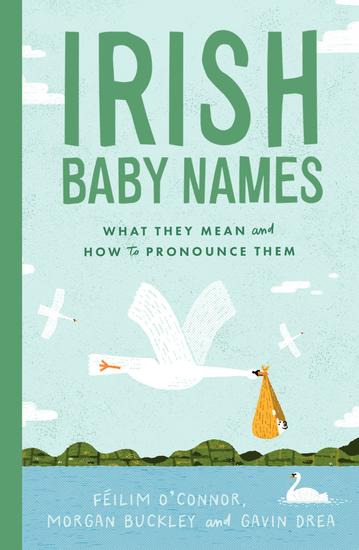
Irish Baby Names - What they mean and how to pronounce them - cover

Irish Baby Names - What they mean and how to pronounce them

Féilim O'Connor, Morgan Buckley, Gavin Drea

Publisher: Gill Books

  • 0
  • 0
  • 0

Summary

Discover the magical origins and meanings behind over 200 Irish names.
It might seem like the classic Irish names are Mary and Joseph, but those are about as Irish as the Pope! Get ready to go back, way back, before Christianity came to these shores. Rediscover names like CÁIT (a fairy creature), FERDIA (a friend of Cú Chulainn), MACHA (an ancient war goddess) and RÉALTÍN (little star) – names from an ancient Ireland of mystery, magic and mythos.
An Irish name is the greatest first gift you can give a child. Here you will be sure to find a name you and your family will love forever.
Available since: 06/05/2025.
Print length: 160 pages.

Other books that might interest you

  • Mothercare - On Obligation Love Death and Ambivalence - cover

    Mothercare - On Obligation Love...

    Lynne Tillman

    • 0
    • 0
    • 0
    Brilliantly original novelist and cultural critic Lynne Tillman became one of nearly 53 million Americans who care for a sick family member when her mother developed an unusual and little understood condition called Normal Pressure Hydrocephalus. 


    Instantly, Tillman's independent and spirited mother went from someone she knew to someone else, a woman entirely dependent on her children—an eleven-year process through which her mother underwent many surgeries and some misdiagnoses, while the family navigated consultations and confrontations with doctors, adjusting to the complexity of her cognitive issues, including memory loss. 


    With her notoriously exquisite writing style and reputation as a "rich noticer of strange things" (Colm Toíbín), Tillman describes, without flinching, the unexpected, heartbreaking, and frustrating years of caring for a sick parent. 


    Mothercare is both a cautionary tale and sympathetic guidance for anyone who suddenly becomes a caregiver, responsible for the life of another—a parent, loved or not, or a friend. This story may be helpful, informative, consoling, or upsetting, but it never fails to underscore how impossible it is to get the job done completely right.
    Show book
  • Sociology of Social Structures - Understanding Social Systems and Institutions (5 in 1) - cover

    Sociology of Social Structures -...

    Fred Grandsen

    • 0
    • 0
    • 0
    This book provides an in-depth exploration of the intricate social systems that shape human behavior, societal norms, and everyday life.  
    The Sociology of Crime examines the complex relationship between social structures and criminal behavior. It looks into how crime is defined, why individuals commit crimes, and how societal reactions to crime shape both law enforcement and criminal justice policies. 
    The Sociology of Deviance delves into behaviors that deviate from societal norms and the social processes that label them as deviant. This section explores how norms are constructed, the role of social institutions in defining deviance, and the impact of these labels on individuals and groups. 
    The Sociology of Education explores the role of education in society, focusing on how educational institutions serve as agents of socialization, reproduction of social structures, and vehicles for upward mobility. 
    The Sociology of Work highlights the changing nature of work, labor markets, and employment practices in contemporary society. It covers the evolution of work structures, from industrial labor to service-oriented economies, and the social implications of labor practices on individuals and communities. 
    The Sociology of Consumption looks at the cultural and social aspects of consumption, including how consumer behaviors are influenced by economic forces, marketing, and social norms. This book explores the relationship between identity and consumption, how consumer culture reflects social values, and the environmental and ethical implications of consumerism.  
    Together, these five books offer a comprehensive understanding of the key social structures and institutions that influence human behavior and societal development.
    Show book
  • Marcus Daly's Road to Montana - cover

    Marcus Daly's Road to Montana

    Brenda Wahler

    • 0
    • 0
    • 0
    The Making of a Copper King!Born in 1841 to tenant farmers, Marcus Daly came from ruralIreland to New York as a boy. Having learned the big city’s harsh lessons, he traveled west to the gold and silver mining camps ofCalifornia, Nevada, Utah and Montana. Then, a spectacular discovery in the Anaconda mine him one of Montana’s famed Copper Kings. Yet, his early life remained shrouded in myth. Famed for his machinations in state politics and shaping Butte into the “Richest Hill on Earth,” his path from farm boy to mining king has been overlooked. For the first time, author Brenda Wahler brings his secretive and formative early years to life.
    Show book
  • Beyond Your Bubble - How to Connect Across the Political Divide Skills and Strategies for Conversations That Work - cover

    Beyond Your Bubble - How to...

    Tania Israel

    • 0
    • 0
    • 0
    As featured in the New York Times, the Washington Post, TED Talks, and the Orange County Register, this practical, politically neutral book offers concrete skills for holding meaningful conversations that cut across today's intense political divide, showing listeners how to connect to the people in their lives. 


    Political polarization is at an all-time high, and the consequences for our personal relationships are significant. Many people have friends and family members with whom they feel they can no longer communicate because of their extreme political views. In this book, psychologist Tania Israel presents her program for helping people have meaningful, constructive conversations with those they disagree with politically. 


    Chapters show listeners how to develop and use the scientifically-proven skills that are the foundation of constructive conversation, including strategies for effective listening, managing emotions, and understanding someone else's perspective, as well as finding common ground, avoiding self-righteousness, and telling your own story. Throughout, conversation prompts, practical exercises, case examples, and self-quizzes help listeners visualize and practice starting, sustaining, and ending challenging conversations.
    Show book
  • Policy of Deceit - Britain and Palestine 1914-1939 - cover

    Policy of Deceit - Britain and...

    Peter Shambrook

    • 0
    • 0
    • 0
    This is the untold story of Britain's role in the Israel–Palestine conflict. During the First World War, the British High Commissioner in Egypt reached a secret agreement with the Sharif of Mecca. If the Sharif allied with Britain against the Ottomans, after the war an independent Arab state that included Palestine would be established. The Sharif kept his word. The British did not. Instead, two years later Lloyd George's government declared that Palestine would be for the global Jewish community. Through meticulous analysis of official records and private papers, Peter Shambrook exposes how Britain came to betray the Arabs. He debunks the myth that Palestine was never part of the lands guaranteed to the Sharif and details the attempts of successive British governments to prevent the truth from ever becoming public. For anyone interested in the history of the Israel–Palestine conflict, this is a must-read.
    Show book
  • Splitting the Confederacy: The History of the Union Campaigns to Take the Mississippi River - cover

    Splitting the Confederacy: The...

    Editors Charles River

    • 0
    • 0
    • 0
    Given its importance, it’s somewhat surprising in retrospect that the Union managed to capture New Orleans in an easier manner than places like Vicksburg and Atlanta. Admiral David Farragut’s naval forces battered their shaky Confederate counterparts and were able to get over a dozen ships upriver past a couple of crucial Confederate forts along the Mississippi. By May 1862, Union forces occupied the city and General Benjamin Butler became its military governor, leaving the last true bastion of Confederate defenses on the Mississippi at Vicksburg. 
    At the start of 1863, Robert E. Lee’s Army of Northern Virginia had been frustrating the Union in the Eastern theater for several months, but the situation in the West was completely different. The Confederates had lost control of several important states throughout 1862, and after New Orleans was taken by the Union, the North controlled almost all of the Mississippi River, which Confederate general James Longstreet called “the lungs of the Confederacy”. By taking control of that vital river, the North would virtually cut the Confederacy in two, putting the South in a dire situation. 
    The only domino left to fall was the stronghold of Vicksburg, and both sides knew it. The Union Army of the Tennessee, led by Ulysses S. Grant, would spend months trying to encircle the army and eventually force John Pemberton’s Confederate army to surrender. Grant eventually succeeded on July 4, 1863, but since it came a day after the climactic finish of the Battle of Gettysburg, Vicksburg was (and still is) frequently overlooked as one of the turning points of the Civil War. In fact, had the Confederate’s military leadership listened to Longstreet, who advocated detaching soldiers from Lee’s army to head west and help the Confederates deal with Grant or Rosecrans in that theater, the Battle of Gettysburg might never have happened.
    Show book