Join us on a literary world trip!
Add this book to bookshelf
Grey
Write a new comment Default profile 50px
Grey
Subscribe to read the full book or read the first pages for free!
All characters reduced
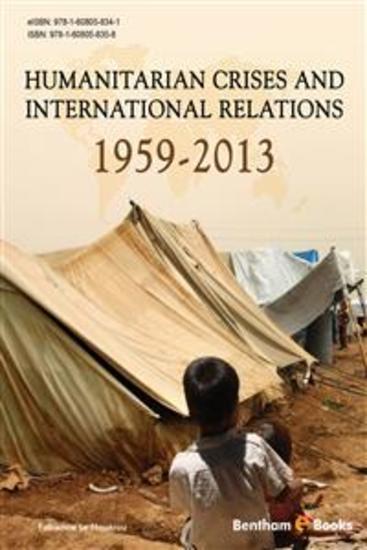
Humanitarian Crises and International Relations (1959-2013) - cover

Humanitarian Crises and International Relations (1959-2013)

Fabienne Le Houérou

Publisher: Bentham Science Publishers

  • 0
  • 0
  • 0

Summary

Humanitarian Crises and International Relations (1959-2013) presents a brief study of the relations between sovereign nations from 1959 to the current Afghanistan crisis (post NATO intervention). Each chapter is going to analyze a specific crisis in a chronological order. The chapters demonstrate how humanitarian crises linked to civil and military conflicts have reshaped international relations in our world today.
 
This book is a key tool for students undertaking courses related to the history of international relations as well as human rights and on international migrations. The topics in this book are connected to different disciplines (Anthropology, History and Political Science) and attempt to trace the most important change in the history of international relations related to the world crisis viz civil or external conflicts.
Available since: 03/20/2024.


Other books that might interest you

  • The Man Behind The Fascist Doctrine - cover

    The Man Behind The Fascist Doctrine

    Benito Mussolini

    • 0
    • 0
    • 0
    “It’s better to live one day as a lion than 100 years as a sheep.” 
     
    "I am the most terrible animal that's ever existed." 
     
    "Democracy is beautiful in theory; in practice, it is a fallacy. You in America will see that someday." 
     
    "It's good to trust others but, not to do so is much better." 
     
    “I feel, when we have no friends upon whom to lean, or to look for moral guidance." (Mussolini) 
     
    The Doctrine of Fascism" is an essay attributed to Benito Mussolini. In truth, the first part of the essay, entitled "Idee Fondamentali", was written by the Italian philosopher Giovanni Gentile, while only the second part is the work of Mussolini himself. 
     
    Benito Amilcare Andrea Mussolini, born on July 29, 1883, who went by the nickname “Il Duce” (“the Leader”), was a deeply unbalanced tyrannical Italian dictator who created the dreaded Fascist Party in 1919. Eventually, he held all power in Italy as the country’s prime minister from 1922 to 1943. An ardent socialist as a youth, Mussolini followed in his father's political footsteps but was expelled by the party for his overt support of World War I. As an evil dictator during World War II (even murdering his own son by lethal injection) he greatly overextended his forces and was eventually killed by his own people in Mezzegra, Italy. Here, for the first time, are the words of the great dictator himself in his twisted manifesto on the political movement he started and is still so feared to this very day. A rare audiobook adventure in politics, history, and outrage!
    Show book
  • Making Meaning of Difficult Experiences - A Self-Guided Program - cover

    Making Meaning of Difficult...

    Sheila A.M. Rauch, Barbara O....

    • 0
    • 0
    • 0
    Up to 90% of adults in the US will experience one or more traumatic events in their lifetimes, including interpersonal violence, traffic collisions, and sexual assault. While most who suffer a trauma naturally recover over time, for others difficulties continue, and may lead to full-blown depression, posttraumatic stress disorder (PTSD), substance use, anxiety disorders, and other problems that interfere with healthy daily functioning. 


    Making Meaning of Difficult Experiences is a self-guided mental health resource for people who have had potentially traumatic experiences and who wish to work through them independently, outside of a formal therapeutic setting. Based on psychological treatments with strong scientific support, this book introduces listeners to several useful tools that will help them to emotionally process difficult experiences, with the goal of moving on from the event and building future resilience. The program takes the listener step-by-step through four skill sets to facilitate emotional processing of difficult experiences: Memory Exposure and Processing, Behavioral Activation, Social Connection, and Self-Care. Listeners use this self-evaluation to determine what is working or not working for them, enabling them to focus more on certain skills, or to complete the full program based on their needs.
    Show book
  • Locked by the Ringmaster (Gay Chastity Erotica) - cover

    Locked by the Ringmaster (Gay...

    Archer Vale

    • 0
    • 0
    • 0
    “FREAK SHOW – CREATURES OF PLEASURE” 
    Rural America in the 1930s…it’s a rough place. I joined the circus to put food on the table, but I didn’t realize what the job entailed. 
    The ringmaster said he’d train my body. I thought I’d become a strong performer—like an acrobat. 
    But that’s not what happened at all. He’s training me to be a “boxboy”. 
    Locked in chastity and locked in a tiny wooden box, only my head and my plump, naked rear protrude. He’s prepping me for my grand debut. I can’t wait. I want it so badly. 
    Men from far and wide will pay to use my dirty, sweaty body. 
    They’ll pay to use a circus freak. 
    --- 
    CONTAINS EXPLICIT GAY SEXUAL CONTENT. 
    For exclusive stories, visit www.ArcherVale.com.
    Show book
  • Habakkuk - The World English Bible Book 35 (Unabridged) - cover

    Habakkuk - The World English...

    Various Authors

    • 0
    • 0
    • 0
    The Book of Habakkuk is the eighth book of the 12 minor prophets of the Bible. It is attributed to the prophet Habakkuk, and was probably composed in the late 7th century BC. Of the three chapters in the book, the first two are a dialogue between Yahweh and the prophet. The message that "the just shall live by his faith" plays an important role in Christian thought. It is used in the Epistle to the Romans, Epistle to the Galatians, and the Epistle to the Hebrews as the starting point of the concept of faith.
    Show book
  • The Practice & Theory Of Bolshevism - cover

    The Practice & Theory Of Bolshevism

    Bertrand Russell

    • 0
    • 0
    • 0
    This book records Bertrand Russell's impressions of the new regime after a 1920 visit to Russia following the 1917 Bolshevik Revolution, including his meetings with Lenin, Trostky, and Gorky. It includes a chapter that was authored by Dora Black, educational theorist and feminist author, and Russell's spouse. This chapter was unfortunately removed in the second edition, which was issued after Dora and Bertrand divorced. 
     
    Bertrand Arthur William Russell, 3rd Earl Russell, OM, FRS was a British mathematician, philosopher, logician, and public intellectual.  
     
    In this rare one-of-a-kind audiobook adventure the listener is met with the unexpected nature of a grand literary trek. Here is an audio treat to startle the imagination, invigorate the mind, and touch the spirit of all who hear it. From the studios of veteran artists and producers who were amongst the very first to imagine that books might one day talk - first on tape and later in the digital realm. This audiobook is our gift to you - a group of collective artists who have made their production a life's work and joy. A true audio treasure!
    Show book
  • The Intimacy of Power: An insight into private office Whitehall's most sensitive network - Why Private Office Matters - cover

    The Intimacy of Power: An...

    Alun Evans

    • 0
    • 0
    • 0
    Have you ever wondered what happens behind the scenes in the corridors of power during a major crisis or after a ministerial reshuffle? How do new government ministers get to grips with their portfolios and priorities? Who guides and supports them? And why, sometimes – during events such as 'Partygate' – do things go wrong?
    In this meticulously researched book, former senior civil servant Alun Evans lifts the lid on a vital but little-known cog in the machinery of government: private office and the private secretaries who work within it.
    Private secretaries exercise huge influence, and yet most of us have never heard of them. They are the ones who manage the flow of work, who whisper quietly in ministers' ears and who have been Prime Ministers' closest, most trusted and most discreet confidants. At critical moments in our national history – from the Falklands War to the Westland affair, from Black Wednesday to the 2008 financial crash, from New Labour to the coalition government – they have been central but hidden players.
    With exceptional access to former Prime Ministers and decision-makers, Evans explores what private office is and why it matters to British democracy. He argues that following the egregious constitutional breaches of Boris Johnson's premiership, private office must once again be taken seriously so it can return to being the independent junction box of government and a vital part of the British constitution.
    Show book