Join us on a literary world trip!
Add this book to bookshelf
Grey
Write a new comment Default profile 50px
Grey
Subscribe to read the full book or read the first pages for free!
All characters reduced
Lectures on the Science of Language - Enriched edition - cover

Lectures on the Science of Language - Enriched edition

F. Max Müller

Publisher: DigiCat

  • 0
  • 0
  • 0

Summary

In "Lectures on the Science of Language," F. Max Müller embarks on a comprehensive exploration of linguistics, emphasizing the relationship between language, thought, and culture. Through a series of engaging lectures, Müller employs a clear and accessible style, merging philosophical inquiry with empirical observation. He critiques the prevailing theories of his time while offering a systematic examination of language acquisition and its evolutionary significance. The work is set against the backdrop of 19th-century philology, where the study of language was emerging as a crucial discipline in understanding human civilization. F. Max Müller, a renowned philologist and a pivotal figure in the development of comparative linguistics, was profoundly influenced by the cultural narratives of his time. His extensive travels in India and his engagement with Sanskrit literature imbued him with a deep appreciation for linguistic diversity. Müller's academic journey, rooted in the intersection of language and spirituality, equipped him to address the complexities surrounding linguistic evolution and its implications on social identity, shaping his arguments in this seminal work. For scholars, students, and language enthusiasts alike, "Lectures on the Science of Language" serves as an indispensable resource. It not only offers foundational insights into linguistic science but also encourages a broader understanding of humanity's interconnectedness through language. This profound exploration will enrich any reader's appreciation of the nuanced relationship between language and cultural identity.

In this enriched edition, we have carefully created added value for your reading experience:
- A succinct Introduction situates the work's timeless appeal and themes.
- The Synopsis outlines the central plot, highlighting key developments without spoiling critical twists.
- A detailed Historical Context immerses you in the era's events and influences that shaped the writing.
- A thorough Analysis dissects symbols, motifs, and character arcs to unearth underlying meanings.
- Reflection questions prompt you to engage personally with the work's messages, connecting them to modern life.
- Hand‐picked Memorable Quotes shine a spotlight on moments of literary brilliance.
- Interactive footnotes clarify unusual references, historical allusions, and archaic phrases for an effortless, more informed read.
Available since: 09/16/2022.
Print length: 326 pages.

Other books that might interest you

  • Yemba Audio Phrasebook - cover

    Yemba Audio Phrasebook

    Resulam

    • 0
    • 0
    • 0
    Yemba Audio Phrasebook is your practical companion for learning and speaking Yemba, one of the major Grassfields languages of Cameroon’s West Region. 
    Designed and produced by Resulam, an organization dedicated to the revival and preservation of African mother tongues. This phrasebook offers clear, carefully pronounced recordings to help learners of all levels communicate with confidence. 
    Inside you will find:Essential everyday expressions: greetings, introductions, numbers, food, travel, and cultural etiquette.Accurate, natural pronunciation: voiced by native speakers to help you sound authentic.Cultural context: tips and notes that explain when and how to use each phrase appropriately.Easy navigation: phrases grouped by real-life situations so you can listen and repeat quickly. 
    Whether you are a traveler, language enthusiast, or a member of the Yemba-speaking community, this audio phrasebook will help you connect, communicate, and celebrate Cameroon’s rich linguistic heritage.
    Show book
  • Importance of Speech - cover

    Importance of Speech

    Saurabh Kumar

    • 0
    • 0
    • 0
    This book tells us about the importance of speech.It allows us to form connections, influence decisions, and motivate change.
    Show book
  • Mahabharata - cover

    Mahabharata

    Miriam Fernandes, Ravi Jain

    • 0
    • 0
    • 0
    Winner of 2025 Toronto Theatre Critics’ Awards Best New Canadian Work 
    Winner of 2025 Toronto Theatre Critics’  Awards Best Production of a Play 
    Winner of 2025 Toronto Theatre Critics’  Awards Best Sound Design and Music of a Play or MusicalA contemporary dramatic take on a 4,000-year-old Sanskrit epic that is foundational to Indian culture.  
    Why Not Theatre’s large-scale, once-in-a-generation retelling of Mahabharata brings together a cast of performers entirely from the South Asian diaspora, blending cultures and art forms in a spectacular production at the Shaw Festival and the Barbican Theatre in London. Over two parts (Karma and Dharma) and a communal meal (Khana), this translation and adaptation of Mahabharata spans generations and takes audiences into the hearts and minds of some of the most complex and enduring characters ever created.  
    With warring families and devious revenge plots, Mahabharata tells the story of an ancient feud with philosophical and spiritual questions that are no less urgent today. In times of division, how do we find wholeness? Are we destined to repeat the mistakes of our ancestors? And how can we build a new world when we have nearly destroyed this one?  
    Contains the full text of the play along with materials opening up the behind-the-scenes world of the production, including interviews with the creators, background and context about the source material, production photographs, a Mahabharata family tree, and glossary. 
    "Ravi Jain and Miriam Fernandes’s contemporary take on the Mahabharata is one of the most beautiful emotional journeys I have had the privilege to witness. It is inspiring, mind broadening, and speaks to all the senses. It even brings you back to the origins of theatre itself, when people would gather in the quarries around a bonfire to tell stories. With their tasteful use of technology, dance, and opera, the 4,000-year-old Sanskrit poem comes to life and feels more universal than ever. A captivating theatre experience, from the first flame to the last pixel." – Robert Lepage 
    "In their stunning rendition of the great Indian epic Mahabharata, Ravi Jain and Miriam Fernandes brilliantly reverse the whole concept of what Bertolt Brecht famously advised theatre directors: to make the familiar, unfamiliar. Jain and Fernandes have turned the unfamiliar into the familiar. The 4,000-year-old saga most Indians grew up with is made accessible to a contemporary audience the world over. No mean feat.
      ‘The play, true to its source, crosses all boundaries of culture, class, and geography. Its timeless storytelling and evocative stage design is transformed into a saga for the world, with its fundamental emotions of human nature – power, hate, jealousy, greed, and lust. To be gob-smacked by this innovation would be an understatement. Immerse yourself in this take on the Mahabharata and travel with it in time into the past, present, and future of humanity." – Deepa Mehta
    Show book
  • Arabic Made Easy - Lower beginner - Volume 1 of 3 - cover

    Arabic Made Easy - Lower...

    Lingo Wave

    • 0
    • 0
    • 0
    We broke our new series on learning Arabic down into different learning stages. Start with the “Lower Beginner” books followed by the “Beginner” and “Upper Beginner” books. Next, progress to the “Intermediate” series, then test and reinforce your knowledge with the “Conversations” series.  
    This audiobook is divided into units. While it provides different learning patterns and accommodates various needs, this audiobook focuses on helping you improve your ability to understand, speak, and memorise Arabic. The sample will give you a taste of what you can look forward to.  
    In Unit 1 you will hear Arabic decoded with each syllable spoken very slowly and clearly with repetition. Immediately before each sentence is spoken, you will hear the translation, so you will always understand what is being said. Unit 2 focuses solely on increasing your listening ability, which will improve your abilities to engage in dialogue with a native Arabic speaker. This chapter requires you to listen very carefully to nuances in the language.  
    By Unit 3 you will already notice progress in your abilities to speak and understand Arabic. The spoken translation is followed by two repetitions in Arabic at a completely natural speed. While you are learning to process naturally spoken Arabic, Units 3 and 4 will help you memorise new vocabulary and full sentences. In Unit 5 you can test yourself on how much you have learned. If you are having difficulties, we suggest you revisit the listening, speaking, or memorisation section of Units 1, 2 3 or 4, according to what you need more help with. 
    Topics covered in this book: 
    - Greeting 
    - Asking personal information 
    - Asking about people or things 
    - Talking about the current time and date 
    - Talking about the location of things 
    - Describing things  
    - Likes and dislikes 
    - Talking about abilities 
    - Talking about appearance 
    - Talking about personality 
    - Talking about the weather 
    - Talking about food 
    - Talking about the house
    Show book
  • Filipino Made Easy - Lower beginner - Volume 1 of 3 - cover

    Filipino Made Easy - Lower...

    Lingo Wave

    • 0
    • 0
    • 0
    We broke our new series on learning Filipino [Tagalog] down into different learning stages. Start with the “Lower Beginner” books followed by the “Beginner” and “Upper Beginner” books. Next, progress to the “Intermediate” series, then test and reinforce your knowledge with the “Conversations” series.  
    This audiobook is divided into units. While it provides different learning patterns and accommodates various needs, this audiobook focuses on helping you improve your ability to understand, speak, and memorise Filipino [Tagalog]. The sample will give you a taste of what you can look forward to.  
    In Unit 1 you will hear Filipino [Tagalog] decoded with each syllable spoken very slowly and clearly with repetition. Immediately before each sentence is spoken, you will hear the translation, so you will always understand what is being said. Unit 2 focuses solely on increasing your listening ability, which will improve your abilities to engage in dialogue with a native Filipino [Tagalog] speaker. This chapter requires you to listen very carefully to nuances in the language.  
    By Unit 3 you will already notice progress in your abilities to speak and understand Filipino [Tagalog]. The spoken translation is followed by two repetitions in Filipino [Tagalog] at a completely natural speed. While you are learning to process naturally spoken Filipino [Tagalog], Units 3 and 4 will help you memorise new vocabulary and full sentences. In Unit 5 you can test yourself on how much you have learned. If you are having difficulties, we suggest you revisit the listening, speaking, or memorisation section of Units 1, 2 3 or 4, according to what you need more help with. 
    Topics covered in this book: 
    - Greeting 
    - Asking personal information 
    - Asking about people or things 
    - Talking about the current time and date 
    - Talking about the location of things 
    - Describing things  
    - Likes and dislikes 
    - Talking about abilities 
    - Talking about appearance 
    - Talking about personality 
    ...
    Show book
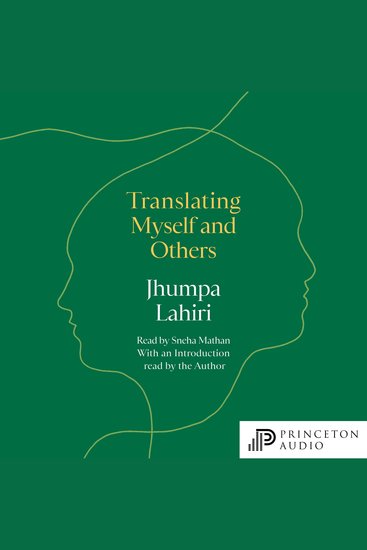
  • Translating Myself and Others - cover

    Translating Myself and Others

    Jhumpa Lahiri

    • 0
    • 0
    • 0
    Sneha Mathan narrates these luminous essays on translation and self-translation by award-winning writer and literary translator Jhumpa Lahiri
    
    With an introduction, afterword, and acknowledgements read by the author
    Translating Myself and Others is a collection of candid and disarmingly personal essays by Pulitzer Prize–winning author Jhumpa Lahiri, who reflects on her emerging identity as a translator as well as a writer in two languages.
    
    With subtlety and emotional immediacy, Lahiri draws on Ovid's myth of Echo and Narcissus to explore the distinction between writing and translating, and provides a close reading of passages from Aristotle's Poetics to talk more broadly about writing, desire, and freedom. She traces the theme of translation in Antonio Gramsci's Prison Notebooks and takes up the question of Italo Calvino's popularity as a translated author. Lahiri considers the unique challenge of translating her own work from Italian to English, the question "Why Italian?," and the singular pleasures of translating contemporary and ancient writers.
    
    Featuring essays originally written in Italian and published in English for the first time, as well as essays written in English, Translating Myself and Others brings together Lahiri's most lyrical and eloquently observed meditations on the translator's art as a sublime act of both linguistic and personal metamorphosis.
    Show book