Rejoignez-nous pour un voyage dans le monde des livres!
Ajouter ce livre à l'électronique
Grey
Ecrivez un nouveau commentaire Default profile 50px
Grey
Abonnez-vous pour lire le livre complet ou lisez les premières pages gratuitement!
All characters reduced
India: What can it teach us? - A Course of Lectures Delivered before the University Of Cambridge - cover

India: What can it teach us? - A Course of Lectures Delivered before the University Of Cambridge

F. Max Müller

Maison d'édition: DigiCat

  • 0
  • 0
  • 0

Synopsis

In "India: What Can It Teach Us?", F. Max Müller embarks on a profound exploration of Indian philosophy, culture, and spirituality, arguing for the richness and depth of India's contributions to global thought. The book is characterized by Müller's elegant prose and scholarly rigor, as he juxtaposes Western paradigms with Eastern wisdom, illustrating how Indian thought can illuminate issues of morality, ethics, and the nature of existence. Throughout the text, Müller employs a comparative literary style that entertains while educating, inviting readers to reconsider the philosophical foundations of their own beliefs in the context of Indian traditions like Vedanta and Buddhism. Friedrich Max Müller was a pioneering philologist and indologist, renowned for his work in translating and interpreting ancient Indian texts. His deep engagement with Sanskrit literature and his formative experiences in both Germany and India shaped his understanding of the intricate relationship between language, culture, and spirituality. Müller's passion for fostering cross-cultural dialogue and his belief in the transformative power of Indian wisdom led him to compile this work, aiming to bridge the East and West intellectually and ethically. This book is a must-read for scholars of comparative religion, philosophy, and anyone interested in the intersection of Eastern and Western thought. Müller's insightful observations provide not only an understanding of India's spiritual depth but also a call for introspection and integration of these lessons into contemporary life. Readers will find themselves challenged and enriched by the ideas presented, making it a vital addition to any library.
Disponible depuis: 15/08/2022.
Longueur d'impression: 223 pages.

D'autres livres qui pourraient vous intéresser

  • Destination; Remarkable - Surviving the Dark Side of Success - cover

    Destination; Remarkable -...

    Mary Grothe

    • 0
    • 0
    • 0
    This isn’t an ordinary business book, or an ordinary autobiography. It’s not merely a rollercoaster, either, but an entire theme park full of them: a traumatic childhood, two tragic accidents, multiple descents into darkness and slow climbs back into the light, reckoning with the disease of alcoholism, years working to exhaustion in the trenches, leaving one family to find another, a breakdown and redemption–and that’s just the first half of the story. Here, every stage of life becomes its own rollercoaster: love, marriage, pregnancy, motherhood, all while becoming a first-time founder, CEO, and Christian. Grothe’s dramatic life story merges with a twisting, turning chronicle on the highest highs and lowest lows of business–and of faith–and how all of the above are inextricably intertwined.
    Voir livre
  • Spirit Voices - The Mysteries and Magic of North Asian Shamanism - cover

    Spirit Voices - The Mysteries...

    David Shi

    • 0
    • 0
    • 0
    A guide to authentic North Asian Shamanism, past and present 


    The word shamanism is frequently bandied about but rarely used accurately. Shamanologist Nicholas Breeze Wood coined the following definition: "A shaman is someone chose by the spirits [typically at/before birth] and who can go into a controlled and repeatable deliberate trance state, during which they: A) experience 'spirit flight,' where they go to meet the spirit worlds and meet spirits, who they either fight with, negotiate with, or trick, in order to create change in this physical world, or B) are often taken over/possessed by the spirits (normally ancestral shaman spirits, or local land spirits) while in this physical world—the spirits using the shaman's voice and body to heal, or give advice to members of the shaman's community.  Without the spirits, and their blessing, a shaman can not exist or function. Without the trance state, it is not shamanism." 


    Author David Shi, for whom these are family traditions, explores the history and practice of shamanism. What is it? Where is it from? How does one become a shaman? Shi guides listeners through unfamiliar territory—the landscape of North Asia—and through what are largely hidden and unfamiliar traditions. Spirit Voices takes and in-depth look at three main cultural shamanic traditions: Turkic, Mongolic, and Tungus.
    Voir livre
  • War in Ukraine - Making Sense of a Senseless Conflict - cover

    War in Ukraine - Making Sense of...

    Nicolas J.S. Davies, Medea...

    • 0
    • 0
    • 0
    Russia's brutal February 2022 invasion of Ukraine has attracted widespread condemnation across the West. Government and media circles present the conflict as a simple dichotomy between an evil empire and an innocent victim. In this concise, accessible and highly informative primer, Medea Benjamin and Nicolas Davies insist the picture is more complicated. 


    Yes, Russia's aggression was reckless and, ultimately, indefensible. But the West's reneging on promises to halt eastward expansion of NATO in the wake of the collapse of the Soviet Union played a major part in prompting Putin to act. So did the U.S. involvement in the 2014 Ukraine coup and Ukraine's failure to implement the Minsk peace agreements. The result is a conflict that is increasingly difficult to resolve, one that could conceivably escalate into all-out war between the United States and Russia—the world's two leading nuclear powers. 


    Skillfully bringing together the historical record and current analysis, War in Ukraine looks at the events leading up to the conflict, surveys the different parties involved, and weighs the risks of escalation and opportunities for peace. For anyone who wants to get beneath the heavily propagandized media coverage to an understanding of a war with consequences that could prove cataclysmic, this timely book will be an urgent necessity.
    Voir livre
  • Manners in the Great Kingdom - cover

    Manners in the Great Kingdom

    Sezgin Ismailov

    • 0
    • 0
    • 0
    The choices which we make for our future, who we really want to be, how we want to feel every day, how many and what friends we need to have, what are the biggest obstacles for us, how we would like our life to go on, all that can be learned and understood from the good manners of the crown Prince Max. The final stage of Max's training consist of meetings with people and events in the different kingdoms. Each story is about everyday relationships and the personal experiences in his/her life. The right choice, is the formula for a beautiful and peaceful life.
    Voir livre
  • For The Love of Trains - cover

    For The Love of Trains

    Paul Routledge

    • 0
    • 0
    • 0
    Dedicated ‘Puffer Nutter’ Paul Routledge has loved trains all his life. 
    Whether it’s chugging along on a scenic steam railway or whizzing through towns and fields to the other side of the country, for Paul it has never lost its magic. 
    A journalist for nearly 60 years years and Daily Mirror columnist for 27 of those, Paul has written regularly about the joys of train travel. 
    Now the country is set to celebrate the 200th anniversary of the modern railway – The Stockton & Darlington Railway opened on September 27, 1825 – when better to pen a love letter to trains? 
    Looking at everything from the earliest days, fascinating stories, famous faces and future of the railways, Paul’s ode to trains is a must-read for any railway fan as well as those enthusiastic amateurs who just want to know a little more about transport they possibly take for granted.
    Voir livre
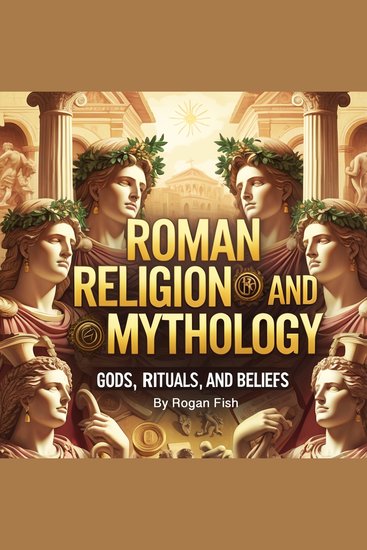
  • Roman Religion and Mythology - Gods Rituals and Beliefs - cover

    Roman Religion and Mythology -...

    Rogan Fish

    • 0
    • 0
    • 0
    Roman religion was deeply intertwined with the culture, politics, and daily life of its people. Unlike many other ancient religions, it was not based on a single sacred text or central doctrine but was instead a complex system of beliefs, rituals, and traditions that evolved over time. The foundations of Roman religion can be traced back to early influences, the societal role of religious practices, and the establishment of a structured priesthood. 
    The origins of Roman religion were shaped by various influences, including the Etruscans and Greeks. The Etruscans, who inhabited central Italy before the rise of Rome, contributed many religious customs, such as the practice of interpreting omens and the organization of priestly colleges. Greek influence introduced a pantheon of gods with human-like qualities, which Romans later adopted and adapted to fit their own cultural identity. This blending of traditions resulted in a unique religious system that emphasized duty, order, and reciprocity between humans and the divine. 
    Religion played a crucial role in Roman society, guiding both private and public life. Every household maintained a sacred space for worshiping domestic deities, such as the Lares and Penates, who were believed to protect the home and family. On a larger scale, the state religion was intertwined with governance, and public rituals were performed to secure divine favor for Rome’s prosperity. The performance of religious ceremonies was not merely a matter of personal faith but was considered essential for the stability of the state. Romans believed that their success as a civilization depended on maintaining good relations with the gods through proper observance of rituals and sacrifices.
    Voir livre