Join us on a literary world trip!
Add this book to bookshelf
Grey
Write a new comment Default profile 50px
Grey
Subscribe to read the full book or read the first pages for free!
All characters reduced
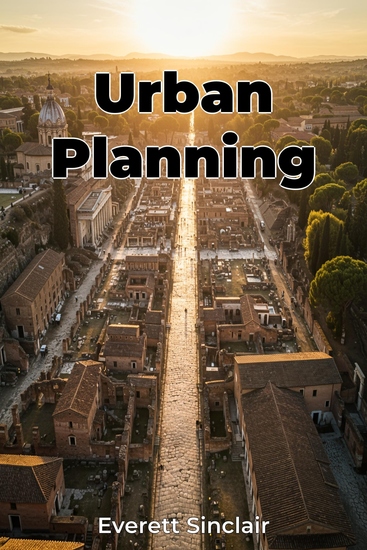
Urban Planning - cover

Urban Planning

Everett Sinclair

Translator A AI

Publisher: Publifye

  • 0
  • 0
  • 0

Summary

Urban Planning explores the historical roots of modern urban design by examining the architectural principles and urban infrastructure of ancient cities. It reveals how ancient civilizations tackled issues like population density and resource management, challenges still pertinent today. The book uniquely highlights the enduring influence of ancient planning on contemporary urban landscapes. For instance, the grid street layouts, found in many modern cities, were first implemented in ancient Mesopotamia. The book progresses from introducing core urban planning concepts, through case studies of Mesopotamia, Egypt, Greece, and Rome, to analyzing specific aspects of ancient urban design. Chapters delve into street layouts, examining grid systems and their impact on traffic flow, and infrastructure, investigating ancient water management. By drawing parallels between ancient practices and modern challenges, the book provides valuable insights for creating sustainable and livable cities. It demonstrates that many contemporary urban innovations have their origins in ancient solutions, adapted over time.
Available since: 03/29/2025.
Print length: 69 pages.
Other books that might interest you

  • From Prosperity to Peril - The Economic History of Argentina - cover

    From Prosperity to Peril - The...

    Anya Solace

    • 0
    • 0
    • 0
    The economic history of Argentina is deeply rooted in its colonial past, which shaped much of the country’s early economic structures and patterns. Argentina, as part of the Spanish Empire, was initially regarded as a peripheral region, with its economic activities largely shaped by the colonial powers’ interests. The Spanish imposed a rigid economic system in which the colony’s natural resources were exploited to benefit Spain, primarily through the export of silver, agricultural products, and other raw materials. This colonial legacy set the stage for Argentina’s agricultural-based economy and influenced the development of land ownership patterns and labor systems that would persist well into the 19th century. 
    During the colonial period, the region that would become Argentina was an important supplier of agricultural products, such as cattle and grains, to the Spanish Empire. Large estates, known as estancias, were established, and much of the labor force was provided by indigenous peoples and African slaves. The development of these estates led to the establishment of an agrarian economy that would remain a cornerstone of Argentina’s economic identity. The concentration of land and wealth in the hands of a few, however, created significant economic inequalities that would become a recurring theme in Argentina’s history. 
    Following Argentina’s independence from Spain in 1816, the young nation faced significant challenges in establishing its economic identity. The economic institutions that had been put in place by the colonial powers were largely centered around the needs of the empire, and there was little infrastructure to support an autonomous economy. The new republic was faced with the task of building a functional economy that could support its growing population while integrating itself into the global economy.
    Show book
  • Julian - Rome's Last Pagan Emperor - cover

    Julian - Rome's Last Pagan Emperor

    Phillip Freeman

    • 0
    • 0
    • 0
    "When we think of ancient Rome, it's impossible not to think of Christianity, one of its most notable exports—but what if it hadn't been? This is the question provoked by classicist Philip Freeman in Julian, an appealing new entry in Yale's Ancient Lives series, which tells the story of the old faith's last imperial torchbearer."—Anna Heyward, New York Times Book Review 


    Flavius Claudius Julianus, or Julian the Apostate, ruled Rome as sole emperor for just a year and a half, from 361 to 363, but during that time he turned the world upside down. Although a nephew of Constantine the Great, the first Christian emperor of Rome, Julian fought to return Rome to the old gods who had led his ancestors to build their vast empire. 


    As emperor, Julian set about reforming the administration, conquering new territories, and reviving ancient religions. He was scorned in his time for repudiating Christianity and demonized as an apostate for willfully rejecting Christ. Through the centuries, Julian has been viewed by many as a tragic figure who sought to save Rome from its enemies and the corrupting influence of Christianity. Christian writers and historians have seen Julian much differently: as a traitor to God and violent oppressor of Christians. Had Julian not been killed by a random Persian spear, he might well have changed all of history.
    Show book
  • Esther - The World English Bible Book 17 (Unabridged) - cover

    Esther - The World English Bible...

    Various Authors

    • 0
    • 0
    • 0
    The Book of Esther, also known in Hebrew as "the Scroll" ("the Megillah"), is a book in the third section of the Jewish Tanakh (the Hebrew Bible). It is one of the five Scrolls (Megillot) in the Hebrew Bible and later became part of the Christian Old Testament.
    The book relates the story of a Hebrew woman in Persia, born as Hadassah but known as Esther, who becomes queen of Persia and thwarts a genocide of her people. The story forms the core of the Jewish festival of Purim, during which it is read aloud twice: once in the evening and again the following morning. The books of Esther and Song of Songs are the only books in the Hebrew Bible that do not mention God.
    Show book
  • Navalny - Putin's Nemesis Russia's Future? - cover

    Navalny - Putin's Nemesis...

    Jan Matti Dollbaum, Ben Noble,...

    • 0
    • 0
    • 0
    A fascinating account of Russia's famous dissident and the politics he embodies. 


    Who is Alexei Navalny? Poisoned in August 2020 and transported to Germany for treatment, the politician returned to Russia in January 2021 in the full glare of the world media. His immediate detention at passport control set the stage for an explosive showdown with Vladimir Putin. 


    But Navalny means very different things to different people. To some, he is a democratic hero. To others, he is betraying the Motherland. To others still, he is a dangerous nationalist. Navalny explores the many dimensions of his political life, from his pioneering anti-corruption investigations to his ideas and leadership of a political movement. It also looks at how his activities and the Kremlin's strategies have shaped one another. 


    Navalny makes sense of this divisive character, revealing the contradictions of a man who is the second most important political figure in Russia—even when behind bars. In order to understand modern Russia, you need to understand Alexei Navalny.
    Show book
  • Los amigos en la escuela Friends at School - cover

    Los amigos en la escuela Friends...

    Kim Mitzo Thompson, Karen Mitzo...

    • 0
    • 0
    • 0
    A los niños les encantará esta divertida historia sobre dos niños que se hacen amigos en la escuela. Disfrutarán escuchando esta adorable historia que presenta efectos de sonido y voces profesionales para ayudar a los niños a desarrollar vocabulario y mejorar sus habilidades auditivas. La historia se presenta primero en español y luego en inglés, lo que lo convierte en un recurso maravilloso para que los niños aprendan un idioma diferente. Las oraciones simples, la enunciación clara y las palabras repetitivas alentarán a los niños a enamorarse de contar historias y aprender un nuevo idioma. 
     
    
    Kids will love this playful story about two children becoming friends at school. They will enjoy listening to this adorable story that features sound effects and professional voices to help children develop vocabulary and improve listening skills.  The story is first presented in Spanish and then in English making this a wonderful resource for children learning a different language.  Simple sentences, clear enunciation, and repetitive words will encourage children to fall in love with storytelling and learning a new language.
    Show book
  • The Way of Dante - Going Through Hell Purgatory and Heaven with C S Lewis Dorothy L Sayers and Charles Williams - cover

    The Way of Dante - Going Through...

    Richard Hughes Gibson

    • 0
    • 0
    • 0
    Rediscovering Dante with Lewis, Sayers, and Williams
    For centuries, readers have marveled at the imaginative brilliance of authors like C. S. Lewis, Dorothy L. Sayers, and Charles Williams. But what inspired these literary giants? The Way of Dante takes you on a journey of discovering how the medieval poet Dante Alighieri and his masterwork, The Divine Comedy, shaped their thoughts, artistry, and faith.
    In The Way of Dante, Richard Hughes Gibson reveals the profound influence of The Divine Comedy on the writings of Sayers, Williams, and Lewis through
    
    - Following the authors as they read, reflect on, and debate Dante's allegorical journey through hell, purgatory, and heaven
    - Challenging common misconceptions about Dante's work
    - Exploring how Dante prompts reflection on sin, love, and glory
    - Revealing the psychological, social, and theological lessons learned
    The Way of Dante is ideal for readers, scholars, teachers, and students interested in The Divine Comedy; the works of Sayers, Lewis, and Williams; or the spiritual dimensions of storytelling. Step into the minds of three of the 20th century's most beloved writers and be inspired to view Dante through a new lens.
    About the Series
    The Hansen Series celebrates the literary and spiritual contributions of seven British authors whose works have captivated readers across generations: Owen Barfield, G. K. Chesterton, C. S. Lewis, George MacDonald, Dorothy L. Sayers, J. R. R. Tolkien, and Charles Williams. These seven authors were all deeply involved in the friendships and intellectual exchanges that shaped the Inklings, a mid-twentieth-century group of Christian writers and thinkers in Oxford, England. This series invites readers to deepen their engagement with these timeless voices and their enduring influence on literature, faith, and the life of the imagination.
    Show book