Join us on a literary world trip!
Add this book to bookshelf
Grey
Write a new comment Default profile 50px
Grey
Subscribe to read the full book or read the first pages for free!
All characters reduced
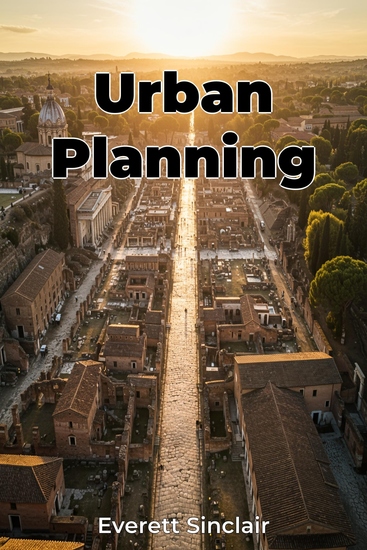
Urban Planning - cover

Urban Planning

Everett Sinclair

Translator A AI

Publisher: Publifye

  • 0
  • 0
  • 0

Summary

Urban Planning explores the historical roots of modern urban design by examining the architectural principles and urban infrastructure of ancient cities. It reveals how ancient civilizations tackled issues like population density and resource management, challenges still pertinent today. The book uniquely highlights the enduring influence of ancient planning on contemporary urban landscapes. For instance, the grid street layouts, found in many modern cities, were first implemented in ancient Mesopotamia. The book progresses from introducing core urban planning concepts, through case studies of Mesopotamia, Egypt, Greece, and Rome, to analyzing specific aspects of ancient urban design. Chapters delve into street layouts, examining grid systems and their impact on traffic flow, and infrastructure, investigating ancient water management. By drawing parallels between ancient practices and modern challenges, the book provides valuable insights for creating sustainable and livable cities. It demonstrates that many contemporary urban innovations have their origins in ancient solutions, adapted over time.
Available since: 03/29/2025.
Print length: 69 pages.

Other books that might interest you

  • Sports and Play - from Civizilation in The United States - cover

    Sports and Play - from...

    Ring W. Lardner

    • 0
    • 0
    • 0
    What does America call play? Mostly watching someone else do it. 
     
    In this sharp and irreverent essay from *Civilization in the United States*, celebrated humorist and sportswriter Ring W. Lardner turns his attention to America’s passionate—and often contradictory—relationship with athletics. 
     
    With baseball stadiums, football fields, boxing arenas, and racetracks packed with spectators, Americans proudly consider themselves a nation devoted to sport. Yet Lardner notices an inconvenient truth: while thousands cheer from the grandstands, comparatively few take part in the games themselves. 
     
    Moving briskly through baseball, football, boxing, horse racing, golf, tennis, and other popular pastimes, Lardner questions whether watching athletes perform provides the physical and mental benefits fans claim. He examines the expense, discomfort, danger, and absurdity surrounding competitive sports while exposing the national habit of transforming players into heroes. 
     
    Beneath the jokes lies a pointed cultural criticism. Why are the grandstands full while the playgrounds remain empty? Why do Americans admire physical achievement more eagerly than they pursue it themselves? And when does recreation become another form of passive consumption? 
     
    First published in 1922, *Sport and Play* is a concise, lively satire of spectator culture, hero worship, leisure, and the American obsession with organized athletics. 
     
    Narrated by John Riddle.
    Show book
  • Themistocles: The Life and Legacy of Ancient Greece’s Greatest General - cover

    Themistocles: The Life and...

    Charles River Editors

    • 0
    • 0
    • 0
    The ancient Greeks have long been considered the forefathers of modern Western Civilization, but the Golden Age of Athens and the spread of Greek influence across much of the known world only occurred due to some of the most crucial battles of antiquity: the Battle of Marathon and the Battle of Salamis. Those battles turned the tide in the Greeks’ favor against the Persians in the Persian Wars and ultimately played a role in Athens’ rise to a preeminent role in the Hellenic world.  
    	No general played a bigger role in the Persian Wars than Themistocles, the Athenian hero who commanded soldiers at both Marathon and Salamis. Both his contemporaries and historians have remembered him as an ambitious, brilliant, and deeply controversial architect of Athens' rise to greatness as the city-state transitioned into the most formidable naval power of the eastern Mediterranean. His career unfolded during an age of extraordinary upheaval, when the expanding Achaemenid Empire threatened the independence of the Greek world, but as crucial a role as he played in those decisive conflicts, he was a major political influence as well.  
    From an early stage in his career, Themistocles recognized the longevity of Athens and its future prosperity would not be secured solely by the hoplite soldiers, but instead by the city's ability to command the sea. The policies he often argued for in the Assembly ultimately laid the foundations for the vast Athenian fleet that later allowed his city-state to dominate the eastern Mediterranean during its Golden Age. But despite being regarded as one of antiquity's greatest figures and a savior in his own right, Themistocles remained an intensely divisive figure even during the era in which he lived. To many Athenians, he was a visionary whose intelligence, leadership and patriotic nature saved not only Athens, but potentially the Greek world from Persian conquest.
    Show book
  • Poor Folk - cover

    Poor Folk

    Fyodor Mikhailovich Dostoyevsky

    • 0
    • 0
    • 0
    Even the quietest voices can tell the most unforgettable stories.
    
    In Poor Folk, Fyodor Dostoevsky introduces readers to a deeply moving tale of human dignity, resilience, and compassion. Told through an intimate exchange of letters, this remarkable novel reveals the emotional lives, hopes, and struggles of ordinary people as they navigate hardship with courage and unwavering humanity.
    
    Blending literary fiction with psychological insight and social realism, Dostoevsky explores timeless themes of poverty, kindness, loneliness, sacrifice, and the need for meaningful human connection. His compassionate storytelling and richly developed characters transform everyday experiences into a powerful reflection on the resilience of the human spirit.
    
    As Dostoevsky's debut novel, Poor Folk announced the arrival of one of literature's greatest voices. Its emotional authenticity, memorable characters, and profound understanding of human nature continue to resonate with readers, making it an enduring favorite among lovers of classic fiction and Russian literature.
    
    Celebrated for its literary significance and heartfelt narrative, Poor Folk established Fyodor Dostoevsky as a major literary talent and remains an essential work of nineteenth-century fiction. Its universal themes and timeless message continue to inspire readers around the world.
    
    Discover the novel that launched one of history's greatest authors. Download Poor Folk today and experience a timeless classic of compassion, hope, and unforgettable storytelling.
    Show book
  • Struggle for Constantinople The: The History of the Battles for the Byzantine Empire’s Capital - cover

    Struggle for Constantinople The:...

    Charles River Editors

    • 0
    • 0
    • 0
    The Byzantine Empire was the heir to two great cultures that cradled and nurtured European civilization: Greece and Rome. Constantinople, now called Istanbul, became a center of power, culture, trade, and technology poised on the edges of Europe and Asia, and its influence was felt not only throughout Europe but the Middle East, Africa, Central Asia, and the Far East. Coins dating from the reign of Emperor Justinian I (r.527-565) have been found in southern India, and Chinese records show that the “Fulin,” as the Chinese named the Byzantines, were received at court as early as 643. For nearly a thousand years, the Byzantine Empire protected Europe from Islamic powers, allowing it to pursue its own destiny, and Byzantium was a polyglot society in which a multitude of ethnic groups lived under the emperor prizing peace above war.  
    	Of course, it wasn’t an accident that Constantinople survived for so long. Walls have protected great civilizations and occasionally been their downfall, and the Byzantine Empire relied on Constantinople’s extensive, sophisticated walls, among the greatest engineering achievements of the ancient world and Early Middle Ages, to survive as long as it did.  
    	The Umayyad Caliphate constantly fought the Byzantines, and on August 15, 717, their formidable army, under the command of General Maslama ibn 'Abd al-Malik, arrived in Thrace and laid siege to the imposing walls of Constantinople. This event, which lasted a full year until August 15, 718, represented the apex of the Islamic expansionist project aimed at definitively eradicating the Byzantine Empire and subjugating its seemingly impregnable capital. 
    The Fourth Crusade from 1202-1204 was significant in medieval history because it was the first time a crusade was directed against another Christian group. It was also significant since it encompassed two of the four major sieges of Constantinople, and it also sparked a third in 1235 (an unsuccessful attempt to reverse the Latin gains in 1204).
    Show book
  • Totemism Tattoo and Fetishism as Forms of Sign Language - Ancient Egypt the Light of the World Book 2 - cover

    Totemism Tattoo and Fetishism as...

    Gerald Massey

    • 0
    • 0
    • 0
    So ancient was Totemism in Egypt that the Totems of the human Mothers had become the signs of Goddesses, in whom the head of the beast was blended with the figure of the human female. The Totems of the human Mothers had attained the highest status as Totems of a Motherhood that was held to be divine, the Motherhood in Nature which was elemental in its origin. –from “Totemism, Tattoo and Fetishism as Forms of Sign Language” It goes unappreciated by modern Egyptologists, but it is embraced by those who savor the concept of a “hidden history” of humanity, and those who approach all human knowledge from the perspective of the esoteric. Gerard Massey’s massive Ancient Egypt: The Light of the World–first published in 1907 and the crowning achievement of the self-taught scholar–redefines the roots of Christianity via Egypt, proposing that Egyptian mythology was the basis for Jewish and Christian beliefs. Here, Cosimo proudly presents Book 2 of Ancient Egypt, in which Massey reads the prehistoric story of human civilization that can be studied in the language of ceremonial rites, ancient customs, and ritual dance, and consequently explores the resultant concept that religion evolved out of expressions of human fertility and sexuality–particularly as embodied in the primeval symbols of blood, sacrifice, and motherhood–and formed the first influences on Judeo-Christianity. Peculiar and profound, this work will intrigue and delight readers of history, religion, and mythology. British author GERALD MASSEY (1828-1907) published works of poetry, spiritualism, Shakespearean criticism, and theology, but his best-known works are in the realm of Egyptology, including A Book of the Beginnings and The Natural Genesis.
    Show book
  • Harpy - A Manifesto for Childfree Women - cover

    Harpy - A Manifesto for...

    Caroline Magennis

    • 0
    • 0
    • 0
    'Harpy is a tonic; a tongue-in-cheek manual for dealing with Spanish Inquisition-style questioning about saying pass to procreation and building an enriching life beyond the nuclear family' VOGUE
    
    
    'Harpy made me nod in recognition, and shake my head with sorrow, and then it made me laugh out loud' EMILIE PINE, author of NOTES TO SELF and RUTH & PEN
    'Defiant, funny and inspiring' SEÁN HEWITT, author of ALL DOWN DARKNESS WIDE
    
    Each generation has more childfree women than the one before. For many, it is an active decision made for a wide range of reasons. Despite this growing trend, we continue to live in a society where women are often judged for deciding to remain childfree - for not conforming to narrow expectations. For being a Harpy.
    
    In this timely and thoughtful book, Caroline Magennis looks beyond the often-divisive conversation around women who choose to be childfree and offers an alternative message of hope and celebration. With humour and intelligence, she explores why motherhood isn't right for everybody and how any woman - whether a parent or childfree - can live a full life, while also reminding the reader that your freedoms and the right to autonomy should never be taken for granted.
    Show book