Join us on a literary world trip!
Add this book to bookshelf
Grey
Write a new comment Default profile 50px
Grey
Subscribe to read the full book or read the first pages for free!
All characters reduced
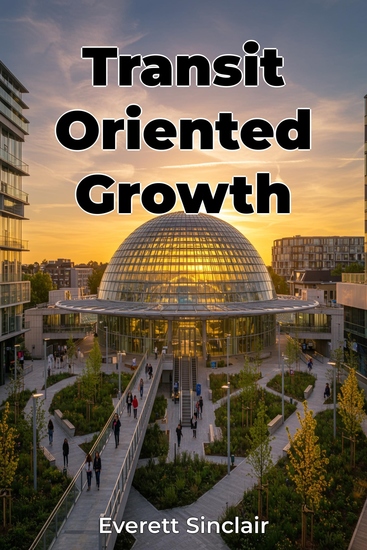
Transit Oriented Growth - cover

Transit Oriented Growth

Everett Sinclair

Translator A AI

Publisher: Publifye

  • 0
  • 0
  • 0

Summary

Transit Oriented Growth explores how integrating transportation infrastructure with urban design can create sustainable and equitable communities. It examines transit-oriented development (TOD) principles, emphasizing walkability, reduced congestion, and enhanced mobility. The book argues for a shift from auto-centric planning to prioritizing public transit, pedestrian, and bicycle infrastructure, addressing urban sprawl and social inequity. It also considers the architecture and political dimensions of policy implementation in the context of these urban transformations.

 
The book begins by tracing urban planning's evolution and introduces TOD principles like mixed-use development and density near transit hubs. Case studies illustrate successful and unsuccessful TOD implementations. For example, TOD can increase property values and reduce transportation costs.

 
It further delves into the social equity implications of TOD, focusing on affordable housing and inclusive community development. The framework presented guides policymakers and planners in implementing TOD strategies by navigating zoning regulations and community engagement. The book draws evidence from urban planning studies, transportation data, and economic assessments, offering a practical guide for creating sustainable cities through effective transit-oriented development.
Available since: 02/21/2025.
Print length: 82 pages.


Other books that might interest you

  • Memoirs of Extraordinary Popular Delusions and the Madness of Crowds Volume 1 - cover

    Memoirs of Extraordinary Popular...

    Charles Mackay

    • 0
    • 0
    • 0
    The book chronicles and vilifies its targets in three parts: "National Delusions", "Peculiar Follies", and "Philosophical Delusions".  
    The subjects of Mackay's debunking include alchemy, beards (influence of politics and religion on), witch-hunts, crusades and duels. Present day writers on economics, such as Andrew Tobias, laud the three chapters on economic bubbles. (summary from wikipedia)
    Show book
  • From The Accession Of Henry The Third To The End Of The Reign Of Richard The Second AD 1216—1399 - cover

    From The Accession Of Henry The...

    Gilbert Abbott À Beckett

    • 0
    • 0
    • 0
    "A fun introduction to English history for those who may find conventional history books dry and tedious... it offers an accessible and enjoyable alternative to more traditional texts." 
    "a delightful blend of history, humor, and art. It provides readers with an entertaining way to learn about England’s past while enjoying the wit and creativity of A. Beckett. Whether you are a history buff or someone looking for a lighthearted approach to learning, this book offers something for everyone." 
    In the third drily hilarious volume of A Comic History Of England, we move forward to the thirteenth century, when a succession of Edwards and Henrys gain the throne and immediately use it to steal everything they can from the population, in order to fund attempts to conquer France (or pay their debts from conquering England). Along the way we get the fabled Black Prince, one of the greatest battles in English history, a queen far more powerful than her king or sons, and a consideration of the manners and condition of the English period up to this point in the history. 
    Covers: 
    Henry The Third, Surnamed Of Winchester. 
    Edward The First, Surnamed Longshanks. 
    Edward The Second, Surnamed Of Caernarvon. 
    Edward The Third. 
    Richard The Second, Surnamed Of Bordeaux. 
    On The Manners, Customs, And Condition Of The People.
    Show book
  • Free Thought and Official Propaganda - cover

    Free Thought and Official...

    Bertrand Russell

    • 0
    • 0
    • 0
    Russell discusses how governments and institutions use propaganda to shape the beliefs and actions of citizens. He argues that propaganda is often used to create a sense of unity and to suppress dissent, rather than to inform and educate the public. This can lead to a situation where people are unwilling or unable to question the status quo, which can be detrimental to the progress of society. Overall, "Free Thought and Official Propaganda" is a powerful critique of the use of propaganda in society and a passionate defence of free thought. It remains a relevant and thought-provoking essay in today's world, where propaganda and the manipulation of information continue to be pressing issues. Read in English, unabridged.
    Show book
  • Risque Business - Breastaurants in American Culture - cover

    Risque Business - Breastaurants...

    Ty Matejowsky

    • 0
    • 0
    • 0
    Risqué Business serves up the breastaurant industry, where food service, sex appeal, identity, and gender politics mix. 
    Risqué Business explores the rise and ongoing cultural reckoning of "breastaurants": sports bar–style restaurants like Hooters and Twin Peaks, which have long relied on the sexualized presentation of female servers to attract a mostly straight, male clientele. Ty Matejowsky, professor of anthropology at the University of Central Florida, is uniquely positioned in America's foundational, breastaurant-saturated landscape. From this vantage, he offers a well-balanced account that draws on pop culture, media analysis, and contemporary gender politics. He delivers a smart, layered analysis of how breastaurants commodify youth and femininity, uphold retrograde masculinity, and serve as symbolic battlegrounds in today's highly charged political environments, including America's deeply polarized Red State/Blue State divide. 
    With case studies, cultural critique, and a critical lens on labor and sexuality, Matejowsky reveals how these restaurants are more than just risqué marketing gimmicks. They reflect deeper anxieties about gender, identity, and the uneasy fusion of sex and service in American consumer culture. Risqué Business is a high-spirited study of an industry that thrives at the intersection of appetite and identity.
    Show book
  • Inquisition - The Reign of Fear - cover

    Inquisition - The Reign of Fear

    Toby Green

    • 0
    • 1
    • 0
    A journey across centuries of religious conflict Toby Green's incredible new book brings a vast panorama to life by focusing on the untold stories of individuals from all walks of life and every section of society who were affected by the Inquisition. From witches in Mexico, bigamists in Brazil, Freemasons, Hindus, Jews, Moslems and Protestants, the Inquisition reached every aspect of society. This history, though filled with stories of terror and the unspeakable ways in which human beings can treat one another, is ultimately one of hope, underscoring the resilience of the human spirit. Stretching from the unification of Spain under Ferdinand and Isabella in the fifteenth century to the Napoleanic wars, The Inquisition details this incredible history in all its richness and complexity.
    Show book
  • Talking to Strangers: What We Need to Understand About Strangers - A Group Discussion - cover

    Talking to Strangers: What We...

    Vines Graener

    • 0
    • 0
    • 0
    For most of history, people lived in small, tight-knit communities where interactions were with familiar faces. But with the Age of Exploration, strangers became a regular part of life. Misunderstandings, amplified by language barriers and cultural differences, were common, and these issues still persist today, even among people who speak the same language. It's easy to make assumptions about how others see the world, and it’s difficult to avoid the biases we carry. 
    Some misunderstandings arise because of lies, and lies can be incredibly difficult to detect. Some deceivers are skilled at hiding their dishonesty, while others may lie poorly, yet still manage to gain people’s trust. It’s not that people are naïve; rather, humans are wired to trust others by default. This tendency, coupled with the belief that we’re good at reading character, often leads us astray. 
    The consequences of misjudging others can be severe—ranging from financial loss and wrongful imprisonment to life-threatening situations. It’s essential to be mindful of the gaps in our understanding and work to see things from others’ perspectives.
    Show book