Join us on a literary world trip!
Add this book to bookshelf
Grey
Write a new comment Default profile 50px
Grey
Subscribe to read the full book or read the first pages for free!
All characters reduced
Revolutionary Architecture Shifts - cover

Revolutionary Architecture Shifts

Everett Sinclair

Translator A AI

Publisher: Publifye

  • 0
  • 0
  • 0

Summary

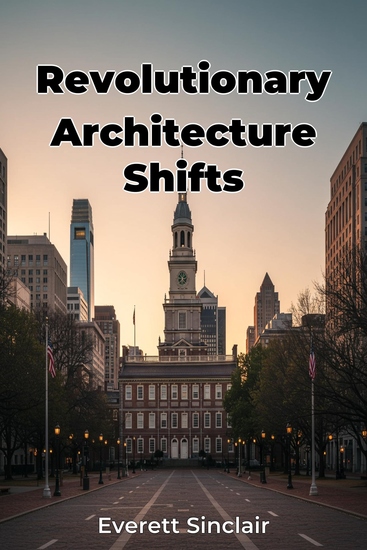
Revolutionary Architecture Shifts explores the profound relationship between political revolutions and architectural design in late 18th-century Paris, London, and Philadelphia. It examines how revolutionary ideals of liberty, equality, and fraternity manifested in urban planning, public buildings, and symbolic design. The book reveals how architecture served as a powerful tool for shaping political ideology and establishing national identity during a period of immense social and intellectual change, such as the Enlightenment. For instance, neoclassical architecture, with its emphasis on order and reason, became a visual representation of these new political concepts. The book uniquely juxtaposes architectural developments in these three distinct cities to highlight the contrasting ways that universal Enlightenment ideals were adapted across different revolutionary contexts.

 
Beginning with an overview of neoclassical architecture and Enlightenment thought, the book dedicates individual sections to Paris, London, and Philadelphia, analyzing specific architectural projects and urban planning initiatives within each city. It culminates in a comparative analysis, highlighting both the common threads and unique divergences in how each city used architecture to reflect its political transformation and to shape its civic identity.
Available since: 02/25/2025.
Print length: 62 pages.
Other books that might interest you

  • Mastering Motivation in the Age of Instant Reward - cover

    Mastering Motivation in the Age...

    Marcus Reed

    • 0
    • 0
    • 0
    Your brain was never built for infinite scroll. Mastering Motivation in the Age of Instant Reward explores the real neuroscience behind dopamine, habit formation, and the modern struggle to stay focused in a world of constant stimulation. Cutting through the myths of “detox culture,” this book explains how dopamine actually works — not as a pleasure chemical, but as the engine of curiosity, learning, and perseverance. It offers a clear, practical framework for rewiring reward systems through deliberate effort, anticipation, and balance, helping you regain control over attention, energy, and purpose. Grounded in modern psychology and motivation science, it’s a guide for anyone seeking meaning in an era of endless distraction — not by rejecting pleasure, but by redefining it.
    Show book
  • I’m in the Army Now - World War 2 Letters of Glenn Max Whitacre - cover

    I’m in the Army Now - World War...

    Martin Whitacre

    • 0
    • 0
    • 0
    These letters were discovered in an Army Air Force footlocker after being locked away for almost 80 years. Follow the story of one World War 2 Army Air Force soldier, Glenn Max Whitacre, from Bowling Green Ohio through basic training, schooling, combat prep, and into battle. He wrote home almost every day to keep in touch with his family, his friends, and the girl he loved. While also sharing details of everyday military life, as he prepares for, and eventually enters into the battle. These letters create a story not only about one young man’s military service, but about life in America during the 1940’s. When the world was at war. And the greatest generation put everything aside to fight and, if necessary, die for their country. 
    Volume 1 – Include letters from induction, through basic training, Radio Operator/Mechanic School, and Gunnery School. At which time he’s granted his much anticipated Furlough home. 
    Volume 2 - Include all remaining letters during flight and combat training, as well as his travels overseas, combat missions, and an unfortunate sudden end to the correspondence’.
    Show book
  • Integrate your inner child Recovery from childhood trauma Meditation Courses & Coaching Sessions - reparent your little one overcome childhood neglect abandonment reconnect self-love - cover

    Integrate your inner child...

    Love, And, Bloom

    • 0
    • 0
    • 0
    Sometimes in childhood, we may accumulate anger sadness, or feel emotional neglect when our needs were not met. This may result from the loss of connections in our identity. We felt anger disappointment or possibly rage.  
    We will use a meditation session to release the feeling of shame. It takes a conscious healing method to repair our little one inside. There may be hidden feelings that we have not been aware of.  
    Then, we will have a deep integration process work. We find our true identity and let our little one once again express the pain and sadness. We let them shine and be playful. We are no longer at war with ourselves reacting to the old programs and past coping mechanisms. 
    Show book
  • How to Grieve - An Ancient Guide to the Lost Art of Consolation - cover

    How to Grieve - An Ancient Guide...

    Marcus Tullius Cicero

    • 0
    • 0
    • 0
    An engaging new translation of a timeless masterpiece about coping with the death of a loved one 


    In 45 BCE, the Roman statesman Cicero fell to pieces when his beloved daughter, Tullia, died from complications of childbirth. But from the depths of despair, Cicero fought his way back. In an effort to cope with his loss, he wrote a consolation speech—not for others, as had always been done, but for himself. And it worked. Cicero's Consolation was something new in literature, equal parts philosophy and motivational speech. Drawing on the full range of Greek philosophy and Roman history, Cicero convinced himself that death and loss are part of life, and that if others have survived them, we can, too; resilience, endurance, and fortitude are the way forward. 


    Lost in antiquity, Cicero's Consolation was recreated in the Renaissance from hints in Cicero's other writings and the Greek and Latin consolatory tradition. The resulting masterpiece—translated here for the first time in 250 years—is infused throughout with Cicero's thought and spirit. 


    Complete with an inviting introduction, Michael Fontaine's engaging translation makes this searching exploration of grief available to readers once again.
    Show book
  • Tao Te Ching - A New English Version - cover

    Tao Te Ching - A New English...

    Anonymous

    • 0
    • 0
    • 0
    In 81 brief chapters, Lao-Tzu's Tao Te Ching, or Book of the Way, provides advice that imparts balance and perspective, a serene and generous spirit, and teaches us how to work for the good with the effortless skill that comes from being in accord with the Tao—the basic principle of the universe.  
    Stephen Mitchell's bestselling version has been widely acclaimed as a gift to contemporary culture.
    Show book
  • Egyptian Science and Mathematics - Innovations of an Ancient Civilization - cover

    Egyptian Science and Mathematics...

    Omar Khalil

    • 0
    • 0
    • 0
    Egyptian civilization, one of the oldest in human history, made extraordinary contributions to various fields of knowledge, particularly science and mathematics. These innovations, which spanned thousands of years, helped shape the development of ancient society and continue to influence modern science and mathematics. In ancient Egypt, knowledge was not merely a tool for survival but an integral part of their spiritual and practical lives. From monumental structures like the pyramids to advancements in medicine and astronomy, Egyptian science and mathematics were not just theoretical pursuits; they were embedded in the daily lives of the people and their understanding of the world around them. 
    The ancient Egyptians developed a deep understanding of the natural world, building complex systems of mathematics and science that were essential for both practical and religious purposes. The sciences of astronomy, engineering, and medicine, along with an elaborate system of mathematics, formed the backbone of their civilization. These scientific endeavors were often linked to the Egyptians' strong religious beliefs, which saw the cosmos, time, and the earth as interconnected and governed by divine forces. This understanding led to the creation of highly sophisticated technologies and systems, such as the construction of the pyramids, the development of early medicine, and the creation of accurate calendars for agricultural and religious purposes.
    Show book