Join us on a literary world trip!
Add this book to bookshelf
Grey
Write a new comment Default profile 50px
Grey
Subscribe to read the full book or read the first pages for free!
All characters reduced
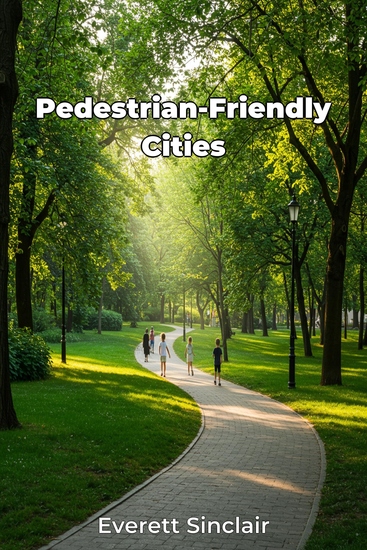
Pedestrian-Friendly Cities - cover

Pedestrian-Friendly Cities

Everett Sinclair

Translator A AI

Publisher: Publifye

  • 0
  • 0
  • 0

Summary

Pedestrian-Friendly Cities explores the crucial role of walkability in modern urban planning, arguing that prioritizing pedestrian-centered design enhances public health, environmental sustainability, and community revitalization. It challenges the car-centric planning of the 20th century, which led to sprawling suburbs and a decline in walkable neighborhoods, and demonstrates that consciously designing for pedestrians can significantly improve urban life.

 
Cities were historically pedestrian-friendly, offering lessons for today's urban planners seeking to create more livable spaces. The book examines design strategies like mixed-use zoning and traffic calming, presenting case studies of successful pedestrian-friendly cities. It demonstrates how prioritizing walking can lead to longer, healthier lives for residents and stronger community bonds.

 
By integrating architecture with public health considerations, the book offers a holistic perspective, emphasizing that creating walkable cities involves more than just sidewalks; it requires a fundamental shift in urban planning philosophy. Beginning with foundational concepts, the book progresses to analyze specific design strategies, concluding with a practical guide for implementing pedestrian-friendly principles.

 
It addresses the interconnectedness of urban design, individual well-being, and environmental sustainability, making it a valuable resource for urban planners, policymakers, and community advocates aiming to create thriving, resilient urban environments.
Available since: 03/04/2025.
Print length: 95 pages.

Other books that might interest you

  • Strange Ocean Facts That Will Put You To Sleep - cover

    Strange Ocean Facts That Will...

    Melanie Roach

    • 0
    • 0
    • 0
    Immerse yourself in a tranquil sleep aid that uses low-stakes marine biology to silence insomnia and induce rest. Designed specifically for a restless mind seeking relief from night-time anxiety, this audio experience creates a drowsy, hypnotic atmosphere essential for a healthy bedtime routine.
     
    Discover a cure for wakefulness through:
    
    Curious but unstimulating facts about drifting marine life and coral structures.
    Soft, circular narratives that mimic the soothing sensation of rocking waves.
    A continuous stream of calming imagery designed to let attention fade.
    Rhythmic language that functions like verbal white noise for deep relaxation.
    
     
    Allow your thoughts to loosen their grip on the day as the narrative moves seamlessly from the water's surface to the dark, peaceful ocean floor. Float through this gentle exploration until the steady turning of the planet lulls you into a restorative slumber.
    Show book
  • The Science of The Mandalorian - cover

    The Science of The Mandalorian

    Mark Brake

    • 0
    • 0
    • 0
    Take a trip beyond this Earth to explore the myths of The Mandalorian and uncover the anatomy of the newest space western in the Star Wars Universe. Star Wars dominates the film world. The combined box office revenue of the Star Wars movies equates to over $10 billion, making it the second highest-grossing film franchise of all time. But this franchise is no blaster from the past. Its fantastically successful films have now been followed by multiple television series set in that same galaxy far, far away. The franchise’s flagship television series, and likely the firmest fan favorite for some time to come, is The Mandalorian. Tracing the tale of the titular bounty hunter, traveling across the furthest reaches of that mythic galaxy, The Mandalorian has been greatly praised and highly acclaimed for creating characters with gravitas and originality, worlds with depth and impact, resulting in some of the best Star Wars content ever. Even though it’s set in deep space, The Mandalorian has as much in common with Western movies as it does with science fiction. Saloons. Bandits. “Gun” duels. Bounty hunters. Outlaws with a price on their heads. Space exploration as a “final frontier.” And a wild hero who doesn’t quite belong in a lawless part of the Galaxy after the fall of Empire. The Science of The Mandalorian takes you on a badass journey with a mysterious, lone gunfighter in the outer reaches of the galaxy, where your beskar armor will protect you from many things, but not the sight of a small, green, carnivorous humanoid with big black eyes and mysterious powers. This is the way.
    Show book
  • New Menopausal Years - The Wise Woman Way by Susun Weed - cover

    New Menopausal Years - The Wise...

    Susun Weed

    • 0
    • 0
    • 0
     Recommended for women 30-90. This lively session expands upon Susun’s incredibly popular book, New Menopausal Years The Wise Woman Way, the menopause “bible” for millions of women. What your doctor doesn’t know about menopause is here, in simple language. If you want to be strong-boned, hale-hearted and juicy for another 50 years, this talk is for you! 
     
    Susun Weed is the voice of the Wise Woman Tradition and director of the Wise Woman Center in Woodstock, NY. She is a grandmother of herbal medicine. She is the author of Wise Woman Herbal for the Childbearing Years, Healing Wise, New Menopausal Years - The Wise Woman Way, and Breast Cancer? Breast Health! Susun is an internationally renowned teacher with an encyclopedic knowledge of herbs and health. Visit www.susunweed.com. 
    Show book
  • Methuselah's Zoo - What Nature Can Teach Us about Living Longer Healthier Lives - cover

    Methuselah's Zoo - What Nature...

    Steven N. Austad

    • 0
    • 0
    • 0
    Opossums in the wild don't make it to the age of three; our pet cats can live for a decade and a half; cicadas live for seventeen years. Whales, however, can live for two centuries and tubeworms for several millennia. Meanwhile, human life expectancy tops out around the mid-eighties, with some outliers living past 100 or even 110. Is there anything humans can learn from the exceptional longevity of some animals in the wild? In Methusaleh's Zoo, Steven Austad tells the stories of some extraordinary animals, considering why, for example, animal species that fly live longer than earthbound species and why animals found in the ocean live longest of all. 


    Austad—the leading authority on longevity in animals—argues that the best way we will learn from these long-lived animals is by studying them in the wild. Accordingly, he proceeds habitat by habitat, examining animals that spend most of their lives in the air, comparing insects, birds, and bats; animals that live on, and under, the ground—from mole rats to elephants; and animals that live in the sea. 


    Humans have dramatically increased their lifespan with only a limited increase in healthspan; we're more and more prone to diseases as we grow older. By contrast, these species have successfully avoided both environmental hazards and the depredations of aging. Can we be more like them?
    Show book
  • Structuring Inequality - How Schooling Housing and Tax Policies Shaped Metropolitan Development and Education - cover

    Structuring Inequality - How...

    Tracy L. Steffes

    • 0
    • 0
    • 0
    How inequality was forged, fought over, and forgotten through public policy in metropolitan Chicago. As in many American metropolitan areas, inequality in Chicagoland is visible in its neighborhoods. These inequalities are not inevitable, however. They have been constructed and deepened by public policies around housing, schooling, taxation, and local governance, including hidden state government policies.In Structuring Inequality, historian Tracy L. Steffes shows how metropolitan inequality in Chicagoland was structured, contested, and naturalized over time even as reformers tried to change it through school desegregation, affordable housing, and property tax reform. While these efforts had modest successes in the city and the suburbs, reformers faced significant resistance and counter-mobilization from affluent suburbanites, real estate developers, and other defenders of the status quo who defended inequality and reshaped the policy conversation about it. Grounded in comprehensive archival research and policy analysis, Structuring Inequality examines the history of Chicagoland’s established systems of inequality and provides perspective on the inequality we live with today.
    Show book
  • Handbook of Health in War and Peace - A Manual of Personal Preparedness - cover

    Handbook of Health in War and...

    Charles Edward Amory Winslow

    • 0
    • 0
    • 0
    This book is a comprehensive guide that educates individuals on how to maintain good health and hygiene during times of war and peace. It deals a lot with personal health and hygiene. Amazingly enough much of the information hasn't changed since this was published in 1917. It is a great resource for students, healthcare professionals, and anyone interested in improving their personal health and hygiene.
    Show book