Join us on a literary world trip!
Add this book to bookshelf
Grey
Write a new comment Default profile 50px
Grey
Subscribe to read the full book or read the first pages for free!
All characters reduced
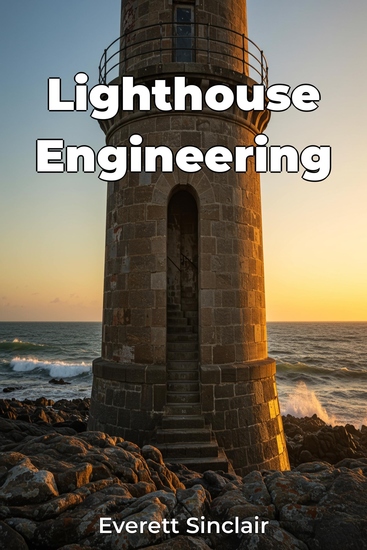
Lighthouse Engineering - cover

Lighthouse Engineering

Everett Sinclair

Translator A AI

Publisher: Publifye

  • 0
  • 0
  • 0

Summary

Lighthouse Engineering explores the captivating history and complex engineering behind maritime beacons, from simple signal fires to advanced automated systems. These structures, designed to withstand extreme conditions, showcase a blend of art and science. Lighthouses have evolved significantly; for instance, the development of Fresnel lenses dramatically improved light visibility, and modern LED lighting offers unprecedented efficiency. The book examines structural integrity, light-source technology, and automation, illustrating how lighthouse advancements mirror broader progress in engineering and materials science. 

 
Early chapters focus on fundamental design principles and construction methods. Later sections detail the evolution of light sources, from basic fires to electric lights, and the integration of remote monitoring and solar power. Case studies and historical records support the narrative.

 
 Uniquely, the book combines technical details with historical context, presenting a comprehensive view suitable for engineers, architects, and anyone interested in the intersection of technology and architecture. It emphasizes the interplay between human ingenuity and environmental challenges, highlighting adaptations necessary for the marine environment. The book progresses logically, building from foundational concepts to modern innovations, offering practical insights for coastal infrastructure and historical appreciation.
Available since: 02/20/2025.
Print length: 68 pages.
Other books that might interest you

  • Paul Cézanne - Still Lifes of Pure Thought - cover

    Paul Cézanne - Still Lifes of...

    Élie Faure

    • 0
    • 0
    • 0
    Cézanne was perhaps the most complex artist of the 19th century. One of the greatest of the Postimpressionists, his works and ideas were crucial to the aesthetic development of many 20th-century artists and art movements, especially Cubism.
    Cézanne's ambition, in his own words, was "to make out of Impressionism something as solid and durable as the paintings of the museums". He aimed to achieve the monumental in a modern language of glowing, vibrating tones. Cézanne wanted to retain the natural colour of an object and to harmonize it with the various influences of light and shade trying to destroy it; to work out a scale of tones expressing the mass and character of the form.
    Show book
  • The Lighthouse Cat - A Tale of Light Courage and the Sea - cover

    The Lighthouse Cat - A Tale of...

    Wren Maplehart

    • 0
    • 0
    • 0
    The Lighthouse Cat: A Tale of Light, Courage, and the Sea 
     In a quiet lighthouse perched on a storm-tossed cliff, where the waves crash and the winds whisper forgotten stories, lives a small but fearless feline named Nixie. Guardian of the lantern and silent watcher of the tides, Nixie isn’t just any cat—she holds a secret as old as the sea itself. 
    When a fierce tempest threatens to swallow a nearby village and the lighthouse keeper goes missing, it’s up to Nixie to brave the storm. Guided by instinct, memory, and the flickering flame of the beacon above, she embarks on a heart-pounding journey across treacherous rocks, haunted shores, and crashing waves. 
    Blending the charm of classic animal tales with the lyrical beauty of maritime folklore, The Lighthouse Cat is a timeless story of courage in the face of darkness, the enduring power of light, and the mysterious bond between the sea and those who call it home. 
    Perfect for readers young and old, this is a tale that will warm hearts, stir imaginations, and remind us all that even the smallest among us can shine the brightest light.
    Show book
  • Vincent van Gogh - Sunflowers and Silence - the Intensity of Being - cover

    Vincent van Gogh - Sunflowers...

    Victoria Charles

    • 0
    • 0
    • 0
    Vincent van Gogh's life and work are so intertwined that it is hardly possible to observe one without thinking of the other. Van Gogh has indeed become the incarnation of the suffering, misunderstood martyr of modern art, the emblem of the artist as an outsider. An article, published in 1890, gave details about van Gogh's illness. The author of the article saw the painter as "a terrible and demented genius, often sublime, sometimes grotesque, always at the brink of the pathological." Very little is known about Vincent's childhood. At the age of eleven he had to leave "the human nest", as he called it himself, for various boarding schools. The first portrait shows us van Gogh as an earnest nineteen year old. At that time he had already been at work for three years in The Hague and, later, in London in the gallery Goupil & Co. In 1874 his love for Ursula Loyer ended in disaster and a year later he was transferred to Paris, against his will. After a particularly heated argument during Christmas holidays in 1881, his father, a pastor, ordered Vincent to leave. With this final break, he abandoned his family name and signed his canvases simply "Vincent". He left for Paris and never returned to Holland. In Paris he came to know Paul Gauguin, whose paintings he greatly admired. The self-portrait was the main subject of Vincent's work from 1886c88. In February 1888 Vincent left Paris for Arles and tried to persuade Gauguin to join him. The months of waiting for Gauguin were the most productive time in van Gogh's life. He wanted to show his friend as many pictures as possible and decorate the Yellow House. But Gauguin did not share his views on art and finally returned to Paris. On 7 January, 1889, fourteen days after his famous self-mutilation, Vincent left the hospital where he was convalescing. Although he hoped to recover from and to forget his madness, but he actually came back twice more in the same year. During his last stay in hospital, Vincent painted landscapes in which he recreated the world of his childhood. It is said that Vincent van Gogh shot himself in the side in a field but decided to return to the inn and went to bed. The landlord informed Dr Gachet and his brother Theo, who described the last moments of his life which ended on 29 July, 1890: "I wanted to die. While I was sitting next to him promising that we would try to heal him. [...], he answered, 'La tristesse durera toujours (The sadness will last forever).'"
    Show book
  • Ahae Gangster Patron - Gangster Patron - cover

    Ahae Gangster Patron - Gangster...

    Bernard Hasquenoph

    • 0
    • 0
    • 0
    April 2014: A ship sinks in South Korea, killing nearly 300 people.
    2013: A Korean amateur photographer exhibits in Versailles.
    August 1987: 32 members of the Korean Odaeyang sect are found dead.
     
    The link between these facts? It was Bernard Hasquenoph who discovered it. Intrigued by the success of Ahae, the pseudonym of the amateur photographer, he leads the investigation and is the first to reveal the true identity of the Korean artist, billionaire and patron of the arts, entrepreneur and guru, with a vast and well-established network of influence. And the further he investigated, the more obscure and unbelievable the revelations became.
    Through the portrait of one man, we plunge into a mafia world with unexpected ramifications, such as international cultural patronage, which brings into question the value of art and the probity of those in charge of it.
    Show book
  • Epic Secrets Behind the Fall of a Great Empire - "Dive into the epic tales of a great empire's fall through immersive audio lessons that captivate and educate!" - cover

    Epic Secrets Behind the Fall of...

    Cyrus Remington

    • 0
    • 0
    • 0
    Epic Secrets Behind the Fall of a Great Empire 
    ⭐⭐ Simplified Audio Guide with Explanations ⭐⭐ 
    Are you eager to advance in your career and deepen your understanding by uncovering the lessons from the past that can inspire your future? 
    Searching for a thorough guide that encompasses all the essential elements to unlock historical wisdom and provide motivation for growth? 
    Your quest ends here! 
    This guide is your ultimate companion for enriching your knowledge, honing your skills, and engaging in practical exercises. With this resource at your side, you're set for success. 
    Updated for the latest insights and frameworks for 2024-2025. 
    Key features of this enhanced guide: 
    - In-depth insights about the lessons from history that can inspire your future 
    - Comprehensive explanations that draw from historical narratives 
    - Effective strategies for applying these lessons in your life 
    Our guide stands out due to its exhaustive approach, which is crucial for your intellectual triumph. Concepts are not just touched upon; they are examined in detail. 
    Crafted with a clear structure and easy-to-understand language, our guide ensures seamless transitions between subjects. Say goodbye to convoluted terminology and embrace content that is clear, accurate, and insightful. 
    So, why hesitate? Click the BUY NOW button, secure your guide, and embark on your journey to unlocking the profound lessons from history that will inspire your future! 
    Embark on a transformative journey through history today!
    Show book
  • Mastering Film & Animation Pitches - Effective Strategies to Sell Your Scripts and Capture Industry Attention - cover

    Mastering Film & Animation...

    Virversity Online Courses

    • 0
    • 0
    • 0
    This course equips aspiring filmmakers and animators with essential skills to craft and deliver compelling pitches that capture attention and secure opportunities. By mastering pitching, students will boost confidence, storytelling abilities, and industry knowledge to present projects successfully.Learn film and animation industry fundamentals, including key roles and processes. Develop captivating narratives with scriptwriting techniques focused on structure, character, and dialogue. Understand your audience through market research to tailor pitches effectively. Create clear, persuasive messages supported by engaging visual aids and well-designed pitch decks.Gain practical skills in negotiation, legal rights, and relationship-building to confidently sell your projects. Explore real-world case studies revealing what makes pitches and script sales successful. Build resilience to handle rejection, use feedback constructively, and network strategically within the industry.Starting with a solid industry foundation, the course guides you through storytelling fundamentals to craft narratives that resonate. Learn to develop pitches that highlight your project’s value and stand out in a competitive market. Emphasis on visual aids ensures presentations engage potential investors or collaborators.Beyond pitching, the course covers selling strategies, protecting your work with contracts, and building meaningful industry relationships. Case studies provide insight into effective real-world strategies. Emotional tools help you handle rejection with resilience and leverage feedback for growth.By course end, you’ll have a comprehensive toolkit for confident pitching—from storytelling and presentation to navigating the industry—enabling you to turn creative ideas into tangible film and animation opportunities with clarity and professionalism.(1,754 characters)
    Show book