Join us on a literary world trip!
Add this book to bookshelf
Grey
Write a new comment Default profile 50px
Grey
Subscribe to read the full book or read the first pages for free!
All characters reduced
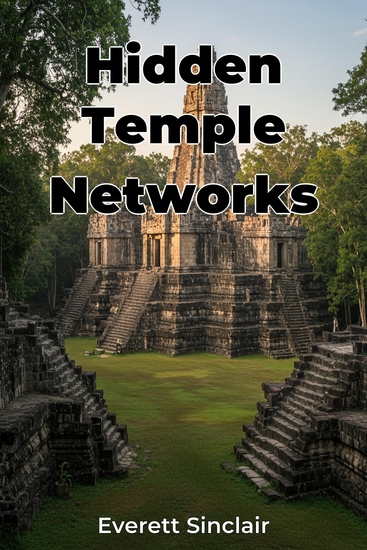
Hidden Temple Networks - cover

Hidden Temple Networks

Everett Sinclair

Translator A AI

Publisher: Publifye

  • 0
  • 0
  • 0

Summary

"Hidden Temple Networks" unveils the fascinating interconnectedness of ancient temple complexes, revealing them not as isolated structures but as vital networks shaping past societies. These temple networks, often featuring subterranean passageways, served as conduits for religious processions, knowledge dissemination, and cultural exchange. The book explores how architecture, history, and religious practices intertwined within these physical spaces, reinforcing the social and spiritual order of ancient civilizations.

 
By examining temple networks across diverse cultures, including Mesoamerica and Southeast Asia, the book uncovers the deliberate design behind these complexes. It demonstrates how their layouts and construction techniques embodied cosmological beliefs and power structures, reflecting a universal human impulse to create sacred spaces. The book challenges conventional interpretations by emphasizing the interconnectedness of these sacred spaces, offering a comprehensive understanding of ancient cultures from an Art History, Religious Studies, and Anthropology perspective.

 
The book progresses by first introducing the concept of temple networks, then focusing on specific geographical regions to analyze architectural features, symbolic elements, and historical context. This approach, drawing on archaeological evidence and historical texts, highlights the significance of these networks in understanding ancient civilizations.

 
The book uniquely emphasizes the interconnectedness of temple complexes, providing a more holistic view of ancient cultures.
Available since: 03/04/2025.
Print length: 86 pages.


Other books that might interest you

  • Plato's Cave - Philosophy's First Reality Show - cover

    Plato's Cave - Philosophy's...

    Sophia Blackwell

    • 0
    • 0
    • 0
    Ever wondered why a rich Athenian who died 2,400 years ago still dominates Western thought? Or why your professor keeps talking about invisible triangles and prisoners staring at shadows? "Plato's Cave: Philosophy's First Reality Show" is the hilarious guide to Plato you never knew you needed. 
    In this irreverent takedown of philosophy's founding father, author Sophia Blackwell translates Plato's lofty ideas into actual human language while mercilessly mocking his metaphysical obsessions, aristocratic biases, and suspicious fondness for "perfect forms." 
    You'll discover: 
    Why the Cave Allegory is history's most elaborate way of calling everyone else stupid 
    How Plato convinced generations that imaginary triangles are more real than actual ones 
    Why "platonic relationship" means the exact opposite of what Plato intended 
    How one failed playwright created Western philosophy's most successful PR smear campaign 
    Why we're still arguing about the same questions 2,400 years later 
    Perfect for philosophy students suffering through required reading, professors with a sense of humor, or anyone who's ever wondered why we care what a privileged Athenian thought about reality. "Plato's Cave" proves that understanding philosophy doesn't have to be painful—though Plato himself might disagree. 
    Buy now and escape the cave of philosophical confusion! No prior knowledge required—just a willingness to laugh at one of history's most influential thinkers. 
    Part of the bestselling "Cogito Ergo Nope!" series that makes philosophy accessible without being condescending and funny without sacrificing accuracy.
    Show book
  • Representative Democracy - A Justification - cover

    Representative Democracy - A...

    Dimitri Landa, Ryan Pevnick

    • 0
    • 0
    • 0
    Despite the not-so-distant invocations of the "end of history," representative democracy is, today, under siege even from corners where one once might have expected strong sympathy and support. Indeed, confidence in representative democracy has, in recent years, been shaken by the economic and political performance of many such regimes. 
     
    Representative Democracy explains why the definitive institutional features of representative democracy—the electoral selection of policymaking officials who are independent in the interim between elections—are attractive relative to salient alternatives (including direct democracy, lottery-based systems, and meritocratic alternatives) and, relatedly, why it is a distinctively attractive institutional arrangement, rather than—as it is often perceived to be—a pale stand-in for more robust and genuine forms of democratic government. Building on novel arguments that connect the distinctive institutional features of representative democracy to important epistemic and stability-based benefits, the book provides a normative account of a well-functioning system of representative democracy against which proposed reforms can be evaluated.
    Show book
  • The Sacred Canopy - Elements of a Sociological Theory of Religion - cover

    The Sacred Canopy - Elements of...

    Peter L. Berger

    • 0
    • 0
    • 0
    "The most important contribution to the sociology of religion since Max Weber's The Protestant Ethic and the Spirit of Capitalism" (Commonweal). 


    Acclaimed scholar and sociologist Peter L. Berger carefully lays out an understanding of religion as a historical, societal mechanism in this classic work of social theory. Berger examines the roots of religious belief and its gradual dissolution in modern times, applying a general theoretical perspective to specific examples from religions throughout the ages. Building upon the author's previous work, The Social Construction of Reality, with Thomas Luckmann, this book makes Berger's case that human societies build a "sacred canopy" to protect, stabilize, and give meaning to their worldview.
    Show book
  • The Brexit Referendum - The UK's EU Departure - cover

    The Brexit Referendum - The UK's...

    Nova Ashford

    • 0
    • 0
    • 0
    The Brexit referendum, which took place on June 23, 2016, marked a pivotal moment in the history of the United Kingdom and its relationship with the European Union. The decision to leave the EU, known as Brexit, came after years of mounting debate and growing division within British society and politics. The referendum was the result of a long-standing debate over the UK’s membership in the European Union, with political, economic, and cultural tensions playing a central role in shaping the outcome. 
    The road to Brexit began long before the referendum vote. The United Kingdom joined the European Economic Community (EEC) in 1973, a precursor to the European Union, and since then, the nation’s relationship with the organization has been fraught with disagreement. Euroscepticism, or skepticism about the benefits of EU membership, had been steadily rising, particularly among certain political groups and sections of the public. Critics of the EU argued that membership undermined national sovereignty and that the UK was bound by regulations and policies that did not align with its interests. This sentiment was exacerbated by issues such as immigration, trade regulations, and the financial burden of contributing to the EU budget. 
    In the years leading up to the referendum, the political landscape of the UK began to shift. The rise of UKIP (the United Kingdom Independence Party), led by Nigel Farage, brought the issue of EU membership into sharper focus. UKIP’s success in the 2014 European Parliament elections, where it emerged as the largest UK party, put pressure on the Conservative Party to address the growing concerns over the EU. Prime Minister David Cameron, seeking to quell dissent within his own party and avoid a potential electoral challenge from UKIP, promised a referendum on EU membership in 2013. This pledge set the stage for the referendum that would ultimately decide the UK’s fate within the EU.
    Show book
  • The Leading Ladies at The School - cover

    The Leading Ladies at The School

    Andi Sulistiadi

    • 0
    • 0
    • 0
    The characteristics of school leaders who are appointed merely on the instructions of their superiors differ significantly from those of principals who enter the profession out of a deep sense of calling. Leaders appointed by directive often carry out their responsibilities as an obligation or administrative duty, focusing primarily on compliance and fulfilling external expectations. Their authority is derived from positional power rather than intrinsic motivation. In contrast, school principals who assume their role on the basis of personal calling demonstrate a greater sense of commitment, passion, and responsibility for the growth of both students and teachers. Their leadership is not confined to administrative functions but extends to fostering a vision, building a positive culture, and inspiring others. The difference becomes evident in the way they make decisions, manage challenges, and build relationships within the school community. Ultimately, this divergence can be traced back to their initial motivations: while one group enters education out of necessity or appointment, the other chooses the path because of a genuine dedication to the educational mission. The women in this book remind us that leadership is not about power, it is not about status,  it is about service, it is about the courage to balance logic with compassion. Through their vision, education is transformed.
    Show book
  • Transcendence and Liberation - cover

    Transcendence and Liberation

    Ralph Waldo Emerson

    • 0
    • 0
    • 0
    Ralph Waldo Emerson was an American essayist, lecturer, philosopher, abolitionist, and poet who led the transcendentalist movement of the mid-19th century. He was seen as a champion of individualism and a prescient critic of the countervailing pressures of society, and his ideology was disseminated through dozens of published essays and more than 1,500 public lectures across the United States. 
     
    Emerson gradually moved away from the religious and social beliefs of his contemporaries, formulating and expressing the philosophy of transcendentalism in his 1836 essay "Nature". Following this work, he gave a speech entitled "The American Scholar" in 1837, which Oliver Wendell Holmes Sr. considered to be America's "intellectual Declaration of Independence." 
     
    Emerson wrote most of his important essays as lectures first and then revised them for print. His first two collections of essays, Essays: First Series and Essays: Second Series, represent the core of his thinking. They include the well-known essays "Self-Reliance", "The Over-Soul", "Circles", "The Poet", and "Experience." Together with "Nature", these essays made the decade from the mid-1830s to the mid-1840s Emerson's most fertile period. Emerson wrote on a number of subjects, never espousing fixed philosophical tenets, but developing certain ideas such as individuality, freedom, the ability for mankind to realize almost anything, and the relationship between the soul and the surrounding world. Emerson's "nature" was more philosophical than naturalistic: "Philosophically considered, the universe is composed of Nature and the Soul." Emerson is one of several figures who "took a more pantheist or pandeist approach by rejecting views of God as separate from the world."
    Show book