Join us on a literary world trip!
Add this book to bookshelf
Grey
Write a new comment Default profile 50px
Grey
Subscribe to read the full book or read the first pages for free!
All characters reduced
Floating Roads - cover

Floating Roads

Everett Sinclair

Translator A AI

Publisher: Publifye

  • 0
  • 0
  • 0

Summary

Floating Roads explores the cutting-edge intersection of architectural design and technology in bridge construction and floating highway systems, examining how these innovations are revolutionizing modern transportation. These structures facilitate the connection of previously isolated regions. The book highlights how floating bridges offer practical solutions for spanning deep or unstable bodies of water, pushing past traditional bridge limitations. The book emphasizes the use of advanced materials like high-performance concrete and composite materials. It also covers innovative structural designs to enhance stability. Addressing environmental impact, it advocates for sustainable practices in infrastructure development. Through case studies and engineering reports, the book illustrates practical applications and key lessons learned, providing insights into their performance over time. The book progresses from fundamental concepts to detailed analyses of construction techniques, dedicating sections to environmental impact and case studies. Integrating civil engineering, architecture, materials science, and environmental science, it offers a comprehensive understanding for engineers, architects, urban planners, and anyone interested in sustainable transportation solutions.
Available since: 03/12/2025.
Print length: 78 pages.

Other books that might interest you

  • IGNOU PGDCA Second Semester Previous Years Unsolved Papers - cover

    IGNOU PGDCA Second Semester...

    Manish Soni

    • 0
    • 0
    • 0
    The Book has been carefully curated to serve as an essential resource for students enrolled in the Post Graduate Diploma in Computer Applications (PGDCA) program at IGNOU. This book is a comprehensive compilation of previous years' theory papers for all Semester 2 subjects, designed to offer students a practical and thorough preparation tool for their exams. 
    The PGDCA program is known for its rigorous curriculum, covering fundamental and advanced topics in computer science, programming, software development, and applications. With the growing demand for skilled professionals in the field of information technology, this diploma equips students with the knowledge and skills required to excel in the industry. However, mastering the concepts and successfully navigating through the examinations is no easy feat, and that is where this book aims to assist. The primary goal of this book is to help students gain a deeper understanding of the core subjects taught in Semester 2 of the PGDCA program. By providing access to unsolved theory papers from previous years, this book serves as a valuable tool for students to practice and refine their problem-solving skills, improve their understanding of key concepts, and become familiar with the format and structure of the IGNOU examinations.
    Show book
  • Manifesto for the Revitalisation of Cities - A Solution to Portugal's Housing Crisis - cover

    Manifesto for the Revitalisation...

    Miguel Rebelo

    • 0
    • 0
    • 0
    The housing crisis in Portugal serves to illustrate a problem that has implications beyond the borders of the country, shedding light on challenges that are faced by major European and global cities. The rise in housing prices, driven by real estate speculation, the growth of tourism and the influx of foreign investment, has made it increasingly challenging for many in the population, especially the middle and lower classes, to access home ownership or renting. 
    The digitalisation of work has opened the possibility for highly qualified professionals to consider where they would like to live, regardless of the physical location of their job. Cities like Lisbon and Porto have become increasingly attractive destinations, offering a good quality of life combined with a range of professional opportunities. Nevertheless, this phenomenon has placed additional strain on the real estate market, leading to rising prices and the displacement of residents to the outskirts. 
    The housing policies that have been adopted thus far have not been as effective as might have been hoped, and in some cases may even have had the opposite effect. It seems that measures such as strict rent control, poorly targeted subsidies and the massive construction of new housing without proper urban and infrastructural planning have not solved the problem, and in some cases may have made it worse. Perhaps it would be beneficial to reconsider these approaches, acknowledging their shortcomings and adapting them to reflect the current situation. 
    It may be worth considering rehabilitating vacant buildings as a viable and sustainable solution. By restoring existing buildings, we can explore ways to increase the supply of affordable housing, revitalise run-down urban areas and preserve historical and cultural heritage to promote more inclusive and sustainable cities.
    Show book
  • The Artifice of Intelligence - Divine and Human Relationship in a Robotic Age - cover

    The Artifice of Intelligence -...

    Noreen Herzfeld, Ted Peters

    • 0
    • 0
    • 0
    AI is becoming ubiquitous. Whatever its arrival portends for our future, whether riches or ruin, it cannot be avoided. The Artifice of Intelligence explores two questions at the heart of a theological response to AI. Is it possible for human beings to have authentic relationships with an AI? How does the increasing presence of AI change the way humans relate to one another? In pursuing answers to these questions, Herzfeld explores what it means to be created in the image of God and to create AI in our own image. It utilizes and expands Karl Barth's relational understanding of the imago Dei to examine humanity's relationship both with AI and, through it, with one another. 


    Barth's injunctions—look the other in the eye (embodiment), speak to and hear the other (communication), aid the other (agency), and do it gladly (emotion)—provide the basis for the main chapters, each of which concludes with a case study of a current AI application that exemplifies the difficulties AI introduces into human relationality. The Artifice of Intelligence concludes with an examination of the incarnation, one that points toward the centrality of embodiment for full relationality.
    Show book
  • Surviving Climate and Chaos - What Dinosaurs Teach Us About Climate Change and Resilience - cover

    Surviving Climate and Chaos -...

    Evan Jevnikar

    • 0
    • 0
    • 0
    What dinosaurs teach us about survival. What if dinosaurs could help us prepare for the future? In Surviving Climate and Chaos, paleontologist and science communicator Evan Jevnikar reveals how the prehistoric past holds critical lessons for understanding modern climate change, extinction, and survival.Dinosaurs weren’t just ancient curiosities. They were vital parts of ancient ecosystems whose rise and fall mirrors many of the patterns scientists see in today’s rapidly changing world. With a blend of cutting-edge science, fascinating fossil discoveries, and philosophical reflection, Jevnikar explores how the extinction of these giants can help us confront humanity’s future.From mass extinctions and ecosystem collapse to resilience and adaptation, this book makes the case that dinosaurs still have much to teach us. Whether you are a lifelong dino fan, a science fan, or someone curious about how Earth’s past predicts its future, Surviving Climate and Chaos is an essential and captivating listen.Inside, you’ll find: 
    How ancient ecosystems reveal patterns in today’s climate change 
    What dinosaur fossils teach us about survival and extinction 
    How to apply lessons from prehistory to modern environmental challengesIf you liked The Rise and Fall of the Dinosaurs, Locked in Time, or Weird Universe, you’ll love Surviving Climate and Chaos.
    Show book
  • I Wasted $10k+ on Ai Courses So You Don't - 2 Books in 1 — The Practical 9-Day System For Beginners I Wish I Had to Master P - cover

    I Wasted $10k+ on Ai Courses So...

    Tigran G. Voskanyan

    • 0
    • 0
    • 0
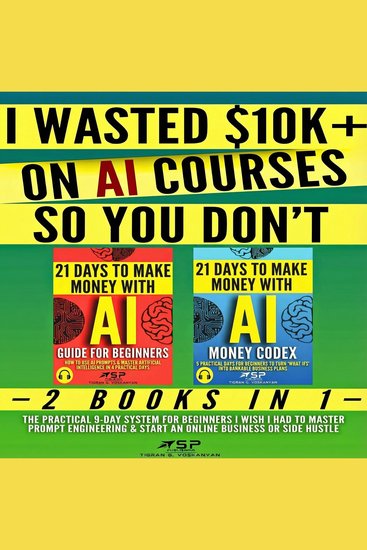
    [Comes With Access To Your Personalized Companion Course] 
    + A Digital Prompt Book 
    + Beta Access to My Upcoming Book 
    📅 9 ruthless days. 
    💰 0 tech degree. Designed to help AI Beginners who are afraid of code, but yearn to have passive income with AI. 
    ❌ No filler, no ethics panel, no reposted blog articles. 
    ✅ Author is a REAL human who has already burned through all the shiny objects. 
    ✅ Action > Theory 
    STOP. 
    Before you spend another dollar on AI-gnerated fluff courses or sink in all the free advice that goes nowhere... Read this. 
    I PAID 10437 DOLLARS FOR OVERLY-HYPED AI COURSES SO YOU DON T HAVE TO - the half-baked theories, the gurus who have never made anything real, the overpowering tech jargon that is designed to make you feel stupid. This 2-Books-in-1 package is the system I would have liked to have. It is your no-nonsense, no-BS, 9-day blitz to not only know AI, but to have it as your obedient, money-making slave. 
    Thinking that the AI revolution is a club and you are on the outside? It is that nagging feeling which is your cue. This is not some other abstract "intro to AI." It is your practical AI manual to taking charge, learning the art of prompt engineering, and weaponizing those capabilities right now toward a legitimate AI business or a powerful side hustle. 
    It only takes 9 days to turn the tables: 
    Book one: AI Guide to beginners (days 1-4) 
    Day 1: Your brain. Now AI. 
    Day 2: They lied to you about AI. 
    Day 3: Spells that work. Even when they shouldn't. 
    Day 4: Your brain will start to leak. 
    These first 4 days are your indoctrination. You'll move from AI beginner to someone who can bend artificial intelligence to their will, using powerful ChatGPT prompts and other AI prompts to make AI tools your personal AI assistant. 
    Book two: AI MONEY CODEX (Days 5-9) 
    Day 5: [REDACTED] Brain Protocols 
    Day 6: Sleep While It Sweats.
    Show book
  • Data-Intensive Applications - Design Development and Deployment Strategies for Scalable and Reliable Systems - cover

    Data-Intensive Applications -...

    Brian Murray

    • 0
    • 0
    • 0
    “Data-Intensive Applications: Design, Development, and Deployment Strategies for Scalable and Reliable Systems” is a comprehensive guide to building robust and scalable applications in the era of big data. With the explosion of data in recent years, building applications that can handle massive amounts of data has become increasingly important. This book covers the entire lifecycle of data-intensive applications, from designing and developing the application to deploying it in a production environment. 
    The book begins with an introduction to the challenges and opportunities of building data-intensive applications. It then moves on to cover the key concepts and technologies used in building these applications, including distributed systems, data processing frameworks, and storage technologies. The book also covers best practices for designing and developing data-intensive applications, including how to handle data at scale, how to ensure reliability and fault tolerance, and how to optimize performance. 
    In addition, the book covers the deployment and management of data-intensive applications, including strategies for deploying applications in the cloud, managing infrastructure, and monitoring and debugging applications in production. The book also includes case studies and real-world examples from companies that have successfully built and deployed data-intensive applications. 
    Whether you are a software engineer, data scientist, or IT professional, this book will provide you with the knowledge and skills you need to build and deploy data-intensive applications that are scalable, reliable, and performant. 
     
    Show book