Join us on a literary world trip!
Add this book to bookshelf
Grey
Write a new comment Default profile 50px
Grey
Subscribe to read the full book or read the first pages for free!
All characters reduced
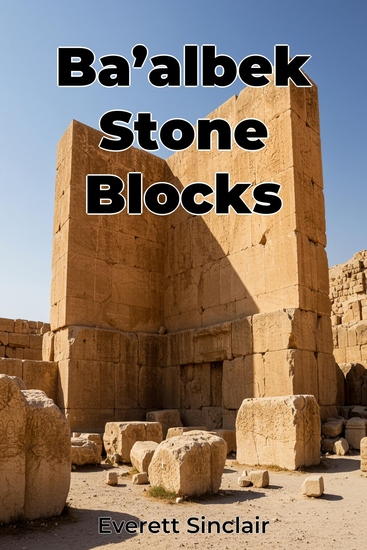
Ba’albek Stone Blocks - cover

Ba’albek Stone Blocks

Everett Sinclair

Translator A AI

Publisher: Publifye

  • 0
  • 0
  • 0

Summary

"Ba’albek Stone Blocks" explores the architectural marvel of Ba’albek, focusing on how ancient builders moved and placed colossal stone blocks, some weighing over a thousand tons. This feat of ancient construction showcases remarkable Roman engineering and ingenuity. The book delves into the quarrying, transportation, and precise arrangement of these megastructures, examining the socio-political context that drove their creation. One intriguing element is the Trilithon, composed of three massive stones each weighing approximately 800 tons, challenging our understanding of ancient technological capabilities. The book adopts an engineering-based approach, avoiding unsubstantiated theories and focusing on archaeological evidence and established engineering principles. It begins with an introduction to the site's history and the mysteries surrounding the stone blocks. It then examines the quarries and transportation methods, followed by a detailed analysis of the construction techniques used to arrange the blocks. By understanding Ba'albek, we gain insight into the complexities of monumental structures and ancient construction. The book synthesizes evidence from archaeological surveys, geological analysis, and historical texts to reconstruct the construction process. It highlights the Roman influence in the Levant and explores the organization of labor and resources needed for such large-scale projects. This comprehensive analysis aims to demystify the site while emphasizing its architectural grandeur, making it valuable for architecture enthusiasts, history buffs, and anyone intrigued by ancient mysteries.
Available since: 03/04/2025.
Print length: 58 pages.

Other books that might interest you

  • The Mendacity of Hope - Barack Obama and the Betrayal of American Liberalism - cover

    The Mendacity of Hope - Barack...

    Roger D. Hodge

    • 0
    • 0
    • 0
    “The Mendacity of Hope should help wake up all those Obama-voters who've been napping while the wars escalate, the recession deepens, and the environment goes straight to hell.” —Barbara Ehrenreich 
    From the former editor-in-chief of Harper's Magazine comes a bold manifesto exposing President Obama's failure to enact progressive reform at home and abroad. National Magazine Award finalist Roger Hodge makes a hard-hitting case against Obama's failure to deliver on the promises of his campaign. The first book-length critique of the Obama's presidency from a prominent member of the left, The Mendacity of Hope will strike a chord with anyone stirred by the words of Keith Olbermann, Rachel Maddow, and Frank Rich. It's the book that every frustrated progressive in America has been waiting to read.
    Show book
  • The Common Reader - "Volume 2" - cover

    The Common Reader - "Volume 2"

    Virginia Woolf

    • 0
    • 0
    • 0
    Do not think, because this collection of essays is titled Volume 2, that there is anything lesser or additional to it. Here is Virginia Woolf at her most entertaining and informative, relishing the portraits and insights she presents as she surveys a varied collection of individuals in English society and English literature. 
     
    The subjects range from the Elizabethans to Thomas Hardy, and then concludes, unexpectedly, with ‘How Should One Read A Book?’ Here is one delight after another: twenty-six occasional pieces (journalistic diversions) which demonstrate that her eye for history, for an individual’s place in history and in books, is just as acute and vivid as any character in her better-known novels. 
     
    Many are familiar names. John Donne, Robinson Crusoe, De Quincey, Lord Chesterfield. There is Dr Burney’s Evening Party and George Gissing, names which indicate there is no overall scheme whatsoever! Woolf champions certain figures, such as Mary Wollstonecraft (admiring her personal stance and strength) and yet has time to cast a softer, kindly eye on Dorothy Wordsworth. The detail contained in these portraits will last long in the memory—Beau Brummell descending from being the unimpeachable dandy to a sad decline; the curious eccentric personality of the poet and hymn writer William Cowper and his affection for Lady Austen. 
     
    Time and again, the skill and the wit of the great writer that is Virginia Woolf simply stops one in one’s tracks, as in her opening lines on Laurence Sterne. The essay is on A Sentimental Journey but she starts with tipping the hat to Tristram Shandy, which appeared when the author was 45. Woolf comments on Sterne: ‘No young writer could have dared to take such liberties with grammar and syntax and sense and propriety and the longstanding tradition of how a novel should be written. It needed a strong dose of the assurance of middle age and its indifference to censure to run such risks of shocking the lettered by the unconventionality of one's style, and the respectable by the irregularity of one's morals. But the risk was run and the success was prodigious.’ What a final sentence! Has the 21st century little time for the elegant essay, the joy of focused wit, of kindness, of acute observation, where the very brevity of format provides a space in which to think and reflect? In The Common Reader Volume 2, (published in 1932), the essay lives on and even more so in this sensitive and engaging book by Georgina Sutton.
    Show book
  • Our Nations and Nationalisms - cover

    Our Nations and Nationalisms

    Owen Dudley-Edwards

    • 0
    • 0
    • 0
    'Nationalism' is an increasingly unpopular word. Few would apply the label of 'nationalist' to themselves, and fewer still to any part of our history before the 1700s. But then, where does it come from? And what does it mean for us today?
    With one eye on the present as he unpicks the past, Owen Dudley Edwards finds nationalism to be older than recorded history and broader than modern geography. Our Nations and Nationalisms traces the phenomena back as far as the Old Testament and the works of Homer and Virgil, through the attempts of Shakespeare and James VI & I to found the first British Union, and into the Celtic legends that helped form the identities held in the UK today. 
    Taking wide-ranging examples from ancient to modern, from home and abroad, Dudley Edwards interrogates nationalism in action, asking what it really is and how it has impacted upon all of our lives, wherever we live or were born
    This demonised word, he argues, is a fact of human nature. It may take a variety of forms, but we are all, in some sense, 'nationalists'; it is incumbent upon each of us to find ways to use this fact in the interests of humanity, and not a single nation. 
    Show book
  • Cross-Examine Your Mind - NLP for Lawyers with Less Jargon and More Laughs - cover

    Cross-Examine Your Mind - NLP...

    Julie Sulter

    • 0
    • 0
    • 0
    Sharpen your professional edge with this witty, jargon-free guide to NLP for lawyers, HR professionals, and anyone who needs to communicate with confidence. Discover practical tools to improve persuasion, mindset, and connection — whether you're in the courtroom, the boardroom, or the breakroom — all served with a side of humor.
    Show book
  • The Death of Stalin - cover

    The Death of Stalin

    Sheila Fitzpatrick

    • 0
    • 0
    • 0
    The personal and the political collide in this masterful account of the death of a dictatorWhen Joseph Stalin died in 1953, he had been the unchallenged leader of the Soviet Union for over twenty years, having presided over the ruthless modernisation of the early 1930s, the Great Purges later in the decade, the near-catastrophe and ultimate victory of World War II, and the country's postwar emergence as a superpower. He was surrounded by a cult that made him seem godlike; no successors were in sight. His death was bound to be a deeply unsettling event, both in the Soviet Union and elsewhere.Sheila Fitzpatrick draws on her unparalleled knowledge of Stalin's circle and Soviet society to tell a tale that blends black comedy with forensic analysis, exploring the problems and opportunities -- often missed -- created by the death of the dictator. The final chapter deals with Stalin's eventful afterlife, including his recent resurrection in Putin's Russia. This is both a riveting read and a salutary one.
    Show book
  • The Reveries of the Solitary Walker - cover

    The Reveries of the Solitary Walker

    Jean-Jacques Rousseau

    • 0
    • 0
    • 0
    The Reveries of the Solitary Walker was one of the last works written by the French philosopher Jean-Jacques Rousseau (1712-1778) and was, in fact, not quite complete. It was published four years after his death and came quickly to be regarded as one of his most poetic works. 
     
    It consists of 10 Walks (only the final ‘Walk’ was unfinished) during which he muses on a variety of topics including thoughts on issues which featured strongly in his notable life as a philosopher and commentator, including education and political philosophy. However, interwoven into the reflective narrative are personal observations and memories—some painful, concerning times when he felt attacked and severely criticised for his writings. There are also comments on nature particularly the plants he encounters which, placing the writer in the countryside, balances the darker inner musings. This puts the tone beyond nostalgia, and if there is undoubtedly a feeling of resignation, the essays emanate a sense of end-of-life understanding and acceptance. 
     
    The First Walk sets the scene: “BEHOLD me then as if alone upon the earth, having neither brother, relative, friend or society but my own thoughts; the most social and affectionate of men proscribed as it were by unanimous consent. They have sought in the refinement of their hatred what would be the most cruel torment to my susceptible soul and have rent asunder every bond which attached me to them. I should have loved mankind in spite of themselves and it was only by throwing off humanity that they could avoid my affection. At length, then, behold them strangers, unknown, as indifferent to me as they desired to be; but thus detached from mankind, and everything that relates to them, what am I? This remains to be sought. Unhappily the search must be preceded by casting a glance on my own situation, since I must necessarily pass through this examination, in order to judge between them and myself.” 
     
    Matthew Lloyd Davies reads the first translation into English which appeared in 1796, less than 20 years after Rousseau’s death.
    Show book