

Join us on a literary world trip!
Add this book to bookshelf
Grey
Write a new comment Default profile 50px
Grey
Subscribe to read the full book or read the first pages for free!
All characters reduced
Ancient Temples - cover

Ancient Temples

Everett Sinclair

Translator A AI

Publisher: Publifye

  • 0
  • 0
  • 0

Summary

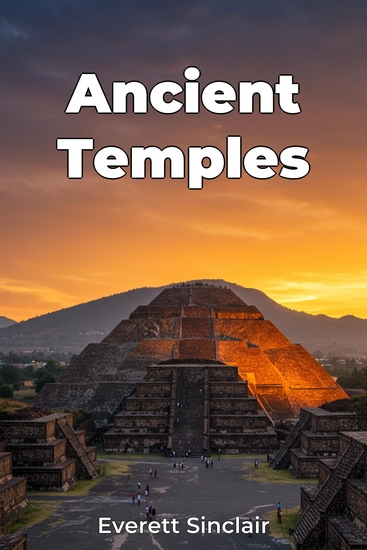
Ancient Temples explores the fascinating world of ancient sacred spaces, examining their architectural grandeur and deep cultural importance. Temples weren't just places of worship; they were also vital hubs for social, political, and economic activities in ancient civilizations. This book uniquely blends history and architecture to reveal how temple design reflects the beliefs and technological advancements of societies across time.

 
The book investigates iconic structures like Karnak in Egypt, where massive scale and intricate hieroglyphics showcased pharaonic power. It also delves into the Parthenon, highlighting its influence on Western architectural traditions rooted in ideal proportions. Progressing through chapters, the narrative examines Mesoamerican pyramids and their complex astronomical alignments, illustrating their role in rituals and social control.

 
By synthesizing archaeological findings, historical texts, and religious studies, Ancient Temples offers a comprehensive perspective. It presents these ancient structures as tangible embodiments of a civilization's worldview, providing invaluable insights into their values, aspirations, and capabilities. The book's comparative approach makes it valuable for students and enthusiasts alike.
Available since: 02/27/2025.
Print length: 64 pages.

Other books that might interest you

  • Taming the Octopus - The Long Battle for the Soul of the Corporation - cover

    Taming the Octopus - The Long...

    Kyle Edward Williams

    • 0
    • 0
    • 0
    The untold story of how efforts to hold big business accountable changed American capitalism. 


    In this vivid and surprising history, we meet twentieth-century activists, investors, executives, and workers who fought over a simple question: Is the role of the corporation to deliver profits to shareholders, or something more? On one side were "business statesmen" who believed corporate largess could solve social problems. On the other were libertarian intellectuals such as Milton Friedman and his oft-forgotten contemporary, Henry Manne, whose theories justified the ruthless tactics of a growing class of corporate raiders. But Kyle Edward Williams reveals that before the "activist investor" emerged as a capitalist archetype, Civil Rights groups used a similar playbook for different ends, buying shares to change a company from within. 


    As a rising tide of activists pushed corporations to account for societal harms from napalm to environmental pollution to inequitable hiring, a new idea emerged: that managers could maximize value for society while still turning a maximal profit. This elusive ideal, "stakeholder capitalism," still dominates our headlines today. Williams's necessary history equips us to reconsider democracy's tangled relationship with capitalism.
    Show book
  • The Yemen Model - Why US Policy Has Failed in the Middle East - cover

    The Yemen Model - Why US Policy...

    Alexandra Stark

    • 0
    • 0
    • 0
    A close look at failed US policies in the Middle East, offering a fresh perspective on how best to reorient goals in the region 


    In this book Alexandra Stark argues that the US approach to Yemen offers insights into the failures of American foreign policy throughout the Middle East. Stark makes the case that despite often being drawn into conflicts within Yemen, the United States has not achieved its policy goals because it has narrowly focused on counterterrorism and regional geopolitical competition rather than on the well-being of Yemenis themselves. She offers recommendations designed to reorient US policy in the Middle East in pursuit of US national security interests and to support the people of these countries in their efforts to make their own communities safe, secure, and prosperous.
    Show book
  • The Last Wilderness - cover

    The Last Wilderness

    Murray Morgan, Tim McNulty

    • 0
    • 0
    • 0
    Murray Morgan's classic history of the Olympic Peninsula, originally published in 1955, evokes a remote American wilderness "as large as the state of Massachusetts, more rugged than the Rockies, its lowlands blanketed by a cool jungle of fir and pine and cedar, its peaks bearing hundreds of miles of living ice that gave rise to swift rivers alive with giant salmon." 


    Drawing on historical research and personal tales collected from docks, forest trails, and waterways, Morgan recounts vivid adventures of the area's settlers—loggers, hunters, prospectors, homesteaders, utopianists, murderers, profit-seekers, conservationists, Wobblies, and bureaucrats—alongside stories of coastal first peoples and striking descriptions of the peninsula's wildlife and land. 


    Freshly redesigned and with a new introduction by poet and environmentalist Tim McNulty, this humor-filled saga and landmark love story of one of the most formidably beautiful regions of the Pacific Northwest will inform and engage a new generation of listeners.
    Show book
  • Calm Your Mind: Why Our Children Are Struggling in Today's World - "Unlock your child's potential with insightful audio lessons that ease their challenges in today’s world!" - cover

    Calm Your Mind: Why Our Children...

    Orson Finchley

    • 0
    • 0
    • 0
    Calm Your Mind: Why Our Children Are Struggling in Today's World  
    ⭐⭐ Simplified Guide & Explanations Included⭐⭐ 
    Are you eager to foster resilience and understanding for future generations by challenging assumptions about today's world? 
    Do you need a comprehensive resource that addresses the crucial elements for empowering our children in a rapidly changing environment?  
    Your search ends here! 
    This guide is your ultimate companion for enhancing your insights, applying practical skills, and engaging in real-world exercises. With this resource, you're on the path to meaningful change for our children’s lives. 
    Updated to reflect current challenges and strategies for 2025. 
    Key features of this enriched guide: 
    - In-depth insights into the issues our children face today 
    - Detailed exploration of societal challenges and effective coping mechanisms 
    - Successful strategies for fostering resilience and understanding 
    What sets our guide apart is its comprehensive approach, essential for fostering a deeper understanding. Concepts are thoroughly examined rather than superficially touched upon. 
    With a clear structure and straightforward language, our guide ensures seamless transitions between topics. Bid farewell to confusing jargon and welcome clear, concise, and technically accurate content. 
    So, why wait? Click the BUY NOW button to secure your guide, and embark on a transformative journey to empower resilient future generations! 
    Dive into this essential guide and help your children thrive in today’s complex world!
    Show book
  • The History and Legacy of the Greatest Empires in the Ancient Levant - cover

    The History and Legacy of the...

    Editors Charles River

    • 0
    • 0
    • 0
    The pages of world history textbooks contain a litany of “lost” empires and civilizations, but usually, upon further review, it is revealed that these so called lost empires are often just lesser known cultures that had a less apparent impact on history than other more well-known civilizations. When one scours the pages of history for a civilization that was inexplicably lost, but had a great impact during its time, very few candidates can be found, but the Hittites are a notable example. Compared to some of their contemporaries – including the Egyptians, Assyrians, and Babylonians – the Hittites were somewhat distant both culturally and geographically. The Hittites were an Indo-European speaking in an ocean of Afro-Asiatic and Semitic groups, their homeland was to the north of Mesopotamia, and it contained no major river like the Nile, Tigris, or Euphrates Rivers. The Hittite empire was also far less enduring than its neighbors, as it only existed from about 1800-1200 BCE (van de Mieroop 2007, 156), which was considerably shorter than most of the other major kingdoms of the Near East. 
    Of all the peoples of the ancient Near East, the Phoenicians are among the most recognizable but also perhaps the least understood. The Phoenicians never built an empire like the Egyptians and Assyrians; in fact, the Phoenicians never created a unified Phoenician state but instead existed as independent city-state kingdoms scattered throughout the Mediterranean region. However, despite the fact there was never a “Phoenician Empire,” the Phoenicians proved to be more prolific in their exploration and colonization than any other peoples in world history until the Spanish during the Age of Discovery.
    Show book
  • Talking to Children About Divorce - cover

    Talking to Children About Divorce

    Jenelle Winter

    • 0
    • 0
    • 0
    Talking to Children About Divorce: A Parent's Handbook on Helping Children Cope With DivorceDivorce can be a difficult and emotional process for all involved, but it can be especially challenging for children. As parents navigate the legal and emotional aspects of ending their marriage, children may struggle to understand and cope with the changes in their lives. This audiobook aims to provide guidance and support for parents, caregivers, and professionals working with children affected by divorce. It aims to help families navigate this difficult time and promote positive outcomes for children.This audiobook will cover the following topics:- The Impact of Divorce on Children's Emotional and Behavioral Development- Co-Parenting After Divorce- Assisting Children in Coping with Life Post-Divorce- The Role of the Family Court System in Divorce Cases Involving Children- Child Custody and Visitation Arrangements- The Monetary Effects of Divorce on Children and Households- Assisting Children During High-Stress Divorce Situations- The Importance of Therapy and Counseling in Assisting Children Post-Divorce- Avoiding Parent-Child Estrangement During and Post-Divorce- How to Promote Positive Outcomes for Children After Divorce - And many more!The end of a marriage can be a traumatic and stressful event for children, and the process of adjusting to a new family structure can be difficult and confusing. To have a helpful resource to navigate through this process, scroll up and click “add to cart” now
    Show book
