
Join us on a literary world trip!
Add this book to bookshelf
Grey
Write a new comment Default profile 50px
Grey
Subscribe to read the full book or read the first pages for free!
All characters reduced
Paris Chronicles - cover

Paris Chronicles

Evelyn Foster

Translator A AI

Publisher: Publifye

  • 0
  • 0
  • 0

Summary

Paris Chronicles explores the captivating history of Paris, revealing its evolution as a global epicenter of culture, art, and revolutionary thought. The book analyzes how Parisian art, from Notre Dame's medieval masterpieces to avant-garde movements, mirrors the city's ever-shifting social and political landscape. Similarly, it examines Parisian fashion not just as trends but as reflections of changing social structures and the evolving roles of women, highlighting the impact of haute couture on global culture. This book uniquely blends tradition and innovation, exploring Paris's ability to preserve its historical heritage while embracing change.

 
Paris Chronicles begins with Paris's Roman origins, progressing through the Renaissance, the French Revolution, the Belle Époque, and into the challenges of the 20th and 21st centuries. The French Revolution serves as a pivotal point, examining its causes, key figures, and lasting impact on Parisian society and urban planning. By drawing from historical documents, art, fashion studies, and sociological research, Paris Chronicles offers a fresh perspective on the interconnectedness of art, fashion, and revolution in shaping Paris's identity. This approach makes it valuable for students, travelers, and anyone interested in a comprehensive understanding of Parisian history and culture, including urban and social history.
Available since: 02/20/2025.
Print length: 56 pages.

Other books that might interest you

  • Uncertain Climes - Debating Climate Change in Gilded Age America - cover

    Uncertain Climes - Debating...

    Joseph Giacomelli

    • 0
    • 0
    • 0
    Uncertain Climes looks to the late nineteenth century to reveal how climate anxiety was a crucial element in the emergence of American modernity. 
     
    Even people who still refuse to accept the reality of human-induced climate change would have to agree that the topic has become inescapable in the United States in recent decades. But as Joseph Giacomelli shows in Uncertain Climes, this is actually nothing new: as far back as Gilded Age America, climate uncertainty has infused major debates on economic growth and national development. 
      
    In this ambitious examination of late-nineteenth-century understandings of climate, Giacomelli draws on the work of scientists, foresters, surveyors, and settlers to demonstrate how central the subject was to the emergence of American modernity. Amid constant concerns about volatile weather patterns and the use of natural resources, nineteenth-century Americans developed a multilayered discourse on climate and what it might mean for the nation’s future. Although climate science was still in its nascent stages during the Gilded Age, fears and hopes about climate change animated the overarching political struggles of the time, including expansion into the American West. Giacomelli makes clear that uncertainty was the common theme linking concerns about human-induced climate change with cultural worries about the sustainability of capitalist expansionism in an era remarkably similar to the United States’ unsettled present.
    Show book
  • African Mythology: Enthralling Myths Fables and Legends from Africa - cover

    African Mythology: Enthralling...

    Billy Wellman

    • 0
    • 0
    • 0
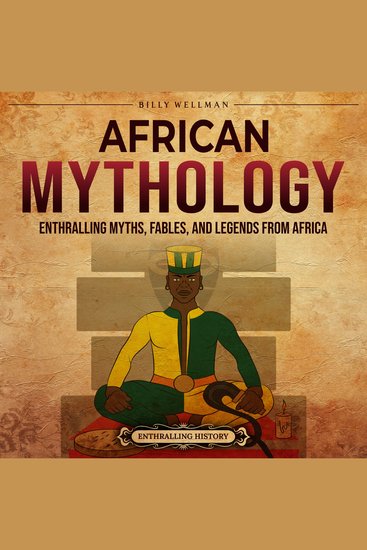
    Africa is huge and varied, and so is its mythology. 
    African ideas of how the world began are very different from the story of Genesis. Though the creator god is repeatedly seen as having withdrawn from the world, people often have a very direct and intense relationship with demigods, ancestors, and bush spirits. The entire landscape is permeated by spiritual meanings and inhabited by gods and spirits. While many Africans today formally follow the Christian or Muslim faiths, they often blend these beliefs with traditional lore and rites. 
    This audiobook examines the central themes of African mythology—the creation, gods and goddesses, trickster tales, animals, monsters, heroes, and mythical rulers—and shows how some motifs recur throughout the corpus of myths. It also looks at how African myths are becoming better known because of writers and filmmakers, particularly from the Black diaspora, who draw on this rich heritage for inspiration. 
    This introductory guide to African myths will allow you to do the following:Learn why the original creator decided to withdraw from Earth.Find out how ancient Egypt had several different creation stories, depending on which god was in ascendancy at the time.Listen to the medieval African emperor said to have been the richest man in history.Find out where Br’er Rabbit really came from.Check out how Anansi the Spider gained ownership of all the stories in the world.Get to know Oshun, the Yoruba river goddess, and how she arrived in Latin America.Learn about Haile Selassie, the emperor who brought Ethiopia into the League of Nations, and how he became a living god to Jamaican Rastafarians.Understand how Voodoo (Vodou) grew out of traditional West African religion. 
    Scroll up and click the “add to cart” button to learn more about African mythology!
    Show book
  • A People's Guide to Capitalism - An Introduction to Marxist Economics - cover

    A People's Guide to Capitalism -...

    Hadas Thier

    • 0
    • 0
    • 0
    A lively, accessible, and timely guide to Marxist economics for those who want to understand and dismantle the world of the 1%. 


    Economists regularly promote Capitalism as the greatest system ever to grace the planet. With the same breath, they implore us to leave the job of understanding the magical powers of the market to the "experts." 


    Despite the efforts of these mainstream commentators to convince us otherwise, many of us have begun to question why this system has produced such vast inequality and wanton disregard for its own environmental destruction. This book offers answers to exactly these questions on their own terms: in the form of a radical economic theory.
    Show book
  • Roman Empire: An Enthralling Overview of Imperial Rome - cover

    Roman Empire: An Enthralling...

    Enthralling History

    • 0
    • 0
    • 0
    Did you know that not all Romans could wear togas? 
    Movies and shows might depict Romans wearing togas and sandals everywhere they went, but that was actually not the case. In fact, togas were considered formal wear and a status symbol, as those in the higher social classes typically wore them. 
    There are many surviving writings authored by ancient Roman historians that describe the interesting traditions and customs of ancient Rome. These records provide detailed insights and scenes of the empire’s past. Some throw in a few myths, while some are infused with bias. Because of this, it can be difficult for curious listeners to distinguish between facts and opinions. 
    However, with this Enthralling History audiobook, you can easily discover the fascinating journey of the ancient Roman Empire, from the emergence of its first emperor until the fall of the Western Roman Empire. 
    Here’s just a tiny fraction of what you’ll discover:How Augustus ended the decades-long civil war and rose as the empire’s “first citizen”;How the emperor’s private military forces, the Praetorian Guard, became powerful enough to slay Rome’s mad emperor;The vicious scenes of Rome’s biggest entertainment shows: the gladiatorial games and chariot races;The unique and luxurious structures of Rome that have survived to this day;Harsh punishments and training of the legionnaires;Comparison between the lush life of the wealthy and the mundane lives of commoners, slaves, and freemen;Early Christians as Emperor Nero’s scapegoats and their terrible persecution;The rise of Christianity and the sacking of Rome;And much, much more! 
    Scroll up and click the “add to cart” button to learn more about the Roman Empire!
    Show book
  • Psychological Coercion - Using Psychological Persuasion to Force Compliance - cover

    Psychological Coercion - Using...

    Cito Harder

    • 0
    • 0
    • 0
    Psychological coercion is a powerful and often insidious form of manipulation designed to force an individual to act against their will or better judgment. It involves the use of mental and emotional tactics to instill fear, guilt, or pressure, making the person feel compelled to comply with demands or expectations. While it does not rely on physical force, the impact of psychological coercion can be just as damaging, if not more so, as it leaves lasting emotional scars that can affect an individual’s sense of self-worth, autonomy, and mental health. 
    At its core, psychological coercion undermines a person’s ability to make decisions freely. It exploits their vulnerabilities—whether emotional, psychological, or social—in order to gain control or influence their behavior. This form of coercion can take many different shapes, including threats, isolation, intimidation, manipulation, or subtle forms of pressure. While the methods may vary, the common thread is the intentional use of mental and emotional tactics to manipulate or control another person’s actions. 
    Psychological coercion is distinct from other forms of persuasion because it involves the use of power and control to manipulate an individual into compliance. In many cases, the person being coerced may not even recognize the pressure being applied to them. This is due to the subtlety with which coercion often operates—it can take place in everyday interactions, with the perpetrator using psychological manipulation in a way that may seem harmless or even caring at first. Over time, however, the individual being manipulated becomes increasingly susceptible to the influence of the coercer, often leading to a loss of personal agency and a sense of powerlessness.
    Show book
  • Free Speech - What Everyone Needs to Know® - cover

    Free Speech - What Everyone...

    Nadine Strossen

    • 0
    • 0
    • 0
    This concise but comprehensive book lays out specific answers to myriad topical questions about free speech law, and also general explanations of how and why the law distinguishes between protected and punishable speech. 


    The book focuses on modern First Amendment law, explaining the historic factors that propelled its evolution in a more speech-protective direction—in particular, the Civil Rights Movement. It highlights the many cases, involving multiple issues, in which robust speech-protective principles aided advocates of racial justice and other human rights causes. The book also shows how these holdings reflect universal, timeless values, which have been incorporated in many other legal systems, and have inspired countless thinkers and activists alike. 


    Without oversimplifying the complexities of free speech law, the book's lively question-and-answer format summarizes this law in an understandable, interesting, and memorable fashion. It addresses the issues in a logical sequence, presenting facts and eloquent language from landmark Supreme Court opinions. It will be illuminating to a wide range of listeners, from those who know nothing about free speech law, to those who have studied it but seek a well-organized summary of major doctrinal rules, as well as insights into their background, rationales, and interconnections.
    Show book