Join us on a literary world trip!
Add this book to bookshelf
Grey
Write a new comment Default profile 50px
Grey
Subscribe to read the full book or read the first pages for free!
All characters reduced
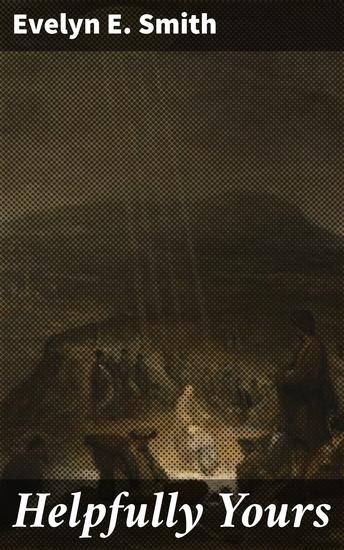
Helpfully Yours - Quirky Tales of Wit and Insight: An Anthology of Timeless Humor and Social Commentary - cover

Helpfully Yours - Quirky Tales of Wit and Insight: An Anthology of Timeless Humor and Social Commentary

Evelyn E. Smith

Publisher: Good Press

  • 0
  • 0
  • 0

Summary

In "Helpfully Yours," Evelyn E. Smith crafts a whimsical narrative that delves into the intricacies of human relationships through the lens of a bittersweet comedy. The novel is characterized by its sharp wit and keen observations, exploring themes of love, companionship, and the challenges of maintaining genuine connections in an increasingly complex world. With a literary style that seamlessly blends irony with tenderness, Smith invites readers to reflect on their own interpersonal dynamics, all while drawing on the literary context of mid-20th-century American fiction where intimacy and existential musings were pivotal. Evelyn E. Smith, an innovative voice of her time, was known for her ability to capture the essence of the human experience. Her diverse background as both a writer and a skilled adapter for television and radio likely informed her unique approach to storytelling. Smith's rich life experiences and her penchant for observing societal norms allow her to weave narratives that resonate deeply, drawing readers into the emotional intricacies she so beautifully delineates. This engaging and thought-provoking work is a must-read for anyone intrigued by the nuances of relationships and the subtleties of human behavior. "Helpfully Yours" offers readers not only a delightful read but also a mirror to examine their own lives, making it an invaluable addition to the library of those who appreciate literary insights into the human condition.
Available since: 10/04/2023.
Print length: 38 pages.

Other books that might interest you

  • A Scene from the Ghetto of Venice - From their pens to your ears genius in every story - cover

    A Scene from the Ghetto of...

    Rainer Maria Rilke

    • 0
    • 0
    • 0
    René Karl Wilhelm Johann Josef Maria Rilke was born into a troubled marriage on the 4th December 1875 in Prague, then part of the Austro-Hungarian Empire.  His mother, having previously lost a baby girl, would dress the young boy up in girl’s clothing.   
    Later his father dispatched him to a military academy at age 10 but after a miserable 5 years the young Rilke left due to illness and instead entered first Prague and then Munich and finally Berlin university to study art history, philosophy and literature. 
    His initial forays into literature was in poetry.  His intense, mystical and lyrical style was much admired and over time inspired many in succeeding generations.    
    His short prose collection ‘Stories of God’, written in an impassioned burst over several nights was published in 1900 and offers a beguiling view of much of Rilke’s influences and outlook.  
    The following year he married the pioneering sculptor and artist Clara Westhoff.  The union produced one child, a daughter Ruth.   
    He lived in Paris for most of the Century’s first decade where he mixed with many great minds of the time.  Although he continued to write he also worked as a secretary to the sculptor, Rodin.   
    It was only after they settled in Switzerland in 1919 that his writing output was in full flow.  Here he wrote profusely in both German and French, which included much on his previous travels, his left-wing sympathies, his religious and existential thoughts, all part of a unique and consummate style. 
    From 1923 on, Rilke increasingly struggled with his health which was now in constant decline and often spent time rehabilitating at a sanatorium.   
    Rainer Maria Rilke died of leukaemia on the 29th December 1926 in Montreux, Switzerland.  He was 51.
    Show book
  • Life in Ten Chapters - cover

    Life in Ten Chapters

    Stewart Scott

    • 0
    • 0
    • 0
    This series of stories address everyday issues sympathetically and with excellent character development whilst depicting people which many readers will identify with as the storylines are creatively and skillfully intertwined. This eclectic collection of stories expresses all of the human emotions of the characters with great sensitivity and with pathos.
    Show book
  • Polaris - cover

    Polaris

    H.P. Lovecraft

    • 0
    • 0
    • 0
    Title: Polaris 
    Author: H. P. Lovecraft 
    Narrator: Jonathan Dunne 
    Original Publication: 1920 
    Public Domain: Yes 
    Series Placement: Number 43 in the Timeless Terrors series 
    Description: 
    Polaris by H. P. Lovecraft is a dreamlike descent into obsession, identity, and cosmic futility. Set beneath the eerie shimmer of the North Star, it unfolds as both a tale of ancient war and a fevered vision of a soul caught between two worlds — the waking and the eternal. 
    The narrator, haunted by dreams of a lost city beneath the Arctic light, becomes convinced he is the reincarnation of a watchman doomed to fail in his sacred duty. As memory, madness, and destiny blur, Polaris becomes a meditation on guilt and the insignificance of man beneath the indifferent stars. 
    Narrated by Amazon bestselling horror author Jonathan Dunne, this performance captures Lovecraft’s hypnotic rhythm and the slow unravelling of sanity that defines his early cosmic vision — the sense that truth may be glimpsed only in dreams, and that awakening brings no escape. While the text is in the public domain, this narration is an original performance and copyright © 2025 Jonathan Dunne. 
    Part of Timeless Terrors, a series devoted to resurrecting the masters of the macabre and uncanny, Polaris endures as an early glimpse of Lovecraft’s cosmic dread — a haunting reminder that even the stars above may whisper our doom.
    Show book
  • Let the stars burn like fireflies - Fall - cover

    Let the stars burn like...

    ~mora

    • 0
    • 0
    • 0
    "Let the Stars Burn Like Fireflies" is a captivating and thought-provoking short story that explores the themes of love, loss, and the human condition. Through its haunting and lyrical prose, the story transports readers to a world where memories, both good and bad, can be as vivid as fireflies lighting up the night sky. With its powerful emotional impact and thought-provoking themes, this story is a must-read for anyone who loves literature that stays with them long after they've finished reading. Follow David as he confronts unimaginable evils, fights for survival, and ultimately discovers his true destiny.
    Show book
  • Weaving Words - Women about Women - cover

    Weaving Words - Women about Women

    Marjorie Banks, Conchita...

    • 0
    • 0
    • 0
    'The premise is simple, the execution is passionate: thirteen short stories of fiction from eight emerging women writers. This anthology is a wonderful example of women lifting up other women, of writers supporting writers, of a community coming together to fulfil ambitions and dreams,' writes Cass Moriarty, in the Foreword for Weaving Words.
    Show book
  • The Fyodor Dostoyevsky Collection Signature Classics - Notes from the Underground The Dream of a Ridiculous Man White Nights and others - cover

    The Fyodor Dostoyevsky...

    Fyodor Dostoyevsky

    • 0
    • 0
    • 0
    Explore the profound depths of human psychology and morality with The Fyodor Dostoyevsky Collection: Signature Classics. This beautifully illustrated anthology brings together some of Dostoyevsky's most iconic works, offering timeless reflections on the complexities of the human condition. 
    Included in this collection are masterpieces such as Notes from the Underground, a gripping exploration of alienation, free will, and existential despair, and The Dream of a Ridiculous Man, a powerful allegory of redemption and the transformative power of love. White Nights captivates readers with its poignant portrayal of unrequited love and the fleeting beauty of human connection, capturing a lyrical tenderness that contrasts with Dostoyevsky's darker themes. 
     Contents: 
     Notes from the Underground,
     White Nights,
     The Dream of a Ridiculous Man,
     The Beggar Boy at Christ's Christmas Tree,
     The Christmas Tree and the Wedding
    Show book