Junte-se a nós em uma viagem ao mundo dos livros!
Adicionar este livro à prateleira
Grey
Deixe um novo comentário Default profile 50px
Grey
Assine para ler o livro completo ou leia as primeiras páginas de graça!
All characters reduced
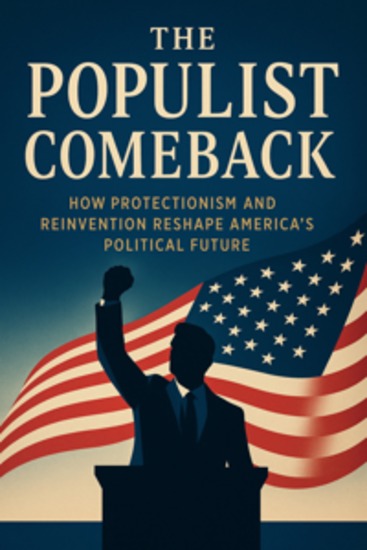
The Populist Comeback: How Protectionism and Reinvention Reshape America’s Political Future - cover
LER

The Populist Comeback: How Protectionism and Reinvention Reshape America’s Political Future

Evelyn Ashcroft

Editora: BookRix

  • 0
  • 0
  • 0

Sinopse

What happens when populism returns with new momentum? The Populist Comeback examines the resurgence of protectionist trade policies, nationalist rhetoric, and populist reinvention in contemporary American politics.Written in a professional and accessible style for students, this book unpacks the dynamics behind trade wars, shifting alliances, and the populist appeal that challenges traditional institutions. It explores how renewed protectionism impacts global markets, reshapes domestic priorities, and fuels political polarization. At the same time, it highlights how populism continually reinvents itself—adapting strategies, language, and platforms to maintain influence.Rather than simply diagnosing problems, the book provides frameworks for understanding populism’s cyclical nature and its implications for democracy. Readers gain both critical insight into today’s political landscape and tools for analyzing how movements of disruption reshape governance.If you want to understand the forces behind modern populism and the protectionist turn in global politics, this book offers the clarity and depth you need.
Disponível desde: 09/09/2025.
Outros livros que poderiam interessá-lo

  • Culture and Society - How Cultural Norms Shape Our Social Reality - cover

    Culture and Society - How...

    Fred Grandsen

    • 0
    • 0
    • 0
    Culture and society are deeply interconnected, shaping human behavior, beliefs, and institutions. Culture encompasses the shared practices, values, symbols, and artifacts that define a group of people, while society refers to the structured interactions and relationships within a community or nation. Culture provides the foundation for social norms, influencing everything from language and customs to laws and moral expectations. At the same time, society determines how culture is transmitted, adapted, and reinforced through institutions such as family, education, and government. 
    One of the key aspects of culture is its learned nature. Unlike biological traits, cultural knowledge is passed down through generations via socialization. From early childhood, individuals absorb cultural norms through interactions with family, peers, and media. These shared understandings create a sense of belonging and cohesion within a group. However, culture is not static; it evolves over time as societies encounter new ideas, technologies, and challenges. The dynamic nature of culture ensures that it remains relevant to the needs and values of the people who uphold it.
    Ver livro
  • Who Owns The Moon? - In Defence of Humanity's Common Interests in Space - cover

    Who Owns The Moon? - In Defence...

    A. C. Grayling

    • 0
    • 0
    • 0
    Silicon for microchips; manganese for batteries; titanium for missiles. 
     
    The moon contains a wealth of natural resources. So, as the Earth’s supplies have begun to dwindle, it is no surprise that the world’s superpowers and wealthiest corporations have turned their eyes to the stars. As this new Space Race begins, A.C. Grayling asks: who, if anyone, owns the moon? Or Mars? Or other bodies in near space? And what do those superpowers and corporations owe to Planet Earth and its inhabitants as a whole? 
     
    From feudal common land, through the rules of the sea, to the vast, nationless expanse of Antarctica, Grayling explores the history of the places which no one, and therefore everyone, owns. Examining the many ways this so-called terra nullius has fallen victim to ‘the tragedy of the commons’ – the tendency for communal resources to be exploited by a few individuals for personal gain at the expense of everyone else – Who Owns the Moon? puts forward a compelling argument for a bold new global consensus, one which recognises and defends the rights of everyone who lives on this planet.
    Ver livro
  • Defeating Jihadist Terrorism - cover

    Defeating Jihadist Terrorism

    Jacques Baud

    • 0
    • 0
    • 0
    Since the early 1990s, terrorism and its victims have increased exponentially. Without any action strategy or exit solution, through political and military incompetence, stupidity and ideological blindness, Western interventions have only contributed to its development. We eliminate terrorists, but not terrorism. The solution lies in a more holistic, more subtle, more intelligent and less dogmatic approach. Terrorism is not an ideology. It is a method that takes many forms, including jihadist terrorism. Each form of terrorism is fought with a specific strategy. Based on the original texts of jihadist strategists as well as on their own analyses of attacks in France, Belgium, Great Britain and the United States, Jacques Baud explains the reasons for Western failure. He uses the analyses of Western intelligence services to decipher the mechanisms of jihadist terrorism, in order to extract strategies of action likely to avoid it or to fight it effectively and durably. The author is a former head of Swiss strategic intelligence and former head of UN peace operations doctrine. In the course of his missions in Africa and Central Asia, the author has had several encounters with jihadists in the field. 
    This audiobook is read by a synthesized voice.
    Ver livro
  • The Cultural Revolution - A Decade of Upheaval - cover

    The Cultural Revolution - A...

    Jun Liu

    • 0
    • 0
    • 0
    The Cultural Revolution, which lasted from 1966 to 1976, was a decade of intense political and social upheaval in China. It was initiated by Mao Zedong, the Chairman of the Chinese Communist Party, as a means to reassert his ideological dominance and eliminate perceived threats within the party and society. The roots of the Cultural Revolution can be traced back to the aftermath of the Great Leap Forward, growing political divisions, and Mao’s desire to reshape China’s ideological landscape. 
    One of the key factors that led to the Cultural Revolution was Mao’s declining influence following the disastrous Great Leap Forward (1958–1962). This economic and social campaign, aimed at transforming China into a communist utopia through rapid industrialization and collectivization, resulted in widespread famine and the deaths of millions. The failures of the Great Leap Forward weakened Mao’s credibility, and he was forced to step back from day-to-day governance, allowing more pragmatic leaders such as Liu Shaoqi and Deng Xiaoping to implement economic reforms. These leaders promoted policies that prioritized economic stability over radical communist ideology, which Mao saw as a betrayal of the revolution’s goals. 
    In response to his diminished authority, Mao sought to reassert control by launching an ideological campaign against those he deemed “capitalist roaders” within the party. By the early 1960s, internal power struggles intensified as Mao and his radical supporters, including Lin Biao and Jiang Qing, clashed with moderate leaders advocating for a more pragmatic approach to governance. Mao viewed the growing influence of his rivals as a direct threat to his vision for China. To counter their policies, he began promoting the idea of a new revolutionary movement that would purify Chinese society and eliminate counterrevolutionary elements.
    Ver livro
  • Black Consciousness - A Love Story - cover

    Black Consciousness - A Love Story

    Hlumelo Biko

    • 0
    • 0
    • 0
    ‘If Steve Biko were alive today, we would have a country that gladly embraces African culture as the dominant driving force for how society is organised ...’ 
    In 1968, two young medical students, Steve Biko and Mamphela Ramphele, fell in love while dreaming of a life free from oppression and racial discrimination. Their love story is also the story of the founding of the Black Consciousness Movement (BCM) by a group of 15 principled and ambitious students at the University of Natal in Durban in the early 1970s. 
      
    In this deeply personal book, Hlumelo Biko, who was born of Steve and Mamphela’s union, movingly recounts his parents’ love story and how the BCM’s message of black self-love and self-reliance helped to change the course of South African history. 
      
    Based on interviews with some of the BCM’s founding members, Black Consciousness describes the early years of the movement in vivid detail and sets out its guiding principles around a positive black identity, black theology and the practice of Ubuntu through community-based programmes. 
      
    In spiritual conversation with his father, Hlumelo re-examines what it takes to live a Black Consciousness life in today’s South Africa. He also explains why he believes his father – who was brutally murdered by the apartheid police in 1977 – would have supported true radical economic transformation if he were alive today.
    Ver livro
  • Imperialism - cover

    Imperialism

    Vladimir Lenin

    • 0
    • 0
    • 0
    Written in 1916 against the backdrop of the First World War, Imperialism: The Highest Stage of Capitalism explains the flaws and power of capitalism, which inevitably lead to monopolies, imperialism and colonialism. Lenin develops Marx’s theories of political economy, which had been put forward 50 years earlier in Das Kapital. He goes on to argue that imperialism is the most advanced state of capitalism, characterised by the domination of monopolies on an international scale, with the export of capital leading to the big imperialist powers carving up the world.More than a century later, Imperialism remains highly relevant in understanding the historical background to the strategies of many of today’s major nations.
    Ver livro