Join us on a literary world trip!
Add this book to bookshelf
Grey
Write a new comment Default profile 50px
Grey
Subscribe to read the full book or read the first pages for free!
All characters reduced
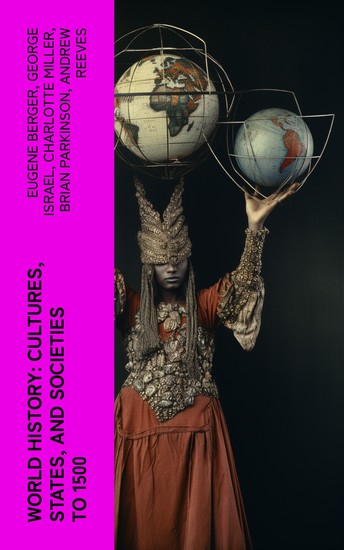
World History: Cultures States and Societies to 1500 - cover

World History: Cultures States and Societies to 1500

Eugene Berger, George Israel, Charlotte Miller, Brian Parkinson, Andrew Reeves, Nadejda Williams

Publisher: e-artnow

  • 0
  • 0
  • 0

Summary

Contents:  Prehistory Early Middle Eastern and Northeast African Civilizations Ancient and Early Medieval India China and East Asia to the Ming Dynasty The Greek World from the Bronze Age to the Roman Conquest The Roman World from 753 BCE to 500 CE Western Europe and Byzantium circa 500 - 1000 CE Islam to the Mamluks African History to 1500 The Americas Central Asia Western Europe and Byzantium circa 1000 - 1500 CE
Available since: 12/18/2023.
Print length: 649 pages.

Other books that might interest you

  • A Sense of Balance - cover

    A Sense of Balance

    John Howard

    • 0
    • 0
    • 0
    On how our sense of balance has defined us as a nation and will safeguard our future. 
      
    In the years that John Howard served in the national parliament he came to understand the special character of Australia; to appreciate its strengths and weaknesses; and most importantly to respect the sense of balance in the formulation of public policy that has long defined us as a nation and made Australia an attractive destination for people from across the world. 
    In this book he explores this balance, its foundations and its future. Written against the backdrop of the COVID-19 pandemic, as well as some of the more contested political events of recent years - the election of Donald Trump, the Brexit vote, the rise of China, and, within our own country, a carousel of six prime ministers in eleven years - these reflections touch on how Australia has responded to pressure over the last decade or so. Commentary on these subjects from politicians, opinion writers and social media can sometimes seem shrill and divisive. Australia's 25th and second longest serving prime minister has faith that no matter what challenges and extremes threaten to upset our sense of balance, the country's institutions and people will remain robust into the foreseeable future. 
    PRAISE 
    'John Howard's ongoing and important contribution to this country continues with his latest laser sharp book, A Sense of Balance. No former leader understands the Australian character better than our 25th Prime Minister' Janet Albrechtsen, columnist
    Show book
  • Uninhabitable Earth The: Book Summary & Analysis - cover

    Uninhabitable Earth The: Book...

    Briefly Summaries

    • 0
    • 0
    • 0
    This is a concise summary and analysis of The Uninhabitable Earth, by David Wallace-Wells.
     
    It is not the original book and is not affiliated with or endorsed by David Wallace-Wells.
     
    Ideal those seeking a quick and insightful overview.
     
    The Uninhabitable Earth presents a stark and urgent look at the consequences of climate change, exploring the devastating impact it will have on the planet if current trends continue. From extreme weather events to economic collapse, the book paints a chilling picture of a world plagued by rising temperatures, rising seas, and widespread ecological destruction. It urges immediate action to prevent the most catastrophic outcomes, urging readers to confront the reality of climate change and its global implications.
    Show book
  • Capitalist's Worst Nightmare Come True The: The Crucifixion of Capital - cover

    Capitalist's Worst Nightmare...

    Richard M. Kiernicki

    • 0
    • 0
    • 0
    The Capitalist's Worst Nightmare Come True: The Crucifixion of Capital: 
    In this break-through multiple-award winning book, Richard exposes the lies, greed, corruption and inequality upon which the capitalist system is built. We have the power to turn the world upside down and free ourselves from the illusions of capitalism forever. 
    "Richard is an ‘outside the box’ thinker and TIME-EQUITY is a bold pathway of change." James B. Fuller, World Alliance for Planetary Health 
    “As time unfolds, it becomes increasingly visible that many of our systems have outlived their purpose. Aligned with our true human spirit, a shift occurs calling for a new approach to value. Richard shows what this could look like.” Nicolette DeVidar, TV Host & Founder, urban2050 
    This book shows how fragile the monetary system is and the elite do not want you to know that. Richard has uncovered their secrets. From mechanic to an exemplary career in the financial industry his self-made billionaire partner told him that his greatest asset is his ability to see things differently because he doesn't have an MBA. His "unconventional" methods were featured in a national financial magazine and TV show. He learned that the majority have to fail financially for the few to win. 
    The thrust of this book is to show us that there are possibilities beyond what we’ve come to accept as our reality; this comes from an unending drive to imagine beyond the conventional wisdom. TIME-EQUITY is the realistic alternative we’ve been waiting for to usher in an age of equality, true democracy, a sustainable planet and quite possibly the first era of peacefulness amongst humanity to work together in realizing our unlimited potential. 
    Published by Downloads From Heaven Publishers 
    richardmkiernicki.com/author
    Show book
  • Deliberative Policymaking - Redesigning How We Make Education Policy - cover

    Deliberative Policymaking -...

    Elizabeth Grant

    • 0
    • 0
    • 0
    A Choice Outstanding Academic Title of the Year 


    In Deliberative Policymaking, Elizabeth Grant advances a fresh framework for making collective decisions about US schools. Grant argues that education policy can be made better by improving education policymaking methods. Informed by accounts of policymaking actions as well as her own experience, she offers a keen assessment of which components of existing education policy and policymaking have been effective and which have not. 


    Grant presents new approaches to the craft of policymaking. She endorses policy design thinking, including user-centered design; greater attention to education statecraft, such as reinforcing federal-state relations; and partnering with intermediaries who can help policymakers determine where the public interest lies. She underscores how these practices support democratized policymaking and implementation, which can lead to more inclusive, equitable policy. 


    Grant notes that the success of policy work depends on civic capacity to initiate and sustain improvement efforts, and on policy's ability to meet the demands of the time. This book is essential for anyone who makes policy or is interested in education reform.
    Show book
  • A Reading of the Inaugural Address of President Ulysses S Grant - cover

    A Reading of the Inaugural...

    President Ulysses S. Grant

    • 0
    • 0
    • 0
    Ulysses S. Grant (April 27, 1822 - July 23, 1885), born in Point Pleasant, OH, was the 18th president of the United States, serving from 1869 to 1877. A veteran of the Mexican–American War, in 1865, as commanding general, Grant led the Union Army to victory in the American Civil War. As president, Grant stabilized the post-war national economy, supported congressional Reconstruction and the Fifteenth Amendment, and prosecuted the Ku Klux Klan. The following is a reading of President Grant's inaugural address delivered on March 04, 1869.
    Show book
  • Great Britain and World War II: The History and Legacy of the British in the War - cover

    Great Britain and World War II:...

    Charles River Editors

    • 0
    • 0
    • 0
    "My good friends," the mustached, bony man with thick eyebrows and large, strong teeth somewhat reminiscent of those of a horse, shouted to the crowds from the second-floor window of his house at 10 Downing Street, "this is the second time in our history, that there has come back to Downing Street from Germany peace with honor. I believe it is peace for our time." The man addressing the crowd, British Prime Minister Neville Chamberlain, had just returned from the heart of Nazi Germany following negotiations with Adolf Hitler, and the crowd gathered outside the English leader's house on September 30, 1938 greeted these ringing words with grateful cheers.  
    Of course, the Munich Agreement is widely reviled today and is held up as the epitome of appeasement, but historians still debate its effects on the Second World War, as well as Neville Chamberlain's character and motivations. Some believe the attempted appeasement of Nazi Germany hastened, or even caused, the mayhem occupying the next seven years. Others believe that the pact merely failed to alter war's inevitable arrival in either direction. Historians and authors alternately interpret Chamberlain as a bumbling, arrogant fool, a strong-willed statesman who simply miscalculated the nature of Hitler and Nazi Germany. Another possible interpretation, with considerable documentary support, asserts Chamberlain wished to enlist Germany's aid against the state most Europeans perceived as the true threat of the era, the Soviet Union.  
    	Europe’s attempts to appease him, most notably at Munich in 1938, failed, as Nazi Germany swallowed up Austria and Czechoslovakia by 1939. Italy was on the march as well, invading Albania in April of 1939. The straw that broke the camel's back, however, was Germany's invasion of Poland on September 1 of that year. Two days later, France and Great Britain declared war on Germany, and World War II had begun in earnest. 
    Show book