Join us on a literary world trip!
Add this book to bookshelf
Grey
Write a new comment Default profile 50px
Grey
Subscribe to read the full book or read the first pages for free!
All characters reduced
How to Be a More Decisive Person - 10 Practical Ways to Make Decisions with More Confidence and Security - cover

How to Be a More Decisive Person - 10 Practical Ways to Make Decisions with More Confidence and Security

Ethan Brooks

Publisher: 101 Seleções

  • 0
  • 0
  • 0

Summary

How to Be a Decisive and Determined Person?How to Learn to Be Decisive?How to Stop Being an Indecisive Person?A decisive person is someone who makes choices with confidence and speed, without getting stuck in doubt or fear of making mistakes. They evaluate their options, choose a path, and act with determination. Even when faced with obstacles, they stay focused and take responsibility for their decisions.This book presents 10 practical ways to help you make decisions with more confidence. With straightforward tips and real-life examples, it shows how to overcome indecision, trust your choices, and act with clarity in different life situations.
Available since: 03/07/2025.
Print length: 32 pages.

Other books that might interest you

  • Scripting Empire - Broadcasting the BBC and the Black Atlantic - cover

    Scripting Empire - Broadcasting...

    James Procter

    • 0
    • 0
    • 0
    Scripting Empire recovers the literary and cultural history of West Indian and West African writing at the BBC in order to rethink the critical mid-century decades of shrinking British sovereignty, late modernism, and mass migration to the metropole. Between the 1930s and the 1960s, a remarkable group of black Atlantic artists and intellectuals became producers, editors, and freelancers at the corporation. Operating at the interface of a range of literary and broadcast genres, this loose network of African Caribbean writers and thinkers prompt a reassessment of the aesthetic, formal, and political fallout of decolonization between the outbreak of World War II and the first airings of post-colonial independence. 


    Scripting Empire works comparatively across dozens of different programs spanning the General Overseas Service, Home Service, Light Program, and Third Program. Drawing upon a transnational archive of materials, including scripts, correspondence, periodicals, visual records, and sound recordings, it seeks to reposition the cultural contribution of West Indians and West Africans within a more pervasive and porous account of radio transmission, the legacy of which extends well beyond broadcasting.
    Show book
  • Kids vs Halloween: How to Scare Monsters - cover

    Kids vs Halloween: How to Scare...

    Red Cat Reading

    • 0
    • 0
    • 0
    Want to teach your kids all about Halloween? Help get them ready for some of the monsters they will run into this holiday season. In this fun book, your kids will learn about the most popular ghosts, ghouls, and monsters that they'll run into while trick 'r' treating!


    With Kids vs Halloween: How to Scare Monsters:
     
    - Capture your child's imagination with vibrant illustrations on every page of accompanying reference guide.
     
    - Learn about the most popular Halloween monsters and how to scare them.
     
    - Enjoy a bonus song at the end of the audiobook.


    This book will help you:
     
    - Get your child acquainted with the Halloween holiday.
     
    - Spend time with your child and get into the habit of listening to books together.


    This book has been designed and tested to help keep your kids engaged and interested - to maximize their absorption, and frankly, to make story time even more fun!


    Kids of different ages can enjoy this book, and will listen to it again and again.


    Simply listen and repeat out loud.
    Show book
  • Printing Press The: The History and Legacy of the Medieval Invention that Revolutionized Europe - cover

    Printing Press The: The History...

    Editors Charles River

    • 0
    • 0
    • 0
    The history of printing was for ancient Asia an advancement in culture and communication, but for Europe in the 15th century, it was much more, plunging the continent into a new paradigm and aligning it for the modern world. Its importance is often overlooked, but the timeliness of the printing machine was equivalent to the invention of alphabets in antiquity and ranks up there with the digital revolution and the introduction of the internet. Put simply, it made the Renaissance possible and led to the modernization of Europe. 
    Long before the emergence of the modern world, paper was unknown in the West, and all documents were transcribed by hand onto clay, papyrus, and parchment. More importantly, few were allowed to express themselves through written media. Writing was for the most part theological in nature, reserved for scribes mostly living and working in monasteries. Books in the Middle Ages were owned almost exclusively by monasteries and educational institutions, and with reading material being such a rarity, content remained narrow and difficult to access. 
    	Based on earlier Asian principles, Johannes Gutenberg’s movable type printing press propelled an industry that led to the education of the West and ultimately removed the tight grip of the Vatican from daily European life. Within less than a century of Gutenberg’s device appearing on the scene, printing presses had churned out tens of millions of copies of books of all types, and as more people became educated, lower classes became wealthier while revolutionary principles spread across borders like wildfire. In addition to ushering in the Renaissance, the printing press also made the Reformation possible, and just as gunpowder was revolutionizing medieval warfare, the printing press led to battles over ideas and the rise of nationalism. For better and worse, after Gutenberg’s printing press became available, the world would never be the same.
    Show book

  • World War II in 1941: The History of the War’s Most Pivotal Year - cover

    World War II in 1941: The...

    Editors Charles River

    • 0
    • 0
    • 0
    At the beginning of 1941, it was unclear whether the Allies would be able to remain in the war for much longer. British Prime Minister Winston Churchill had already immortalized the men of the Royal Air Force with one of the West’s most famous war-time quotes, but the potential of a German invasion of Britain still loomed. With the comfort of hindsight, historians now suggest that the picture was actually more complex than that, but the Battle of Britain, fought throughout the summer and early autumn of 1940, was unquestionably epic in scope.  
    In the warm predawn darkness of June 22, 1941, 3 million men waited along a front hundreds of miles long, stretching from the Baltic coast of Poland to the Balkans. Ahead of them in the darkness lay the Soviet Union, its border guarded by millions of Red Army troops echeloned deep throughout the huge spaces of Russia. This massive gathering of Wehrmacht soldiers from Adolf Hitler's Third Reich and his allied states – notably Hungary and Romania – stood poised to carry out Operation Barbarossa, Hitler's surprise attack against the country of his putative ally, Soviet dictator Joseph Stalin. 
    All Americans are familiar with the “day that will live in infamy.” At 9:30 a.m. on Sunday, December 7, 1941, Pearl Harbor, the advanced base of the United States Navy’s Pacific Fleet, was ablaze. It had been smashed by aircraft launched by the carriers of the Imperial Japanese Navy. All eight battleships had been sunk or badly damaged, 350 aircraft had been knocked out, and over 2,000 Americans lay dead. Indelible images of the USS Arizona exploding and the USS Oklahoma capsizing and floating upside down have been ingrained in the American conscience ever since. In less than an hour and a half the Japanese had almost wiped out America’s entire naval presence in the Pacific.
    Show book
  • American Revolution Stories: Forgotten Tales of Bravery Betrayal and Triumph during the Revolutionary War - cover

    American Revolution Stories:...

    Ahoy Publications

    • 0
    • 0
    • 0
    Take a deep dive into the history of the American Revolution. 
    Are you a history enthusiast looking to learn more about the Revolutionary War? 
    Are you looking for a history audiobook that contains more than the usual run-of-the-mill facts about a specific historical event? 
    Do you want to learn about forgotten events and characters that marked this historical event? 
    From unusual heroes to lesser-known narratives showcasing courage and determination, this audiobook offers a unique blend of facts that shaped the events of the American Revolution. 
    In this audiobook, you will:Learn how the Culper Spy Ring was formed and what its purpose wasExplore the stories of Guerrilla Warfare in the South, along with the life of one of its most prominent actors, Francis MarionLearn who Deborah Sampson was and why she disguised herself as a soldier of the Revolutionary WarDive into stories of pain and hardship, exploring the dark days of Valley ForgeGain a deeper understanding of how the Battle of Saratoga led to the turning of the tideUnveil the heartbreaking tales of betrayal and loyalty on the frontier during the conflicts in the Mohawk ValleyUnderstand the significance of Benedict Arnold’s betrayalLearn how Daniel Morgan’s tactical genius led to an American victory at the Battle of CowpensTake a voyage through the tumultuous life and naval career of John Paul Jones, the commander of the Bonhomme RichardUnderstand what led to the Treaty of Paris and American independence 
    Click the “add to cart” button to expand your knowledge of this extraordinary historical event.
    Show book
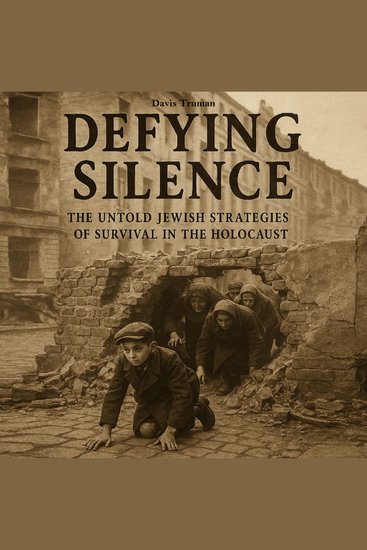
  • Defying Silence - The Untold Jewish Strategies of Survival in the Holocaust - cover

    Defying Silence - The Untold...

    Davis Truman

    • 0
    • 0
    • 0
    Discover the hidden stories of courage, resilience, and ingenuity that defy the silence surrounding Jewish survival during the Holocaust. This groundbreaking book uncovers the lesser-known strategies Jewish individuals and families used to endure unimaginable horrors and sustain hope against all odds. 
    •	Reveals untold survival tactics and resistance efforts rarely explored in history books 
    •	Brings to life firsthand testimonies and personal accounts of strength and perseverance 
    •	Illuminates the courage and creativity that shaped survival amidst relentless persecution 
    •	Offers a fresh perspective on the human spirit’s determination in one of history’s darkest chapters 
    •	A profound tribute to the resilience of Jewish communities and the legacy of hope they left behind 
    •	Essential reading for those interested in Holocaust history, Jewish heritage, and stories of human endurance 
    Defying Silence is more than a historical account; it is a moving testament to the power of hope, resistance, and the will to live.
    Show book