Join us on a literary world trip!
Add this book to bookshelf
Grey
Write a new comment Default profile 50px
Grey
Subscribe to read the full book or read the first pages for free!
All characters reduced
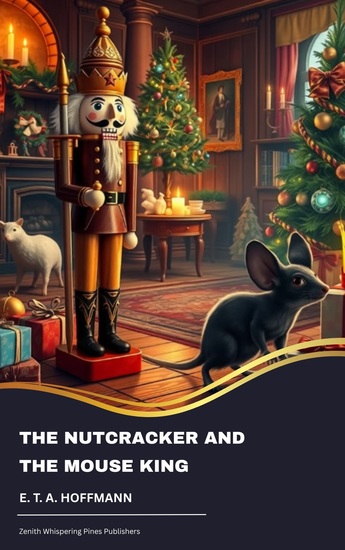
The Nutcracker and the Mouse King - cover

The Nutcracker and the Mouse King

E. T. A. Hoffmann

Publisher: Zenith Whispering Pines Publishers

  • 0
  • 0
  • 0

Summary

Experience the Original Tale Behind the World's Most Beloved Christmas Ballet!

Before Tchaikovsky composed his magical score, there was E. T. A. Hoffmann's enchanting, slightly darker, and wonderfully complex tale: The Nutcracker and the Mouse King.

Join young Marie Stahlbaum as her simple Christmas Eve transforms into a thrilling, sometimes terrifying, adventure. When her new toy nutcracker comes to life, she is swept into a secret war against the evil Mouse King and his seven-headed army.

If you love Christmas, fantasy, and the enduring power of classic children's literature, click "Buy Now" and let the adventure begin!
Available since: 12/15/2025.
Print length: 92 pages.

Other books that might interest you

  • In Bayswater - One family is home to many secrets in this classic modernist short story - cover

    In Bayswater - One family is...

    Mary Butts

    • 0
    • 0
    • 0
    Mary Frances Butts was born on 13th December 1890 in Poole, Dorset. 
     
    Her early years were spent at Salterns, an 18th-century house overlooking Poole Harbour.  Sadly in 1905 her father died, and she was sent for boarding at St Leonard's school for girls in St Andrews. 
     
    Her mother remarried and, from 1909, Mary studied at Westfield College in London, and here, first became aware of her bisexual feelings.  She was sent down for organising a trip to Epsom races and only completed her degree in 1914 when she graduated from the London School of Economics.  By then Mary had become an admirer of the occultist Aleister Crowley and she was given a co-authorship credit on his ‘Magick (Book 4)’. 
     
    In 1916, she began the diary which would now detail her future life and be a constant reference point for her observations and her absorbing experiences. 
     
    During World War I, she was doing social work for the London County Council in Hackney Wick, and involved in a lesbian relationship.  Life changed after meeting the modernist poet, John Rodker and they married in 1918. 
     
    In 1921 she spent 3 months at Aleister Crowley's Abbey of Thelema in Sicily; she found the practices dreadful and also acquired a drug habit.  Mary now spent time writing in Dorset, including her celebrated book of short stories ‘Speed the Plough’ which saw fully develop her unique Modernist prose style. 
     
    Europe now beckoned and several years were spent in Paris befriending many artists and writing further extraordinary stories.   
     
    She was continually sought after by literary magazines and also published several short story collections as books. Although a Modernist writer she worked in other genres but is essentially only known for her short stories.  Mary was deeply committed to nature conservation and wrote several pamphlets attacking the growing pollution of the countryside. 
     
    In 1927, she divorced and the following year her novel ‘Armed with Madness’ was published.  A further marriage followed in 1930 and time was spent attempting to settle in London and Newcastle before setting up home on the western tip of Cornwall.  By 1934 the marriage had failed. 
     
    Mary Butts died on 5th March 1937, at the West Cornwall Hospital, Penzance, after an operation for a perforated gastric ulcer. She was 46. 
     
    Her story ‘In Bayswater’ grippingly describes a man’s friendship with a dysfunctional family he rents a room from.  As each facet reveals itself his opinion and decisions change, back and forth, this way and that….
    Show book
  • Cymbeline King of Britain - cover

    Cymbeline King of Britain

    William Shakespeare

    • 0
    • 0
    • 0
    Cymbeline, also known as The Tragedie of Cymbeline or Cymbeline, King of Britain, is a play by William Shakespeare set in Ancient Britain (c. 10–14)[a] and based on legends that formed part of the Matter of Britain concerning the early Celtic British King Cunobeline. Although listed as a tragedy in the First Folio, modern critics often classify Cymbeline as a romance or even a comedy. Like Othello and The Winter's Tale, it deals with the themes of innocence and jealousy. While the precise date of composition remains unknown, the play was certainly produced as early as 1611.
    Cymbeline, the Roman Empire's vassal king of Britain, once had two sons, Guiderius and Arvirargus, but they were stolen twenty years earlier as infants by an exiled traitor named Belarius. Cymbeline discovers that his only child left, his daughter Imogen (or Innogen), has secretly married her lover Posthumus Leonatus, a member of Cymbeline's court. The lovers have exchanged jewellery as tokens: Imogen with a bracelet, and Posthumus with a ring. Cymbeline dismisses the marriage and banishes Posthumus since Imogen — as Cymbeline's only child — must produce a fully royal-blooded heir to succeed to the British throne. In the meantime, Cymbeline's Queen is conspiring to have Cloten (her cloddish and arrogant son by an earlier marriage) married to Imogen to secure her bloodline. The Queen is also plotting to murder both Imogen and Cymbeline, procuring what she believes to be deadly poison from the court doctor. The doctor, Cornelius, is suspicious and switches the poison with a harmless sleeping potion. The Queen passes the "poison" along to Pisanio, Posthumus and Imogen's loving servant — the latter is led to believe it is a medicinal drug. No longer able to be with her banished Posthumus, Imogen secludes herself in her chambers, away from Cloten's aggressive advances.
    Although the play is named Julius Caesar, Brutus speaks more than four times as many lines as the title character; and the central psychological drama of the play focuses on Brutus' struggle between the conflicting demands of honour, patriotism, and friendship. 
    Among the most significant works William Shakespeare: Hamlet, Othello, King Lear, Macbeth, Orpheus, Romeo and Juliet, Julius Caesar, Troilus and Cressida, The Tempest, Venus and Adonis, Antony and Cleopatra, Measure for Measure, The Winter's Tale and many more.
    Show book

  • The Time Machine - cover

    The Time Machine

    H. G. Wells

    • 0
    • 0
    • 0
    In The Time Machine we are thrown 800,000 years forward - into an age where the Earth is slowly dying. There we discover two bizarre peoples—the ethereal Eloi and the subterranean Morlocks.
    
    Published in 1895, Wells' masterpiece captivated readers on the threshold of a new century.
    Show book
  • If I Were a Man - From their pens to your ears genius in every story - cover

    If I Were a Man - From their...

    Charlotte Perkins Gilman

    • 0
    • 0
    • 0
    Charlotte Perkins Gilman was born on 3rd July 1860 in Hartford, Connecticut, to an unaffectionate mother and a father who abandoned her and her older brother to a life of poverty. 
    Inevitably her schooling was limited and by 15 she had attended seven different schools but received only four years education.  However Charlotte was resourceful and did spend time with her father’s aunts – the suffragist Isabella Beecher Hooker and the ‘Uncle Tom Cabin’s’ author, Harriet Beecher Stowe as well as many hours at the public library studying ancient civilisations. 
    In 1878, she enrolled in classes at the Rhode Island School of Design where she met Martha Luther and they developed a close relationship until Luther married in 1881. Charlotte was devastated and detested romance and love until she met and married the artist Charles Walter Stetson.  
    Their only child, Katharine Beecher Stetson, was born in 1885 but left Charlotte with post-natal depression, then often dismissed as a case of hysteria or nerves.  Unsuited to domestic life she ruptured her life and moved to California with Katherine.  She divorced in 1894 and then sent Katharine east to live with her father and his second wife confirming that his paternal rights be acknowledged and that Katherine establish a relationship with her father. 
    After her mother died in 1893, Charlotte moved back east and became involved with her first cousin, Wall Street attorney, Houghton Gilman who she married in 1900. After his death she moved back to California, where Katherine now lived.   
    Her most popular story is ‘The Yellow Wallpaper’ which touched on her own post-partum depression and underlined the need for women to be responsible for their mental and physical well-being, as the narrator is ordered by her husband/doctor to take compete rest in her room where she is isolated and becomes obsessed with the revolting yellow wallpaper.   
    She wrote other notable short stories the best of which we also include.   
    Charlotte lectured widely for social reform, wrote important non-fiction works that questioned our patriarchal system and left a legacy as a leading and positive spokesperson for feminism.  
    She was diagnosed with incurable breast cancer in 1932 and, as she wrote in her suicide note and autobiography, she ‘chose chloroform over cancer’    
    Charlotte Perkins Gilman took her own life on 17th August 1935, aged 75, in Pasadena, California.
    Show book
  • The Domain of Arnheim - cover

    The Domain of Arnheim

    Sampi Books, Edgar Allan Poe

    • 0
    • 0
    • 0
    In "The Domain of Arnheim", Edgar Allan Poe explores the aesthetics and power of nature through Ellison, a wealthy man who creates an impressive landscaped garden. This tale discusses themes of beauty, art and idealism, as Ellison uses his fortune to shape a perfect earthly refuge.
    Show book
  • The Ghost and the Bone Setter - From their pens to your ears genius in every story - cover

    The Ghost and the Bone Setter -...

    Sheridan Le Fanu

    • 0
    • 0
    • 0
    Joseph Sheridan Le Fanu was born on 28th August 1814 in Dublin into a literary family with Huguenot, Irish and English roots.   
    For a time he and his siblings were tutored but Le Fanu would often immerse himself in the books of his father’s library. 
    In 1833 Le Fanu began his Law studies at Trinity College, Dublin and graduated in 1839. Although called to the bar he instead began a career in journalism.   
    He was also writing. His first fiction story ‘The Ghost and the Bonesetter’ was published in 1838.  In 1843 came the novella ‘Spalatro: From the Notes of Fra Giacomo’, a hero with a particular necrophiliac passion for an undead blood-drinking beauty, a forerunner to his later female vampire ‘Carmilla’.  
    In 1844 Le Fanu married Susanna Bennett with whom he had 4 children. The following year his first novel ‘The C'ock and Anchor’ was published. Works now flowed from his pen and with a rapid increase in family finances they moved, in 1851, to Merrion Square, Dublin, where he remained until his death.  
    In 1858 Susanna died and Le Fanu became reclusive. It was during this period that he produced some of his best work.  Working only by candlelight he wrote through the night, burnishing his reputation as a major figure of 19th Century supernaturalism with many classics including; ‘Green Tea’, ‘Mr Justice Harbottle’, and ‘In a Glass Darkly’.  
    Joseph Thomas Sheridan Le Fanu died in Merrion Square in his native Dublin on February 7th, 1873, at the age of 58.
    Show book