Join us on a literary world trip!
Add this book to bookshelf
Grey
Write a new comment Default profile 50px
Grey
Subscribe to read the full book or read the first pages for free!
All characters reduced
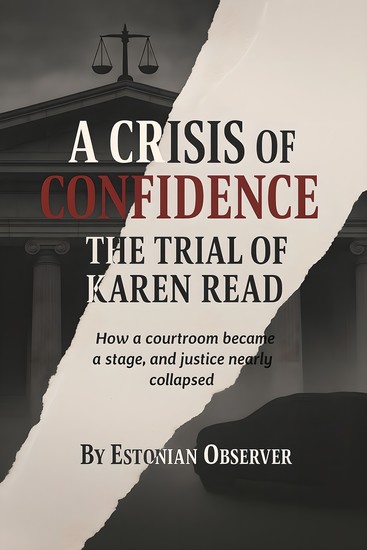
A Crisis of Confidence - The Trial Of Karen Read - cover

A Crisis of Confidence - The Trial Of Karen Read

Estonian Observer

Publisher: Publishdrive

  • 0
  • 0
  • 0

Summary

A high-profile trial should reassure the public that justice works. Instead, the case of Karen Read shook faith in the system. This book tells the story of how a courtroom turned into a stage, where performance overshadowed truth and theater replaced evidence. At the heart of it is a prosecution that pushed the limits of fairness, and a defense forced to fight back against distortion and pressure. Readers will see how close one woman came to being convicted not by proof, but by suggestion — and why that near miss matters for everyone.
 
Tense, sharp, and unsettling, A Crisis of Confidence is more than one woman’s story. It’s about the fragility of justice when confidence replaces evidence, and what happens when ordinary citizens are asked to stand against the weight of the state.
Available since: 08/16/2025.
Print length: 198 pages.

Other books that might interest you

  • The 369 Method Bible - Understand How to Attract the Energy of the Universe and Use it to Achieve Your Goals - cover

    The 369 Method Bible -...

    D. Kobayashi

    • 0
    • 0
    • 0
    THE DEFINITIVE EDITION FOR BEGINNERS ABOUT THE 369 METHOD! +600 AFFIRMATIONS 
    Have you ever noticed that some people seem to be handed all the opportunities or seem to be incredibly lucky, always getting what they want and need without seeming to try? Have you also noticed that there are some people who seem to attract bad luck and never seem to catch a break? Maybe you feel that one of these describes you, and if you do, you are not alone. 
    People everywhere feel like they are missing their potential by being unable to get the opportunities that they need. The 369 Method uses the Law of Attraction to show you how to make the reality you want using the powers of your own mind. The Law of Attraction is often used by spiritual people, but the realm of quantum physics also shows that it is a scientific idea that explains the construction of reality and our universe. Therefore, the Law of Attractions has a special quality of connecting the spiritual and the scientific. 
    Including in this updated edition: 
    - The Law of Attraction: You are the Creator of Your Reality 
    - Signs, Frequencies, and Vibrations of the Universe 
    - Angel Numbers and Signs: Learn How to Use Them to Your Advantage 
    - Science & Math of the Attraction: The Quantum Entanglement 
    - Most Useful Daily Techniques of the 369 Method 
    - + 600 affirmations about love, money and grattitude 
    - And much more!
    Show book
  • The Science of Mummification - Techniques and Secrets Revealed - cover

    The Science of Mummification -...

    Omar Khalil

    • 0
    • 0
    • 0
    Mummification, the art and science of preserving bodies after death, has fascinated both historians and scientists for centuries. In ancient Egypt, mummification was not merely a process of preservation but also a vital part of the culture’s religious beliefs. The Egyptians believed in an afterlife, where the soul would continue to exist in a parallel realm. The preservation of the body was considered essential for the soul’s journey, as it would serve as a vessel for the soul's return. This chapter delves into the origins and purpose of mummification, shedding light on the techniques that evolved over millennia. 
    The practice of mummification is believed to have begun around 3500 BCE, initially as a natural process. Early Egyptians buried their dead in shallow graves in the hot, dry desert sands. The dry conditions naturally desiccated the bodies, preserving them for years or even centuries. However, as Egyptian society developed and religious beliefs became more complex, the need for a more deliberate and refined method of preservation emerged. Over time, the Egyptians developed techniques to prevent decomposition, ensuring that the deceased would be preserved for the afterlife. 
    Mummification’s primary purpose was to ensure the deceased’s body remained intact for the soul’s journey to the afterlife. Ancient Egyptians believed that the body was necessary for the soul to recognize and reunite with the deceased in the next world. The process, therefore, was not just about keeping the body intact; it was about ensuring the deceased's spiritual well-being. Alongside the physical mummification process, elaborate burial rituals were performed, including the offering of food, goods, and prayers to help guide the deceased through the afterlife.
    Show book
  • Truth is the invention of a liar - Conversations on Epistemology and Ethics - cover

    Truth is the invention of a liar...

    Heinz von Foerster, Bernhard...

    • 0
    • 0
    • 0
    "This book is so rich with insights, sparkling dialogue, and wisdom that one would love to distribute it like a leaflet around town."
    
    Südwestrundfunk (German radio station)
    "The intellectual dance that the two dare to dance is intelligent, light, humorous, and enchanting."
    
    Süddeutsche Zeitung (German daily)
    "I recommend this book not only to the cybernetics and systems community, but to anyone."
    
    Ranulph Glanville, Cybernetics and Human Knowing
    "Easy and enjoyable to read, without loss of scientific and philosophical depth and rigor. … The reader will find the book difficult to put down."
    
    Bernd R. Hornung, Journal of Sociocybernetics
    Conversations for skeptics
    
    How real is reality? Are our images of the world mere inventions or do they correspond to an external reality? Is it possible to know the truth?
    
    These are some of the questions that are discussed in this book by physicist and philosopher Heinz von Foerster and media studies scholar Bernhard Poerksen. Together they explore the limits of our cognitive capacities; they debate the apparent objectivity of our sensual perception and the consequences of "truth terrorism"; and they talk about the relationship between knowledge and ethics, sight and insight.
    The authors:
    Heinz von Foerster (1911–2002) completed his studies of physics in Vienna and worked at different research labs before emigrating to the United States in 1949. In 1957, at the University of Illinois, he established the Biological Computer Lab (BCL) – the cradle of the epistemology that would later cause a stir under the label of "constructivism." The focus was on analyzing the logical and methodological problems that in evitably arise when one seeks to know knowledge. He is the author of numerous books, including Understanding Understanding: Essays on Cybernetics and Cognition.
    Bernhard Poerksen is professor of media studies at the University of Tübingen with a particular research interest in the new media age. His books about systemic thinking have been translated into many languages. In 2008 he was voted "Professor of the Year" in honor of his teaching. His most recent book publications in English include From Being to Doing: The Origins of the Biology of Cognition (with Humberto Maturana), The Unleashed Scandal: The End of Control in the Digital Age (with Hanne Detel), and Digital Fever: Taming the Big Business of Disinformation.
    Show book
  • Finis Britanniae - A Military History of Late Roman Britain and the Saxon Conquest - cover

    Finis Britanniae - A Military...

    Murray Dahm

    • 0
    • 0
    • 0
    The end of Roman Britain and the arrival of the invading Saxons forms part of the most disruptive period in Britain’s history. Centuries of relative stability as a Roman province gave way to an age of conquest and destruction. It is a period which is difficult to comprehend, coming at the end of the Roman era and in the pre-dawn of the Medieval. It is a Dark Age, both in terms of our apparent lack of source material and in our understanding of events. As a result, several legendary figures appear – it is the age of Arthur, Merlin and others; figures steeped in mystery, mysticism and magic, allowed to thrive in the paucity of the source material. 
     
    In this new analysis, Murray Dahm explores the military history of Roman Britain’s slow decline, going back to the roots of the province’s final rupture from Rome in the fifth century and the subsequent invasions. Using a wide array of sources, the author illuminates this dark world and examines what we know (or what we think we know) of the Angle, Jute, Saxon and other invasions that took advantage of Rome’s absence and which, in their own way, shaped the Britain of today.
    Show book
  • Keeping Family Secrets - Shame and Silence in Memoirs from the 1950s - cover

    Keeping Family Secrets - Shame...

    Margaret K. Nelson

    • 0
    • 0
    • 0
    All families have secrets but the facts requiring secrecy change with time. Nowadays a lesbian partnership, a "bastard" son, or a criminal grandfather might be of little or no consequence but could have unraveled a family at an earlier moment in history. Margaret K. Nelson is interested in how families keep secrets from each other and from outsiders when to do otherwise would risk eliciting not only embarrassment or discomfort, but profound shame and, in some cases, danger. Drawing on over 150 memoirs describing childhoods in the period between the aftermath of World War II and the 1960s, Nelson highlights the importance of history in creating family secrets and demonstrates the use of personal stories to understand how people make sense of themselves and their social worlds. 


    Keeping Family Secrets uncovers hidden stories of same-sex attraction among boys, unwed pregnancies among teenage girls, the institutionalization of children with mental and physical disabilities, participation in left-wing political activities, adoption, and Jewish ancestry. The members of ordinary families kept these issues secret to hide the disconnect between the reality of their own family and the prevailing ideals of what a family should be. Keeping Family Secrets sheds light not only on decades-old secrets but pushes us to confront what secrets our families keep today.
    Show book
  • Stories Dice and Rocks That Think - How Humans Learned to See the Future–and Shape It - cover

    Stories Dice and Rocks That...

    Byron Reese

    • 0
    • 0
    • 0
    What makes the human mind so unique? And how did we get this way? 


    This fascinating tale explores the three leaps in our history that made us what we are—and will change how you think about our future. 


    Look around. Clearly, we humans are radically different from the other creatures on this planet. But why? Where are the Bronze Age beavers? The Iron Age iguanas? In Stories, Dice, and Rocks That Think, Byron Reese argues that we owe our special status to our ability to imagine the future and recall the past, escaping the perpetual present that all other living creatures are trapped in. 


    Envisioning human history as the development of a societal superorganism he names Agora, Reese shows us how this escape enabled us to share knowledge on an unprecedented scale, and predict—and eventually master—the future. 


    Thoughtful and witty, this must-listen book unravels our history as an intelligent species in three acts. A fresh new look at the history and destiny of humanity, listeners will come away from Stories, Dice, and Rocks That Think with a new understanding of what they are—not just another animal, but a creature with a mastery of time itself.
    Show book