Join us on a literary world trip!
Add this book to bookshelf
Grey
Write a new comment Default profile 50px
Grey
Subscribe to read the full book or read the first pages for free!
All characters reduced
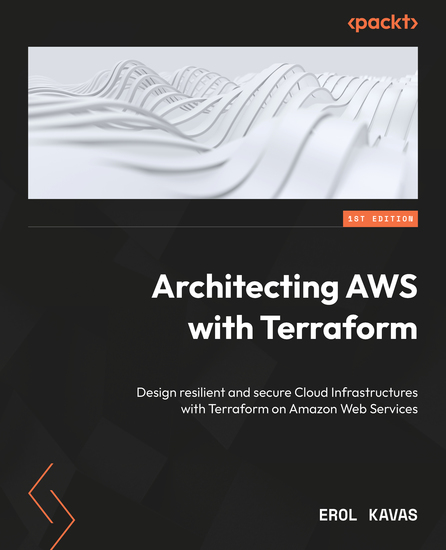
Architecting AWS with Terraform - Design resilient and secure Cloud Infrastructures with Terraform on Amazon Web Services - cover

Architecting AWS with Terraform - Design resilient and secure Cloud Infrastructures with Terraform on Amazon Web Services

Erol Kavas

Publisher: Packt Publishing

  • 0
  • 0
  • 0

Summary

Infrastructure as code (IaC) and Terraform have become essential tools for managing cloud infrastructure and automating deployment processes. Mastering Terraform on AWS presents a step-by-step approach on how to master these tools and build a secure and scalable AWS infrastructure.The book starts with an introduction to patterns and anti-patterns of IaC and Terraform, explaining the common mistakes and pitfalls you must avoid. You’ll then learn about the importance of planning and designing infrastructure projects in AWS and making informed decisions for projects in AWS Terraform. You’ll find out how to implement Terraform in your projects and deploy serverless projects. Next, you’ll be able to deploy containers in AWS with Terraform, exploring the best practices for Terraform IaC projects. You’ll understand how you can leverage Terraform for enterprises, build Git workflows for IaC and Terraform projects, and automate deployment of Terraform projects. The last set of chapters will teach you how to govern AWS with Terraform and build a secure infrastructure. Finally, you’ll discover how to achieve a perfect AWS infrastructure with Terraform.By the end of this book, you’ll have gained a comprehensive understanding of the various aspects of Terraform and IaC, along with the knowledge required to build, manage, and deploy complex infrastructures on AWS.
Available since: 12/29/2023.
Print length: 260 pages.
Other books that might interest you

  • Algorithms - cover

    Algorithms

    Panos Louridas

    • 0
    • 0
    • 0
    Digital technology runs on algorithms, sets of instructions that describe how to do something efficiently. Application areas range from search engines to tournament scheduling, DNA sequencing, and machine learning. Arguing that every educated person today needs to have some understanding of algorithms and what they do, in this volume in the MIT Press Essential Knowledge series, Panos Louridas offers an introduction to algorithms that is accessible to nonspecialists. Louridas explains not just what algorithms are but also how they work, offering a wide range of examples and keeping mathematics to a minimum. 


    After discussing what an algorithm does and how its effectiveness can be measured, Louridas covers three of the most fundamental applications areas: graphs, which describe networks, from eighteenth-century problems to today's social networks; searching, and how to find the fastest way to search; and sorting, and the importance of choosing the best algorithm for particular tasks. He then presents larger-scale applications: PageRank, Google's founding algorithm; and neural networks and deep learning. Finally, Louridas describes how all algorithms are nothing more than simple moves with pen and paper, and how from such a humble foundation rise all their spectacular achievements.
    Show book
  • Space Telescopes - Astronomy and the Electromagnetic Spectrum - cover

    Space Telescopes - Astronomy and...

    Steff Jaywan

    • 0
    • 0
    • 0
    Space telescopes are powerful instruments designed to observe astronomical objects and phenomena from outside the Earth's atmosphere. Unlike ground-based telescopes, which suffer from atmospheric distortion, space telescopes provide a clearer and more detailed view of the universe. They have revolutionized our understanding of the cosmos by capturing images and data across various wavelengths of light, from visible to infrared to ultraviolet and beyond. 
      
    The primary advantage of space telescopes is their ability to operate above the Earth's atmosphere. The atmosphere absorbs and scatters light, which limits the capabilities of ground-based observations. By placing telescopes in space, astronomers can avoid these issues and achieve several key benefits. Space telescopes have an unobstructed view, not being affected by weather, daylight, or atmospheric turbulence, allowing for continuous and consistent observations. They also have broader wavelength coverage, as Earth's atmosphere blocks many wavelengths of light, such as ultraviolet and X-rays. This enables space telescopes to detect and study these wavelengths, offering a more comprehensive view of the universe. Moreover, without atmospheric distortion, space telescopes can capture sharper and more detailed images.
    Show book
  • Designed to the Core - cover

    Designed to the Core

    Hugh Ross

    • 0
    • 0
    • 0
    Are you up for a trip through the ultimate neighborhood? Join astrophysicist Hugh Ross for an insider’s look at our cosmic neighborhood, where you’ll see everything from the largest-scale structure of the universe to Earth’s innermost layers. In Designed to the Core, Ross explains how the most sophisticated scientific instruments reveal exquisite “interior designs” throughout the universe that are ideally suited for human habitation here on Earth right now. This scientific excursion takes us to the interior structures of super-superclusters of galaxies, clusters of galaxies, local galaxies, our Milky Way Galaxy, the Sun, our planetary system, the Moon, and Earth’s interior—all of which reveal fine-tuning that manifests a Designer’s planning and preparation.Please note that you may download accompanying PDFs that provide enhanced materials for this audiobook at https://reasons.org/audiobooks.
    Show book
  • Turtles - A Complete Guide to Turtle Health and Happiness - cover

    Turtles - A Complete Guide to...

    Angie Tracks

    • 0
    • 0
    • 0
    Turtles have long captivated the human imagination with their distinctive, often slow-moving nature and hard, protective shells. These fascinating creatures have been around for over 200 million years, making them one of the oldest surviving reptiles. Whether you encounter them in the wild or decide to keep one as a pet, turtles can offer an enriching and fulfilling experience. 
    This guide aims to provide you with comprehensive information to ensure that your turtle lives a long, healthy, and happy life in your care. Turtles may seem like low-maintenance pets at first glance, but they require specific care, attention, and an understanding of their needs. By learning about their biology, behavior, and specific habitat and dietary requirements, you will be better equipped to provide a comfortable and stimulating environment for your turtle. 
    The first step in becoming a responsible turtle owner is recognizing the responsibility that comes with keeping these animals as pets. Turtles can live for several decades, with some species reaching up to 50 years or more in captivity. This long lifespan means that owning a turtle is a commitment, and you must be prepared for the long-term care and attention they require.
    Show book
  • Wired To Change - How Neuroplasticity Shapes Your Brain Habits And Life - cover

    Wired To Change - How...

    Brian Gibson

    • 0
    • 0
    • 0
    Unlock the astonishing power of your brain to rewire itself, transforming the way you think, act, and live. 
    Wired to Change is a groundbreaking guide that demystifies neuroplasticity, the brain's remarkable ability to adapt and evolve at any stage of life. Drawing on cutting-edge neuroscience, psychology, and practical strategies, this book empowers you to take charge of your mental pathways and rewrite the patterns that shape your daily behavior. 
    Whether you're looking to break free from limiting habits, cultivate resilience, or unlock peak performance, this book offers a science-backed roadmap to rewiring your brain for lasting change. You'll discover: 
    ·        How thought patterns physically reshape your brain's neural architecture 
    ·        The science of habit loops and how to reprogram them 
    ·        Why mindset matters more than motivation 
    ·        Tools to reduce anxiety, boost focus, and enhance emotional balance 
    ·        Proven techniques to create meaningful, lasting personal growth 
    Wired to Change bridges the gap between science and self-transformation, offering insight and action. This book will leave you equipped and inspired to become the conscious architect of your mind. 
    You are not stuck. You are wired to change.
    Show book
  • Time Waves - How to Spot them How to Surf Them - cover

    Time Waves - How to Spot them...

    Michael Mathiesen

    • 0
    • 0
    • 0
    What if time isn’t a straight line—but a wave you can ride? 
    In Time Waves, Michael Mathiesen invites readers on a mind-bending journey through the quantum surf of reality itself. Blending cutting-edge physics, mythic resonance, and visionary storytelling, this book challenges everything we think we know about time, consciousness, and our place in the universe. 
    Spot the Patterns. Feel the Pull. Catch the Wave. 
    This book is more than a theory—it’s a call to action. Mathiesen urges readers to become “time surfers,” attuned to the subtle pulses of possibility that ripple through the cosmos. With practical insights and poetic flair, he shows how to:Recognize when you're caught in a destructive trough—and how to paddle out.Amplify constructive interference in relationships, creativity, and decision-making.Use metaphor as a scientific instrument—bridging the gap between intuition and data.Reframe synchronicity as a measurable phenomenon, not mere coincidence.Design your life as a waveform—balancing chaos and coherence, risk and rhythm. 
    If you’ve ever pondered the nature of time after reading Carlo Rovelli’s The Order of Time, or felt the eerie precision of Jung’s synchronicities, or marveled at gravitational wave detections from LIGO, Time Waves will feel like a homecoming—and a launchpad. 
    Michael Mathiesen is not just writing—he’s building a wave. With cinematic teasers, tweet bursts, and outreach to space agencies, Time Waves is part of a larger mission to shift how we think, feel, and act in relation to time. Readers are invited to become co-creators, surfers, and storytellers in this unfolding paradigm.  
    Show book