Join us on a literary world trip!
Add this book to bookshelf
Grey
Write a new comment Default profile 50px
Grey
Subscribe to read the full book or read the first pages for free!
All characters reduced
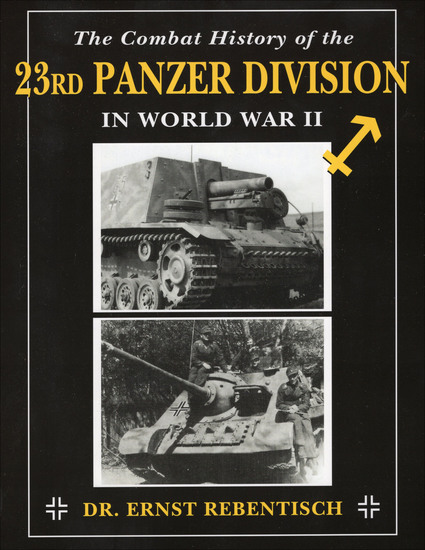
The Combat History of the 23rd Panzer Division in World War II - cover

The Combat History of the 23rd Panzer Division in World War II

Ernst Rebentisch

Publisher: Rowman & Littlefield Publishers

  • 0
  • 0
  • 0

Summary

From a WWII veteran, an illustrated military history of the German tank division that fought exclusively on the Eastern front.   In 1939 and 1940, the German armored division Panzertruppe initiated a chain of victories that seemed unstoppable. In this account from Ernst Rebentisch, a member of the 23rd Panzer division during World War II, you’ll find a history of the tank division unit that operated near Stalingrad and in Ukraine, Poland, Hungary, and Austria, relying heaving on captured enemy tanks such as Soviet T-34s. Containing eight pages of color vehicle profiles, this book is a valuable resource for armor modelers and military enthusiasts.
Available since: 06/14/2023.
Print length: 544 pages.

Other books that might interest you

  • Freedom and Destiny - cover

    Freedom and Destiny

    Rollo May

    • 0
    • 0
    • 0
    The popular psychoanalyst examines the continuing tension in our lives between the possibilities that freedom offers and the various limitations imposed upon us by our particular fate or destiny. 


    "May is an existential analyst who deservedly enjoys a reputation among both general and critical readers as an accessible and insightful social and psychological theorist . . . Freedom's characteristics, fruits, and problems; destiny's reality; death; and therapy's place in the confrontation between freedom and destiny are examined . . . Poets, social critics, artists, and other thinkers are invoked appropriately to support May's theory of freedom and destiny's interdependence." —Library Journal 


    "Especially instructive, even stunning, is Dr. May's willingness to respect mystery . . . There is, too, at work throughout the book a disciplined yet relaxed clinical mind, inclined to celebrate . . . what Flannery O'Connor called 'mystery and manners,' and to do so in a tactful, meditative manner." —Robert Coles, America
    Show book
  • The 6 Types of Working Genius - A Better Way to Understand Your Gifts Your Frustrations and Your Team - cover

    The 6 Types of Working Genius -...

    Patrick M. Lencioni

    • 0
    • 0
    • 0
    New York Times best-selling author Patrick Lencioni unveils a truly groundbreaking new model that will change the way we think about work and teams forever. 
     
    The 6 Types of Working Genius is the fastest way to help people identify the type of work that brings them joy and energy—and avoid work that leads to frustration and burnout. 
     
    Beyond the personal discovery and instant relief that the Working Genius provides, the model also gives teams a remarkably simple and practical framework for tapping into one another’s natural gifts, which increases productivity and reduces unnecessary judgment. 
     
    In classic Lencioni fashion, Pat brings his model to life in a page-turning fable that is as relatable as it is compelling. He tells the story of Bull Brooks, an entrepreneur, husband, and father, who sets out to solve his own frustration at  
    work and stumbles into a new way of thinking that changes the way he sees his work, his team, and even his marriage. 
     
    What sets this book—and the model behind it—apart from other tools and assessments is the speed at which it can be understood and applied, and the relevance it has to every kind of work in life, from running a company to launching a product to managing a family.
    Show book
  • Hermann Röchling: The Factory of the Third Reich - cover

    Hermann Röchling: The Factory of...

    Margaret Manale

    • 0
    • 0
    • 0
    Who now remembers Hermann Röchling (1872-1955), an emblematic figure of German industry during the two world wars. A Nazi from the very beginning, he was one of the main protagonists of this sinister movement, alongside Albert Speer and Adolf Hitler. He did not shy away from any measure to support the National Socialist effort, and his power was such that the Americans referred to him as the “czar” of a regime that functioned on the backs of millions of enslaved workers.
    A steel magnate and notorious anti-Semite, Hermann Röchling fell through the cracks of history. Margaret Manale is the first researcher to devote an exhaustive biography to him. She explains the reasons why such a character has remained almost unnoticed. She sheds light on the difficulty of judging him in the aftermath of the collapse of the Third Reich.
    To put his personality into perspective, Manale goes back to the origins of the family in 1870 and the French defeat by Germany. For 170 years, the Röchlings played a major role in these successive conflicts and in particular in the struggle for control of the mines in Alsace-Lorraine. Herman Röchling was prosecuted and sentenced at Nuremberg for war crimes in 1946 but, under American pressure, he was pardoned in 1951 in order to revive Germany quickly and build a strong Europe in the face of the Soviet threat.
    This shocking book is the implacable account of one man’s deception and the weight of realpolitik.
    Show book
  • Beyond Good and Evil - Philosophy of Morality Truth and Human Strength - cover

    Beyond Good and Evil -...

    Friedrich Nietzsche, Tim Zengerink

    • 0
    • 0
    • 0
    What if you could challenge conventional morality, seek deeper truths, and unlock the strength to live authentically and powerfully? 
    Beyond Good and Evil: Philosophy of Morality, Truth, and Human Strength presents Friedrich Nietzsche’s groundbreaking exploration of ethics, truth, and human nature, now thoughtfully adapted for today’s listeners. 
    Written in the late 19th century, Beyond Good and Evil critiques traditional morality and calls on humanity to rise above simplistic notions of “good” and “evil.” Nietzsche invites us to question societal norms, embrace intellectual freedom, and cultivate the strength to create our own values and meaning. 
    This isn’t just a philosophical work—it’s a transformative guide to thinking independently, embracing life’s complexities, and unlocking your potential to live with purpose and power. Nietzsche’s insights resonate deeply in today’s world, challenging listeners to confront assumptions and discover their true strength. 
    What You’ll Discover: 
    - The Truth About Morality: Examine how traditional ideas of “good” and “evil” limit personal and societal growth. 
    - Intellectual Freedom and Power: Learn to think independently, question everything, and embrace complexity. 
    - Human Strength and Individuality: Rise above conformity, cultivate resilience, and create your own values. 
    Clear, Accessible Language: Experience Nietzsche’s ideas in a modern translation that’s easy to understand and apply. 
    - Nietzsche’s vision challenges us to embrace intellectual courage, authenticity, and the strength to break free from conventional thinking. 
    Imagine having the tools to explore life’s deeper questions, break through limiting beliefs, and create a life of meaning and authenticity. 
    Download your copy today and transform your understanding of morality, truth, and human strength with Nietzsche’s timeless wisdom.
    Show book
  • Treaty Justice - The Northwest Tribes the Boldt Decision and the Recognition of Fishing Rights - cover

    Treaty Justice - The Northwest...

    Charles Wilkinson

    • 0
    • 0
    • 0
    In 1974, Judge George Boldt issued a ruling that affirmed the fishing rights and tribal sovereignty of Native nations in Washington State. The Boldt Decision transformed Indigenous law and resource management across the United States and beyond. The case also brought about far-reaching societal changes, reinforcing tribal sovereignty and remedying decades of injustice. 


    Eminent legal historian and tribal advocate Charles Wilkinson tells the story of the Boldt Decision against the backdrop of salmon's central place in the cultures and economies of the Pacific Northwest. In the 1960s, Native people reasserted their fishing rights as delineated in nineteenth-century treaties. In response, state officials worked with non-Indian commercial and sport fishing interests to forcefully oppose Native actions. These "fish wars" spurred twenty tribes and the United States government to file suit in federal court. Boldt pointedly waited until Lincoln's birthday to hand down a decision recognizing the tribes' right to half of the state's fish. The case's aftermath led from the Supreme Court's affirmation of Boldt's opinion to collaborative management of the harvest of salmon. 


    Treaty Justice weaves personalities and local detail into the definitive account of one of the twentieth century's most important civil rights cases.
    Show book
  • Phoney War The: The History of the Uneasy Calm along the Western Front at the Start of World War II - cover

    Phoney War The: The History of...

    Editors Charles River

    • 0
    • 0
    • 0
    Though the French would be decisively defeated soon after the Nazi invasion of Belgium and France in early 1940, they had not sat on their hands. As the power of Nazi Germany grew alarmingly during the 1930s, the French sought means to defend their territory against the rising menace of the Thousand Year Reich. As architects of the most punitive measures in the Treaty of Versailles following World War I, France was the most natural target for German retribution, so the Maginot Line, a series of interconnected strongpoints and fortifications running along much of France's eastern border, helped allay French fears of invasion.  
    	The popular legend of the Maginot Line portrays the frontier defenses as a useless “white elephant” project that was prompted by a gross misapprehension of warfare's new realities in the mid-20th century and quickly overwhelmed by the forceful advance of the German blitzkrieg. English idiom today invokes this vision of the Maginot Line as a metaphor for any defensive measure strongly believed in but actually useless. Indeed, usages such as “Maginot Line mentality,” describing an overly defensive, reactive mindset, perpetuate the legend. As a French author and military liaison with the British, Andre Maurois, wrote about his disillusionment with the defensive line he originally enthusiastically supported: “We know now that the Maginot line-complex was a dangerous disease of the mind; but I publish this as it was written in January, 1940.”  
    This was what brought about the stasis along the Western Front near the end of 1939, a short period of time now referred to as the Phoney War, during which the Western Allies awaited some sort of action by the Nazis. Ultimately, the Allies had not expected the Germans would be able to move armored units through the Ardennes Forests, a heavily wooded region spanning parts of Belgium, France and the Netherlands. 
    Show book