Join us on a literary world trip!
Add this book to bookshelf
Grey
Write a new comment Default profile 50px
Grey
Subscribe to read the full book or read the first pages for free!
All characters reduced
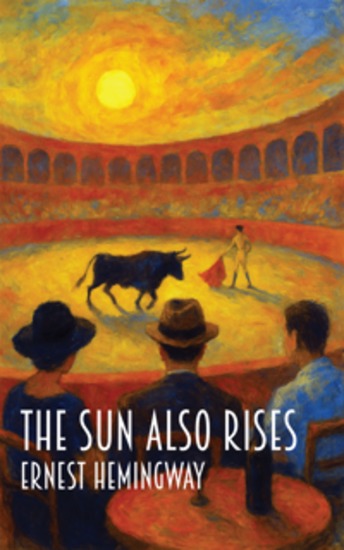
The Sun Also Rises (Classicus Edition) - cover

The Sun Also Rises (Classicus Edition)

Ernest Hemingway

Publisher: Classicus

  • 0
  • 0
  • 0

Summary

First published in 1926, The Sun Also Rises is Ernest Hemingway’s groundbreaking novel of love, loss, and disillusionment in the aftermath of World War I. Set in the bohemian cafes of Paris and the sun-soaked streets of Pamplona, the story follows American journalist Jake Barnes and a group of expatriate friends searching for meaning amid the ruins of their generation. With its vivid scenes of bullfights, romantic entanglements, and restless wandering, the novel captures the reckless energy and emotional detachment of the “Lost Generation.”     At its heart is Jake’s aching devotion to the charismatic Lady Brett Ashley—a woman as magnetic as she is unattainable. Around them swirls a cast of war-damaged characters grasping at pleasure, pride, and purpose in a world that no longer makes sense. Hemingway’s lean, understated prose cuts through pretense and sentimentality, offering an honest, unflinching portrait of human connection in a time of spiritual drift.     Now presented by Classicus, this enduring classic remains as powerful and relevant as ever. The Sun Also Rises is not only a defining work of modernist literature—it’s a timeless meditation on identity, desire, and the fragile search for meaning in a world adrift.
Available since: 05/07/2025.

Other books that might interest you

  • Frankenstein - The Lost Manuscript - cover

    Frankenstein - The Lost Manuscript

    Mary Shelley

    • 0
    • 0
    • 0
    A POWERFUL FULL-CAST DRAMATIC MARATHON  
     
    “Beware; for I am fearless, and therefore powerful.”  
     
    Mary Shelley was an English novelist who wrote the Gothic novel Frankenstein; or, The Modern Prometheus in 1818, which is considered an early example of science fiction. She also edited and promoted the works of her husband, the Romantic poet, and philosopher Percy Bysshe Shelley. Her father was the political philosopher William Godwin and her mother the philosopher and feminist activist Mary Wollstonecraft. 
     
    Shelley's mother died less than a month after giving birth to her. She was raised by her father, who provided her with a rich if informal education, encouraging her to adhere to his own anarchist political theories. When she was four, her father married a neighbor, Mary Jane Clairmont, with whom Shelley came to have a troubled relationship. 
     
    In 1814, Shelley began a romance with one of her father's political followers, Percy Bysshe Shelley, who was already married. Together with her stepsister, Claire Clairmont, she and Percy left for France and traveled through Europe. Upon their return to England, Shelley was pregnant with Percy's child. Over the next two years, she and Percy faced ostracism, constant debt, and the death of their prematurely born daughter. They married in late 1816, after the suicide of Percy Shelley's first wife, Harriet. 
     
    In 1816, the couple and her stepsister famously spent a summer with Lord Byron and John William Polidori near Geneva, Switzerland, where Shelley conceived the idea for her novel Frankenstein. The Shelleys left Britain in 1818 for Italy, where their second and third children died before Shelley gave birth to her last and only surviving child, Percy Florence Shelley.
    Show book
  • To the Lighthouse - cover

    To the Lighthouse

    Virginia Woolf

    • 0
    • 0
    • 0
    What does it mean to truly see the people we love?
    
    First published in 1927, To the Lighthouse by Virginia Woolf is widely regarded as one of the greatest novels of the twentieth century. Set in a summer house by the sea, the novel follows the Ramsay family and their guests over two days separated by a decade, revealing how time, memory, and loss shape human relationships.
    
    Through Woolf's masterful stream-of-consciousness style, the story moves fluidly between inner thoughts and quiet moments, capturing the emotional depth beneath ordinary life. The novel's central journey to the lighthouse becomes a powerful symbol of longing, perception, and artistic vision.
    
    This modernist masterpiece explores themes of family, creativity, impermanence, and the passage of time with extraordinary sensitivity.
    
    Inside this eBook, you'll explore:
    
    One of the defining works of literary modernism
    
    Woolf's innovative narrative technique
    
    A profound meditation on memory and change
    
    A richly layered portrait of family and identity
    
    Frequently studied in literature courses and celebrated for its emotional power, To the Lighthouse remains essential reading for anyone drawn to classic fiction and modernist storytelling.
    
    Journey toward the lighthouse and discover a novel that continues to illuminate the inner life. Buy now and experience one of Virginia Woolf's greatest works.
    Show book
  • Common Sense - cover

    Common Sense

    Thomas Paine

    • 0
    • 0
    • 0
    Do you want to listen to Common Sense? If so then keep reading…Common Sense is the timeless classic that inspired the Thirteen Colonies to fight for and declare their independence from Great Britain in the summer of 1776. Written by famed political theorist Thomas Paine, this pamphlet boldly challenged the authority of the British government and the royal monarchy to rule over the American colonists.By using plain language and a reasoned style, Paine chose to forego the philosophical and Latin references made popular by the Enlightenment era writers. As a result, Paine united average citizens and political leaders behind the central idea of independence and transformed the tenor of the colonists’ argument against the British. As the best-selling American title of all time, Common Sense has been eloquently described by historian Gordon S. Wood as "the most incendiary and popular pamphlet of the entire revolutionary era."Thomas Paine (1737–1809) was an English-American political activist, philosopher, and revolutionary. As one of the Founding Fathers of the United States, he authored the most influential pamphlets at the start of the American Revolution and inspired the colonists to declare independence from Great Britain in 1776. His ideas reflected the Enlightenment-era rhetoric of transnational human rights and the separation of church and state. He has been called a corset-maker by trade, a journalist by profession, and a propagandist by inclination.What are you waiting for Common Sense is one click away, start listening Now!
    Show book
  • Russian Short Story The - Volume 5 - Anton Chekhov to Alexander Kuprin - cover

    Russian Short Story The - Volume...

    Maxim Gorky, Ivan Bunin,...

    • 0
    • 0
    • 0
    The Russian novel has a reputation that is immense, both in narrative and in length.  Unquestionably though the ideas, themes and characters make many novels rightly revered as world class, as icons of literature. 
     
    Perhaps an easier way to enjoy a wider selection of the Russian heritage, with its varied and glorious literary talents, is with the short story.  These gems sparkle and beguile the mind with their characters and narrative, exploring facets of society and the human condition that more Western authors somehow find more difficult to navigate, or to explore, explain and relate to.   
     
    The Russian short story is, in many respects, in a genre of its own.  It is at its captivating best whether it’s an exploration of real-life experiences, through fantasy and fables and on to total absurdity. 
     
    In a land so vast it is unsurprising that it is a world almost unto itself. Cultures and landscapes of differing hues are packed together bound only by the wilful bonds and force of Empire. 
     
    The stories in this collection traverse the decades where one might be a serf under an absolute monarch, and the reality of that was pretty near to slavery, into an emancipation of sorts in the fields, or towns under the despotic will of landowners and the rich into the upheavals of Empire and then the overthrow of the ruling class and its replacement by the communists, who promised equality for all and delivered a society where the down-trodden remained the lowest yet vital cog of the state machine and its will.  
     
    Whilst Tolstoy, Gogol, Dostoevsky, Pushkin and Chekhov are a given in any Russian collection we also explore and include Andreyev, Korolenko, Turgenev, Blavatsky and many others to create a world rich and dense across a sprawling landscape of diverse people, riddled with the class and unfairness in perhaps some of the most turbulent times that Russia has ever experienced. 
     
    01 - The Russian Short Story - Volume 5 - An Introduction 
    02 - About Love by Anton Chekhov 
    03 - Vanka by Anton Chekhov 
    04 - Hide And Seek or Pliatki by Fyodor Sologub 
    05 - In The Steppe by Maxim Gorky 
    06 - Chelkash - Part 1 by Maxim Gorky 
    07 - Chelkash - Part 2 by Maxim Gorky 
    08 - Chelkash - Part 3 by Maxim Gorky 
    09 - Twenty-Six Men and a Girl by Maxim Gorky 
    10 - One Autumn Night by Maxim Gorky 
    11 - Her Lover by Maxim Gorky 
    12 - The Servant by S T Semyonov 
    13 - Son by Ivan Bunin 
    14 - Kasimir Stanislavovitch by Ivan Bunin 
    15 - Gentle Breathing by Ivan Bunin 
    16 - The Outrage by Alexander Kuprin 
    17 - The Park of Kings by Alexander Kuprin
    Show book
  • The Picture in the House - cover

    The Picture in the House

    H. P. Lovecraft

    • 0
    • 0
    • 0
    When the narrator accompanies a withered old Yankee back to his house, he is intrigued by the many old curiosities he finds around it – including precolonial furniture. One of these curiosities, an engraving, brings the old man on a terrifying reminisce about eating things that he was not allowed to have, and the narrator realizes that he could next on his plate. As blood drips from the ceiling onto the book, the narrator narrowly escapes when a bolt of lightning strikes the house, finally ending his streak of immortality.  
    Show book
  • Top 10 Short Stories The - The 1870's - The Men - The top ten short stories written in the 1870s by male authors - cover

    Top 10 Short Stories The - The...

    Fyodor Dostevesky, Mark Twain,...

    • 0
    • 0
    • 0
    Short stories have always been a sort of instant access into an author’s brain, their soul and heart.  A few pages can lift our lives into locations, people and experiences with a sweep of landscape, narration, feelings and emotions that is difficult to achieve elsewhere. 
     
    In this series we try to offer up tried and trusted ‘Top Tens’ across many different themes and authors. But any anthology will immediately throw up the questions – Why that story? Why that author?  
     
    The theme itself will form the boundaries for our stories which range from well-known classics, newly told, to stories that modern times have overlooked but perfectly exemplify the theme.  Throughout the volume our authors whether of instant recognition or new to you are all leviathans of literature. 
     
    Some you may disagree with but they will get you thinking; about our choices and about those you would have made.  If this volume takes you on a path to discover more of these miniature masterpieces then we have all gained something. 
     
    The Century moves on decade by decade. War once again scars Europe, in America wagons roll west.  Social unrest continues even as conditions improve markedly for the few and only a little for the many.  The list of problems and of challenges described by our authors is long and their stories once again full of valuable and telling insights. 
     
    01 - The Top 10 - The 1870's - The Men - An Introduction 
    02 - Bobok by Fyodor Dostevesky 
    03 - A Ghost Story by Mark Twain 
    04 - God Sees The Truth But Waits by Leo Tolstoy 
    05 - Dickon the Devil by Sheridan Le Fanu 
    06 - The Legend of Saint Julian the Hospitaller by Gustave Flaubert 
    07 - A Strange Story by Ivan Turgenev 
    08 - A Lonely Ride by Bret Harte 
    09 - Coward by Vsevolod Garshin 
    10 - The Man Without a Body by Edward Page Mitchell 
    11 - The Vampire by Jan Neruda
    Show book