Join us on a literary world trip!
Add this book to bookshelf
Grey
Write a new comment Default profile 50px
Grey
Subscribe to read the full book or read the first pages for free!
All characters reduced
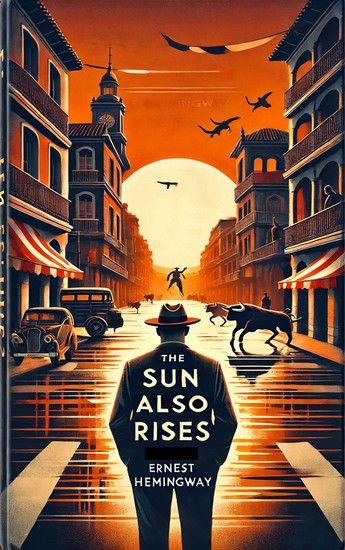
The Sun Also Rises - A Timeless Tale of Love Loss and the Lost Generation - cover

The Sun Also Rises - A Timeless Tale of Love Loss and the Lost Generation

Ernest Hemingway, Zenith Blue Ridge Books

Publisher: Zenith Blue Ridge Books

  • 0
  • 0
  • 0

Summary

Experience one of the greatest literary masterpieces of the 20th century—The Sun Also Rises by Ernest Hemingway, a novel that captures the essence of the Lost Generation with raw emotion, unforgettable characters, and breathtaking prose.

Set in the 1920s, this gripping novel follows Jake Barnes and his circle of expatriate friends as they journey from the bustling nightlife of Paris to the thrilling bullfights of Pamplona, Spain. As they navigate love, heartbreak, and the disillusionment left by World War I, Hemingway's sparse yet powerful writing style immerses readers in a world of passion, longing, and existential crisis.

Through the enigmatic and captivating Lady Brett Ashley, Hemingway crafts a portrait of unfulfilled love and self-destruction, while exploring deeper themes of masculinity, morality, and the search for meaning in an era of decadence.

Hailed as a literary masterpiece, The Sun Also Rises remains one of Hemingway's most celebrated works. Critics and readers alike praise it for its timeless relevance and deeply moving storytelling. A defining novel of the Lost Generation, it has influenced countless authors and remains a must-read for lovers of classic literature.

Immerse yourself in the brilliance of Ernest Hemingway and discover why The Sun Also Rises has stood the test of time. Buy now and step into a world of passion, adventure, and profound human experience.
Available since: 01/30/2025.
Print length: 237 pages.
Other books that might interest you

  • The Castle of Otranto - cover

    The Castle of Otranto

    Horace Walpole

    • 0
    • 0
    • 0
    "The Castle of Otranto" is a novel written by Horace Walpole and first published in 1764. It is considered the first Gothic novel, setting the stage for a genre that would become popular in the late 18th and early 19th centuries. The book is known for its blend of supernatural elements, romance, and suspense. The story is set in the medieval Castle of Otranto in Italy and revolves around the mysterious and supernatural events that unfold within its walls. The narrative involves a cursed noble family, secret passages, prophecies, and a large helmet that seems to portend doom. The novel explores themes of power, love, and the supernatural, creating an atmospheric and suspenseful tale.
    Show book
  • Don't Be Discouraged (Unabridged) - cover

    Don't Be Discouraged (Unabridged)

    Booker T. Washington

    • 0
    • 0
    • 0
    Booker Taliaferro Washington (April 5, 1856 - November 14, 1915) was an American educator, author, orator, and adviser to several presidents of the United States. Between 1890 and 1915, Washington was the dominant leader in the African American community and of the contemporary black elite. Washington was from the last generation of black American leaders born into slavery and became the leading voice of the former slaves and their descendants. They were newly oppressed in the South by disenfranchisement and the Jim Crow discriminatory laws enacted in the post-Reconstruction Southern states in the late 19th and early 20th centuries.
    DON'T BE DISCOURAGED: Last Sunday evening I spoke to you for a few minutes regarding the importance of determining to do the right thing in every phase of your school life. There are a few things that enter into student life which, in a very large degree, cause the untrue to fall by the wayside, and which prevent students from doing their very best. Among these things is the disposition to grow discouraged. Very many people, very many students, who otherwise would succeed, who would go through school creditably, graduating with honours, have failed to succeed because they became discouraged.
    Show book
  • Blood - From their pens to your ears genius in every story - cover

    Blood - From their pens to your...

    Hanns Heinz Ewers

    • 0
    • 0
    • 0
    Hanns Heinz Ewers was born on 3rd November 1871 in Düsseldorf, Germany. 
    His first published poem was at 17 on the death, after a reign of only 99 days, of the German Emperor Frederick III. 
    A stint in the German military was cut short after only 44 days because of his myopia.  Writing was to be the way forward for him with a book of satiric verse published in 1901. At the same time he co-founded a literary vaudeville troupe that toured central and eastern Europe before censors and expenses forced its closure.  An inveterate traveller he was in South America when the Great War enveloped Europe and he relocated to New York. 
    From here his story darkens. Although by now a successful and admired author he was arrested in the U S in 1918 as a German Agent on the pretext of his travels and a falsified Swiss passport. Interned, he was released in 1921 and returned to Germany.  He claimed only to be raising money for the German Red Cross. 
    His literary fame is decidedly easier to clarify. His novels beginning with ‘The Sorcerer’s Apprentice’ in 1910 are dark, they bristle with evil intent and are littered with characters who have a dubious moral compass and yet, along with his short stories, are brazen, brilliant feats of literary narrative. 
    He also wrote and published plays, fairy tales, opera librettos, critical essays and lectured for many years on ‘The Religion of Satan’ and was one of the first to write scripts for the cinema, which he considered a legitimate art form. 
    As the Weimar republic began its chaotic death throes Ewers became attracted to the rising Nazi Party.  At first he was warmly received despite disagreeing with its anti-semitism (his most famed literary character had a Jewish mistress) and he was even commissioned by Hitler to write a biography of the Nazi martyr Horst Wessel.  This together with his own homosexuality culminated with his works being banned in 1934 and his assets and property seized.  It took him many years to have the ban lifted.  This association rightfully clouds his personal reputation but has meant his literary contributions are also overlooked and neglected. 
    Hanns Heinz Ewers died of tuberculosis on 12th June 1943 in his Berlin apartment.
    Show book
  • The Blue Castle - A soothing reading for sleep and relaxation - cover

    The Blue Castle - A soothing...

    Lucy Maud Montgomery

    • 0
    • 0
    • 0
    Enter a peaceful night’s sleep with The Blue Castle, the enchanting novel by L.M. Montgomery, narrated by Andrew Bond and produced by Slumber Studios. 
    This gentle audiobook is designed to quiet your thoughts and carry you softly into rest. Step into the world of Valancy Stirling, a quiet, wistful young woman who dares to imagine a life beyond duty and restraint - a life filled with beauty, courage, and freedom. 
    Let Andrew’s calming voice guide you through the misty forests and shimmering lakes of Muskoka, where Valancy’s journey of self-discovery unfolds with quiet wonder. Each chapter flows like a soft breeze, filled with tender humor, reflection, and the healing power of nature. 
    Rather than conflict or tension, this adaptation moves at a restful pace. Montgomery’s lyrical prose, paired with gentle background music and thoughtful narration, creates a soothing experience... a comforting story to ease your heart and settle your mind as you drift toward dreams. 
    At Slumber Studios, every audiobook is lovingly produced to help you relax and rest deeply. We preserve the heart, charm, and emotion of each story while lightly softening moments that may disturb your peace, ensuring a calm and restorative listening experience. 
    If you’re looking for a tranquil way to end your day, The Blue Castle offers the perfect escape. Just press play, get comfortable, and let Andrew Bond’s warm, steady voice carry you into Valancy’s world... a place of gentle transformation, quiet courage, and peaceful sleep.
    Show book
  • Something to Think Of - cover

    Something to Think Of

    P. O. Dixon

    • 0
    • 0
    • 0
    When Elizabeth returns to London from Kent and meets Jane’s new suitor, her hasty refusal of Mr. Darcy’s marriage proposal gives her something to think of—especially when Mr. Darcy follows her to Hertfordshire, determined to make amends. He means to court her properly, win her heart, and marry her. 
    Likewise, Mr. Bingley vows to pursue Jane, hoping to reclaim her affection. Jane’s new suitor has other ideas about her future felicity, and his identical twin brother has more than a passing interest in Elizabeth’s love life as well. 
    All is fair in the game of love, even if fate leaves one or more of the gentlemen in question behind. Elizabeth encourages her sister to follow her heart, but will she heed her own advice?
    Show book
  • The Woman in White - cover

    The Woman in White

    Wilkie Collins

    • 0
    • 0
    • 0
    A trailblazing work in the mystery and sensation fiction genres, "The Woman in White" enthralls readers with its complex plot, intriguing characters, and spine-tingling atmosphere. The story begins with Walter Hartright's chance encounter with a mysterious woman in white, setting off a chain of events that unravels dark secrets, mistaken identities, and psychological suspense. As the narrative unfolds through multiple narrators, including the unforgettable character of the cunning Count Fosco, the novel keeps readers guessing until its thrilling conclusion. 
     
    Wilkie Collins, an English novelist, and playwright, is renowned as a pioneer of the detective fiction genre. His most famous work, "The Woman in White," published in 1859, captivated readers with its intricate plot, suspenseful narrative, and innovative use of multiple narrators. Collins' contributions to mystery and sensation fiction significantly influenced the development of crime literature.
    Show book