Join us on a literary world trip!
Add this book to bookshelf
Grey
Write a new comment Default profile 50px
Grey
Subscribe to read the full book or read the first pages for free!
All characters reduced
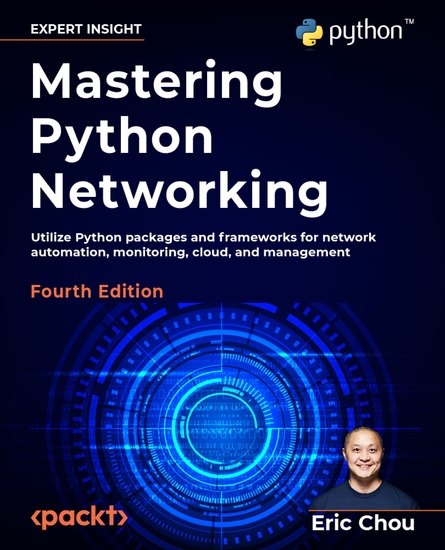
Mastering Python Networking - Utilize Python packages and frameworks for network automation monitoring cloud and management - cover

Mastering Python Networking - Utilize Python packages and frameworks for network automation monitoring cloud and management

Eric Chou

Publisher: Packt Publishing

  • 0
  • 0
  • 0

Summary

Networks in your infrastructure set the foundation for deploying, maintaining, and servicing applications. Python is the ideal language for network engineers to explore tools that were previously available to systems engineers and application developers. Mastering Python Networking, Fourth edition, guides you on a Python-driven journey from traditional network engineering to modern network development.
This new edition incorporates the latest Python features and DevOps frameworks. In addition to new chapters on introducing Docker containers and Python 3 Async IO for network engineers, each chapter is updated with the latest libraries and working examples to ensure compatibility and clarity of the concepts.
Starting with a basic overview of Python, the book teaches you how it can interact with both legacy and API-enabled network devices. You will learn to leverage high-level Python packages and frameworks to perform network automation tasks, monitoring, management, and enhanced network security, followed by AWS and Azure cloud networking. You will use Git for code management, GitLab for continuous integration, and Python-based testing tools to verify your network.
By the end of this book, you'll be a confident network developer capable of automating modern infrastructure using Python, DevOps practices, and cloud technologies.
Available since: 01/20/2023.
Print length: 594 pages.
Other books that might interest you

  • The Third History of Man - cover

    The Third History of Man

    MD John Bershof

    • 0
    • 0
    • 0
    In the spirit of medieval writer Chaucer, all human activity lies within the artist’s scope, the History of Man Series uses medicine as a jumping off point to explore precisely that, all history, all science, all human activity since the beginning of time. The jumping off style of writing takes the reader, the listener into worlds unknown, always returning to base, only to jump off again. History of Man are stories and tales of nearly everything. 
    The Third History of Man leaves bacteria in the rear-view mirror and jumps to viruses and viral infections, the cold, the flu and COVID-19, not just another flu. We’ll cover epidemics, pandemics, and vaccines, the pox infections, and the Spock principle that the needs of the many outweigh the needs of the few … or the one. From COVID and the rise of Zoom, we’ll venture into the rise of Homo sapiensand the fall of Neanderthals, the high sea adventures of Darwin aboard and the high sea adventures of dementia. Our travels will take us along the Silk Road and Spice Trade, another visit with the Age of Discovery when masted ships and European explorers went looking for that elusive sea route to the Far East, and looking for gold, annihilating huge swaths of indigenous Americans at every port of disembarkation, not by the pointy end of a sword, but by tiny infectious microbes. We’ll examine colonialism at its finest, the sordid European history of imperialism and the land grab into Africa and the New World Americas.
    Show book
  • Generative AI in Practice - 100+ Amazing Ways Generative Artificial Intelligence Is Changing Business And Society - cover

    Generative AI in Practice - 100+...

    Bernard Marr

    • 0
    • 0
    • 0
    Generative AI is rewriting the rulebook with its seemingly endless capabilities, from crafting intricate industrial designs, writing computer code, and producing mesmerizing synthetic voices to composing enchanting music and innovating genetic breakthroughs. In Generative AI in Practice, renowned futurist Bernard Marr offers listeners a deep dive into the captivating universe of GenAI. This comprehensive guide introduces you to the basics of this groundbreaking technology and outlines the profound impact that GenAI will have on business and society. 


    In this book, Marr sheds light on the most innovative real-world GenAI applications through practical examples. You'll enjoy a captivating discussion of innovations in media and entertainment, seismic shifts in advertising, and the future trajectory of GenAI. You will: 


    ● Navigate the complex landscapes of risks and challenges posed by Generative AI 


    ● Delve into the revolutionary transformation of the job market in the age of GenAI 


    ● Understand AI's transformative impact on education, healthcare, and retail 


    ● And more 


    This audiobook includes a bonus afterword not included in the print edition.
    Show book
  • Nuclear Fusion - The Race to Build a Mini-Sun on Earth - cover

    Nuclear Fusion - The Race to...

    Sharon Ann Holgate

    • 0
    • 0
    • 0
    Since the 1950s, scientists have attempted to harness nuclear fusion—the process that creates the Sun's energy—to generate near-limitless amounts of electricity. But the fact that we still have no fusion power plants is testament to the complexities of the challenge. Now, the deepening climate crisis means that researchers around the world are in a race to create a mini-Sun here on Earth. The glittering prize is an energy source that emits no greenhouse gases and could solve energy equity and supply issues at a stroke. Sharon Ann Holgate, a former Young Professional Physicist of the Year, tells the compelling story of the ongoing scientific quest for a revolutionary new era of green-energy production.
    Show book
  • Evolution - The Remarkable History of a Scientific Theory - cover

    Evolution - The Remarkable...

    Edward J. Larson

    • 0
    • 0
    • 0
    Edward J. Larson is a Pulitzer Prize-winning author and eminent science historian. This marvelously readable, yet sumptuously erudite work traces the development of the scientific theory of evolution. From Darwin's essential trip to the GalApagos, to the most contemporary studies in sociobiology, this work takes listeners both into the field and laboratories of the world's greatest evolutionary scientists, and shows how the theory of evolution has itself evolved.
    Show book
  • Machine learning - A subset of Artificial Intelligence - cover

    Machine learning - A subset of...

    Bright Mills

    • 0
    • 0
    • 0
    Machine Learning (ML) is a subset of Artificial Intelligence that empowers systems to learn from data and make decisions or predictions without being explicitly programmed. It represents a major shift from traditional rule-based programming to systems that adapt and improve over time. This comprehensive guide delves into the theoretical foundations, types, algorithms, tools, applications, challenges, and the future of Machine Learning. It covers supervised, unsupervised, semi-supervised, and reinforcement learning in detail, explains key techniques such as neural networks, decision trees, support vector machines, and deep learning, and explores real-world applications across domains like healthcare, finance, security, and robotics. Ethical concerns, bias in AI, explainability, and interpretability are also discussed, offering a well-rounded understanding of the state and direction of Machine Learning.
    Show book
  • Eyes in the Sky - Space Telescopes from Hubble to Webb - cover

    Eyes in the Sky - Space...

    Andrew May

    • 0
    • 0
    • 0
    Over 50 years ago, astronomers launched the world's first orbiting telescope. This allowed them to gaze further into outer space and examine anything that appears in the sky above our heads, from comets and planets to galaxy clusters and stars. Since then, almost 100 space telescopes have been launched from Earth and are orbiting our planet, with 26 still active and relaying information back to us. 
     
    As a result of these space-based instruments, such as NASA's iconic Hubble Space Telescope, we know much more about the universe than we did half a century ago. But why is Hubble, orbiting just 540 kilometres above the Earth, so much more effective than a ground-based telescope? How can a glorified camera tell us not only what distant objects look like, but their detailed chemical composition and three-dimensional structure as well? 
     
    In Eyes in the Sky, science writer Andrew May takes us on a journey into space to answer these questions and more. Looking at the development of revolutionary instruments, such as Hubble and the James Webb Space Telescope, May explores how such technology has helped us understand the evolution of the Universe.
    Show book