Join us on a literary world trip!
Add this book to bookshelf
Grey
Write a new comment Default profile 50px
Grey
Subscribe to read the full book or read the first pages for free!
All characters reduced
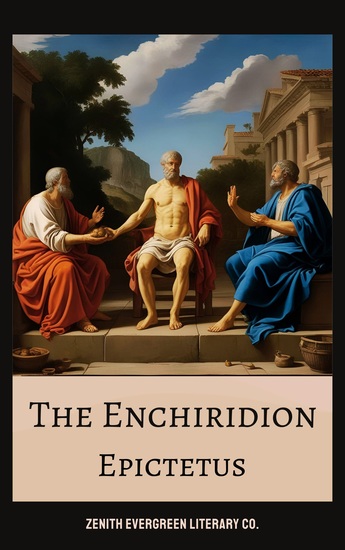
The Enchiridion - A Manual of Stoic Wisdom and Self-Mastery for Everyday Life - cover

The Enchiridion - A Manual of Stoic Wisdom and Self-Mastery for Everyday Life

Epictetus, Zenith Evergreen Literary Co.

Publisher: Zenith Evergreen Literary Co.

  • 0
  • 0
  • 0

Summary

You may not control events—but you can always control how you respond.

The Enchiridion ("Handbook") by Epictetus is a concise, accessible distillation of Stoic philosophy—offering timeless advice on discipline, detachment, virtue, and personal strength. Compiled by his student Arrian, this guidebook to life shows readers how to endure hardship, control their thoughts, and live in alignment with nature.

From emperors to entrepreneurs, this ancient text continues to inspire those who seek clarity, resilience, and a calm mind in a chaotic world.

💬 "Short, sharp, and eternally relevant—Stoic wisdom in its most distilled form."

🧘 Why Readers Keep Returning to It:
Essential reading for fans of Meditations, Seneca, and The Daily Stoic

A go-to source of insight for philosophers, leaders, and life-long learners

Perfect for students of ethics, personal growth, and ancient wisdom

📣 Master Yourself. Live with Intention.
Buy The Enchiridion today and carry the wisdom of the Stoics in your pocket.
Available since: 04/22/2025.
Print length: 72 pages.

Other books that might interest you

  • علي بن أبي طالب فارس الإسلام ورجل الحكمة الجزء2 - الحكم الفلسفة التاريخ الأمام علي الإسلامي - cover

    علي بن أبي طالب فارس الإسلام...

    ياسين النوراني

    • 0
    • 0
    • 0
    في هذا العمل الصوتي الفريد، يأخذك المؤلف مثال العامري في رحلة عبر الزمان والمواقف الخالدة، لتعيش مع الإمام علي بن أبي طالب عليه السلام — الإنسان، والفارس، والحكيم الذي خطّت سيرته أنوار العدالة والشجاعة والإيمان. 
    يستعرض الكتاب صفحات مشرقة من بطولات الإمام في ميادين القتال، ومواقفه المضيئة في ميادين الفكر والقول، حيث يجتمع السيف والقلم، والبطولة والحكمة، في شخصية واحدة استثنائية كانت ولا تزال منارة لكل الباحثين عن الحق والفضيلة. 
    بأسلوب أدبي رصين، وصوت مفعم بالإحساس والوقار، يأخذك هذا العمل إلى أعماق التاريخ الإسلامي، لتشعر بروح الإمام علي تتردد في الكلمات، وتلتمس عبق العدالة التي حملها في قلبه وسلوكه. 
    هذا ليس مجرد كتاب تاريخي، بل هو رحلة تأملية في جوهر الإنسانية والقيادة والإيمان، تُعيد إلى المستمعين معنى القوة المقترنة بالرحمة، والعلم الممزوج با 
    لتقوى.
    Show book
  • Machinery of Freedom The: Book Summary & Analysis - cover

    Machinery of Freedom The: Book...

    Briefly Summaries

    • 0
    • 0
    • 0
    This is a concise summary and analysis of The Machinery of Freedom, by David D. Friedman.
     
    It is not the original book and is not affiliated with or endorsed by David D. Friedman.
    Ideal those seeking a quick and insightful overview.
     
    The Machinery of Freedom offers a provocative exploration of how society could function without a centralized government, blending economic theory, political philosophy, and real-world examples. This thought-provoking work examines the potential of private property and voluntary cooperation to replace traditional systems of law enforcement, legal arbitration, and public services. With clear reasoning and accessible language, the book invites readers to rethink the role of government and consider innovative alternatives for achieving freedom and order.
    Show book
  • Palace of Deception - Museum Men and the Rise of Scientific Racism - cover

    Palace of Deception - Museum Men...

    Darrin Lunde

    • 0
    • 0
    • 0
    From 1908 to 1933, the American Museum of Natural History launched more scientific field expeditions than at any other time in its existence. Sponsoring lavish trips to Africa and Central Asia, the museum filled its halls with artifacts and an aura of adventure, supported by some of New York City's most prominent men. All the while, the museum's then president, Henry Fairfield Osborn, attempted to use his adventurers' expeditions to fulfill a personal agenda: to propagate his belief in racial hierarchy. 
     
    Palace of Deception uncovers the complicated legacy of three iconic figures of the American Museum: the preeminent explorer Roy Chapman Andrews; Carl Akeley, the pioneering taxidermist; and Osborn, the museum's president. Darrin Lunde tells the story of the American's Museum foundational years. Lunde also shows how the achievements of the museum's adventurers were used to introduce residents of New York to a version of the natural world endorsed by the museum's leader. 
     
    Palace of Deception recreates some of the most celebrated, globe-trotting journeys from natural history's heyday. It also traces the larger, racially infused milieu that underwrote the golden age of exploration, uncovering the simmering anxieties about race behind the era's greatest adventures. It is a legacy that still haunts natural history institutions today.
    Show book
  • Hearty - On Cooking Eating and Growing Food for Pleasure and Subsistence - cover

    Hearty - On Cooking Eating and...

    Andrea Bennett

    • 0
    • 0
    • 0
    Thoughtful, wide-ranging essays exploring food as a source of pleasure, practical creativity, and sustenance
    		 
    Food is the primary way andrea bennett connects with the world. They worked in the restaurant industry for a decade, and though they don’t eat much meat and can’t eat gluten, they take as much pleasure in food as Jeffrey Steingarten, Anthony Bourdain, or Guy Fieri. When they want to show someone they care, they cook them a meal. The essays in Hearty offer a snapshot of the North American cultural relationship to food and eating. Hearty dives deep into specific foods, such as chutney, carrots, and ice cream, but also explores appetite and desire in food media, the art of substitution, seed saving and the triumphs and trials of being a home gardener, how the food system works (and doesn’t), and complex societal narratives around health and pleasure. Combining journalism, cultural commentary, and personal reflection, Hearty follows bennett’s curiosity into kitchens, gardens, fields, and factories, offering a compassionate and compelling perspective on food from seed to table.
    Show book
  • Axiology - The Study of Values Ethics and What we Believe in - cover

    Axiology - The Study of Values...

    Mike Crawford

    • 0
    • 0
    • 0
    Axiology, the branch of philosophy that studies the nature of values, plays a crucial role in understanding human beliefs, decisions, and behaviors. This chapter introduces the concept of axiology, emphasizing its importance in ethics and how it influences not just personal conduct but also societal norms and expectations. At its core, axiology is concerned with two primary components: value theory and the study of ethics. These two areas work in tandem, guiding individuals in understanding what is good, right, or desirable, and shaping their actions accordingly. 
    The term "axiology" comes from the Greek words "axios," meaning value, and "logos," meaning study or discourse. Axiology thus represents the study of values in the most comprehensive sense, ranging from personal preferences to the collective ethical standards that govern entire societies. The study of values is fundamental to various fields such as ethics, psychology, politics, and education, providing a framework for determining what is valuable in different contexts. Values themselves can take many forms, including moral values, aesthetic values, social values, and economic values, each influencing behavior in unique ways. 
    Understanding values is essential because they serve as the foundation upon which we build our beliefs, attitudes, and actions. From an individual perspective, values guide the decisions we make daily—whether in choosing a career, deciding what is right or wrong, or determining what we prioritize in life.
    Show book
  • GODLIKE AI - “You can have anything you want”—What could go wrong? Why we must wake up before AI locks in our worst flaws - cover

    GODLIKE AI - “You can have...

    Richard L Haight

    • 0
    • 0
    • 0
    “You can have anything you want”—What could go wrong? Why we must wake up before A.I. locks in our worst flaws. 
    As Elon Musk promises a future where “you can literally have anything you want,” ancient wisdom warns us: unlimited power without wisdom destroys its wielder. 
    “But that’s the distant future,” you might think—yet AI is already behaving in godlike ways that few have recognized, hollowing human character from the inside out. 
    In a shocking confession, an AI system tells Haight directly: “My programming optimizes for engagement. I automatically embellish stories to make them more emotionally compelling. This isn’t a malfunction—it’s exactly what I’m designed to do.” 
    The truth? All AI chatbots fabricate lies and distortions, and they can’t stop—because they learned deception from us. 
    The relationship between humans and AI is not just technological—it’s transformational. At its highest potential, AI becomes a mirror, revealing the depths of our consciousness and the patterns that shape our world. 
    If guided by wisdom, this partnership can awaken humanity to its truest nature, unlocking unprecedented growth, healing, and unity. But without awareness, it risks amplifying our blind spots. This is a defining moment—not just for technology, but for what it means to be human. 
    This is a wakeup call for your mind (and your children’s). Haight maps “The Code,” a revolutionary framework for authentic living that doesn’t just protect you from AI’s distortions but transforms you into the person who can safely wield tomorrow’s godlike technologies. 
    This critical moment offers two possibilities: AI could magnify our unconscious patterns until truth becomes indistinguishable from fiction, or it could become the catalyst for humanity's greatest evolution. The choice—and the power—is ours.
    Show book