Join us on a literary world trip!
Add this book to bookshelf
Grey
Write a new comment Default profile 50px
Grey
Subscribe to read the full book or read the first pages for free!
All characters reduced
The Affluence Blueprint: A Path to Financial Sovereignty - Master your finances build wealth and achieve financial independence retire early Learn finance explained simply for lasting financial intelligence - cover

The Affluence Blueprint: A Path to Financial Sovereignty - Master your finances build wealth and achieve financial independence retire early Learn finance explained simply for lasting financial intelligence

Eos A.I. Saage

Publisher: Saage Media GmbH

  • 0
  • 0
  • 0

Summary

Embark on a structured journey toward financial sovereignty with "The Affluence Blueprint". This guide offers a clear and methodical approach to personal finance, designed to build lasting financial intelligence. It moves beyond temporary fixes, focusing instead on establishing a solid foundation of knowledge and practical skills. 
The book begins by demystifying the world of finance, explaining core concepts such as interest, compound interest, and economic cycles in an accessible manner. You will learn to evaluate financial products critically and develop a mindset conducive to wealth creation. The content systematically guides you through mastering your personal finances, from implementing effective budgeting systems like the envelope method to gaining control over variable and fixed costs. Discover psychological strategies to curb impulse spending and explore the principles of financial minimalism to align your spending with your personal values. 
Further chapters detail concrete strategies for building wealth, even with limited means. Learn how to maximize your savings rate, create additional income streams, and strategically build human capital. The book also addresses crucial aspects of capital protection, including building an emergency fund, systematic debt reduction, and understanding personal risk management. 
Finally, "The Affluence Blueprint" lays out the path to achieving financial independence. It provides tools to calculate your personal financial independence number and outlines strategies to accelerate your journey toward this goal. Prepare for the possibility of early retirement by learning how to strategically manage your assets during the withdrawal phase and navigate life in financial freedom. This book is your comprehensive resource for mastering your finances and achieving lasting financial independence.
Available since: 02/10/2026.
Print length: 265 pages.
Other books that might interest you

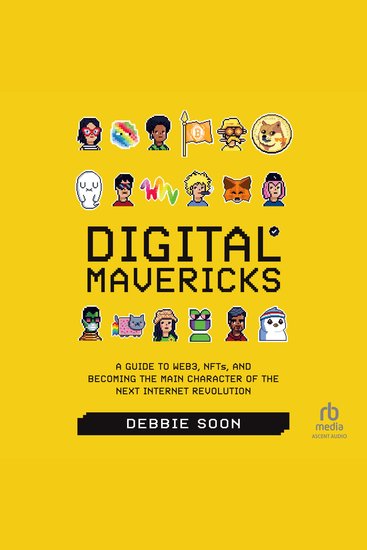
  • Digital Mavericks - A Guide to Web3 NFTS and Becoming the Main Character of the Next Internet Revolution - cover

    Digital Mavericks - A Guide to...

    Debbie Soon

    • 0
    • 0
    • 0
    In Digital Mavericks, founder, NFT collector, and tech entrepreneur Debbie Soon delivers an exciting and eye-opening exploration of the seismic changes and tremendous opportunities that can be found at the intersection of creativity and technology. You'll learn about how blockchain technology and non-fungible tokens (NFTs) are challenging the way we think about our careers and discover inspirational stories behind the personal triumphs and challenges experienced by successful artists, entrepreneurs, and technologists. 


    This book is a career guide for the new age of the Internet, a world being reshaped by blockchain technology. Despite the countless fortunes Web3 has already created, it remains a space subject to both criticism and skepticism. Digital Mavericks is an easy-to-follow roadmap for those eager to play a part in shaping the future of our increasingly digital world. You’ll also find in-depth interviews and stories from movers and shakers in the space; an explanation of the evolution of the Internet, the basics of how Web3 works and is being used today, and its historical significance at this moment in time; A step-by-step guide on how best to enter and navigate the Web3 space; and predictions for the future and how we can best prepare ourselves for the impact of regulatory changes and generative AI on blockchain adoption.
    Show book
  • Just Right - How Neutral-Driven Resolution Can Close the Gap in American Civil Justice - cover

    Just Right - How Neutral-Driven...

    Rob Christopher

    • 0
    • 0
    • 0
    It’s the dirty little secret of our American civil justice system: Getting real justice in everyday lawsuits costs too much. Legal fees and hidden costs dwarf financial stakes, forcing a choice between frustrating settlement or a long slog through litigation’s due process—either path feeling like legalized extortion. This huge and growing gap in our civil justice system occupies a no-man’s-land of prevailing injustice between small claims and high stakes disputes, defying all efforts to control it for decades.Until now. Legal insider Robert Christopher cuts to the core of the problem, offering an effective and practical solution that exposes and deters the claims of schemers and opportunists while making justice attainable and affordable for honest adversaries seeking a better path.Just Right articulates and promotes a simple and innovative neutral-driven approach to conflict resolution, instead of one driven by competing lawyer teams. Developed using lessons taught over a broad forty-year career in litigation and business, the method—which the author calls NDR—enables people and organizations to avoid most common legal disputes, and, when necessary, resolve them quickly and cost-effectively with minimal stress and distraction. Whether prescribed by contract or invoked during negotiations, the method delivers principled, fast, and cost-effective outcomes to all parties—win or lose.This book is a must read if you are:- Passionate about building and keeping long term relationships with partners, customers, suppliers, contractors, employees, and others- A business owner, executive, entrepreneur, or corporate general counsel- An attorney committed to your clients’ best overall interests and net outcomes- Anyone who wants a fair and practical approach to conflict resolution that delivers real justice while saving everyone time, money, and peace of mind
    Show book
  • Become a Nonprofit Pro - Nine Common Pitfalls and How to Avoid Them - cover

    Become a Nonprofit Pro - Nine...

    Tawnia Wise

    • 0
    • 0
    • 0
    Become a Nonprofit Pro: Nine Common Pitfalls and How to Avoid ThemAre you over-worked and under-resourced? It’s possible that your nonprofit has gotten stuck in the startup phase.This phase is not time-dependent. It is behavioral, and organizations can be stuck in startup mode into their thirtieth year of operation and beyond. The startup phase of an organization’s lifecycle is usually characterized as having a lack of formalized structures. It can be defined by the scrappy “get it done on a shoestring budget” mindset that limits investment in strategy, planning, professionalism, structure, and growth.Whether you are launching a new nonprofit or you have been serving your mission for thirty years, Become a Nonprofit Pro will help you make the nonprofit you love more competitive for funding, more effective in its mission, and an overall greater force for the change you want to see in the world.Nonprofit expert and Certified Fundraising Executive Tawnia Wise shares lessons learned from more than two decades working with nonprofits of all sizes and levels of sophistication. As a sought-after nonprofit consultant, Wise will entertain you with the advice she provides her clients most often. She relates the nine most common pitfalls nonprofits encounter using case studies, cautionary tales, and pro tips.Growing up as a resident of section 8 housing and a recipient of public benefits, Tawnia Wise is passionate about helping others from hard beginnings realize their dreams and potential. As founder and CEO of WISE, Tawnia Wise has transformed nonprofit consulting, combining strategy and tactical support to help clients of all sizes elevate their organization’s ability to serve their mission.
    Show book
  • The CEO Playbook for Strategic Transformation - Four Factors That Will Make or Break Your Organization - cover

    The CEO Playbook for Strategic...

    Scott A. Snell

    • 0
    • 0
    • 0
    There is no CEO task more significant than leading change in an organization whose old business model needs updating. Large-scale change involves rethinking how to engage customers, partners, and suppliers with new technology and hard decisions about how to reorganize internal operations—plus the challenges of executing the transformation. Too many things can go wrong, from natural organizational resistance and inertia, to lack of strategic focus, to execution problems. And yet, organizations today must be more dynamic than ever before. Strategy is dynamic, not static, and requires agility, nimbleness, rapid resource deployment, and organizational change. 


    This practical playbook helps CEOs and other key leaders reduce the risks and see through the overwhelming complexity of a major change in organizational strategy. Unlike many other books on leading change that focus narrowly on overcoming resistance, The CEO Playbook for Strategic Transformation offers a comprehensive framework involving four major tasks for leaders: 1) Establish and Communicate the Urgent Need; 2) Engage Stakeholders; 3) Mobilize the Organization; and 4) Develop Organizational Agility. Leaders who guide their organizations through these stages are far more likely to succeed than those who lack a playbook.
    Show book
  • Libertarian Policies - cover

    Libertarian Policies

    Arlo Holders

    • 0
    • 0
    • 0
    Libertarianism is a political philosophy centered on the belief that individuals should have the maximum possible freedom to pursue their own lives, with minimal interference from the government. Rooted in the principles of classical liberalism, libertarianism advocates for a limited government whose primary role is to protect individual rights and maintain peace. It emphasizes personal responsibility, free markets, and the belief that voluntary exchange is the foundation of a prosperous society. At its core, libertarianism seeks to protect the rights of individuals to live as they see fit, free from the coercive power of the state. 
    The history of libertarian thought can be traced back to influential philosophers such as John Locke, who argued for the natural rights of individuals to life, liberty, and property. His ideas formed the intellectual groundwork for the concept of limited government, which would later be expanded by thinkers like Adam Smith, who promoted the idea of free markets. The Enlightenment era, with its focus on reason, individualism, and skepticism of authority, provided a fertile ground for the development of libertarian ideas. In the 20th century, libertarianism gained further prominence through the works of economists such as Friedrich Hayek and Milton Friedman, who critiqued the expansion of government power and emphasized the importance of individual liberty in economic affairs. 
    Libertarianism's role in modern politics is to challenge the prevailing trend toward ever-expanding government intervention in people's lives. Libertarians argue that many of society’s problems are caused by government overreach, and that solutions should instead focus on allowing individuals to make their own decisions, free from state-imposed constraints.
    Show book
  • Economic History of Colombia - From Independence to Modern Times - cover

    Economic History of Colombia -...

    Anya Solace

    • 0
    • 0
    • 0
    The economic history of Colombia is a rich and complex narrative shaped by its colonial past, its struggle for independence, and its evolution into a modern, globalized economy. Colombia’s economic trajectory is marked by cycles of growth, stagnation, and reform, heavily influenced by both internal and external forces. To understand Colombia’s present-day economic standing, it is essential to first explore the historical context that laid the foundation for its economic structure. 
    The history of Colombia’s economy begins with its pre-Colombian civilizations, which thrived through agriculture and trade. The Spanish colonization in the 16th century drastically altered the region's economic systems. Colombia became a key part of the Spanish Empire’s colonial economy, centered on the extraction of gold, silver, and agricultural products. During the colonial era, the economic structure was based on a system of encomiendas, which exploited Indigenous labor, and the export of valuable resources to Spain. This period was foundational in creating the early foundations of the Colombian economy, particularly its dependence on mineral wealth. 
    The struggle for independence from Spain in the early 19th century, which culminated in 1810 with the declaration of independence and a protracted series of wars, significantly disrupted the economy. The wars of independence led to the fragmentation of the region into several separate entities, each facing economic challenges as they sought to stabilize and develop. Upon achieving independence in 1819, Colombia faced a host of problems, including political fragmentation, lack of infrastructure, and limited industrial capacity. These challenges hindered the country's economic development for much of the 19th century.
    Show book