Join us on a literary world trip!
Add this book to bookshelf
Grey
Write a new comment Default profile 50px
Grey
Subscribe to read the full book or read the first pages for free!
All characters reduced
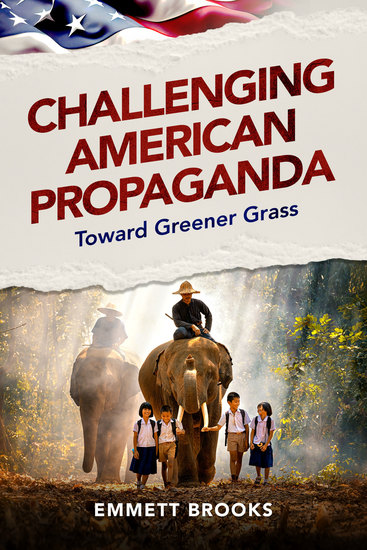
Challenging American Propaganda - Toward Greener Grass - cover

Challenging American Propaganda - Toward Greener Grass

Emmett Brooks

Publisher: Defiance Press and Publishing

  • 0
  • 0
  • 0

Summary

 In "Challenging American Propaganda: Towards Greener Grass," retired American expatriate Emmett Brooks delivers a scathing critique of what he sees as America's decline into authoritarianism, corruption, and social dysfunction. Arguing that the United States has become a "laundromat with nuclear weapons," Brooks details why he permanently left America in 2018 for Thailand, offering his perspective on the global power structures controlling Western nations.
 
This three-part manifesto begins with Brooks' controversial analysis of American society, examining what he identifies as propaganda myths, political manipulation, and the erosion of freedom. The second section provides a cultural and historical overview of Thailand, where Brooks found his new home. He discusses Thai history, Buddhism, the monarchy, and daily life through the eyes of a Western expatriate. The final section offers practical advice for teaching English in Thailand, drawn from Brooks' own experiences in Thai classrooms.
 
Written for those considering escape from what Brooks perceives as Western decline, this unapologetically opinionated guide combines political commentary with practical expatriate advice. While some readers may find his views polarizing, others seeking alternatives to life in America will discover both philosophical justification and tactical guidance for building a new life abroad.
 
If you enjoyed "The Sovereign Individual," "Nomad Capitalist," and "Teaching English Abroad," you'll love "Challenging American Propaganda: Towards Greener Grass."
Available since: 10/29/2024.
Print length: 176 pages.
Other books that might interest you

  • Theodor Fontane: A short biography - 5 Minutes: Short on time – long on info! - cover

    Theodor Fontane: A short...

    5 Minutes, 5 Minute Biographies,...

    • 0
    • 0
    • 0
    Theodor Fontane, German poet and novelist: Life and work in a short biography! Everything you need to know, brief and concise. Infotainment, education and entertainment at its best!
    Show book
  • 2024 - Democracy Ki Jeet - cover

    2024 - Democracy Ki Jeet

    Vijai Trivedi, Rajdeep Sardesai,...

    • 0
    • 0
    • 0
    * Why did pollsters and pundits get the 2024 election forecasts so badly wrong?  
    * Why was the mainstream media narrative so one-sided?  
    * Why did the 'char sau paar' drumbeat for the Modi-led BJP not work on the ground?  
    * How did a Rahul Gandhi-led Congress stage a comeback?  
    * What changed so dramatically in the last five years?  
    * How does Team Modi-Shah operate?  
    * Was it really a free and fair election?  
    * What role did the enforcement agencies play?  
    * How did the battle for the states turn?  
    * Who really won and lost the 2024 election?  
    2024: Democracy Ki Jeet, the Hindi translation of 2024: The Election That Surprised India, brings to life the inside story of a dramatic period in Indian politics and society. Every twist and turn is revealed in an exciting narrative on the tumultuous events of our times. Unsparing and uncompromising, this is an unputdownable account of power politics, the main characters and their role in influencing the headlines of our times. After the bestselling books on the 2014 and 2019 elections, Rajdeep Sardesai now takes a deep dive into India's most bruising and polarized political battle and the many stories that shaped an extraordinary election verdict.
    Show book
  • Politicians and Rebels - Benjamin Franklin Alexander Hamilton and John Muir - cover

    Politicians and Rebels -...

    Kelly Mass

    • 0
    • 0
    • 0
    This book contains 3 titles, which are: 
    Benjamin Franklin - Benjamin Franklin was an author, physicist, innovator, statesman, diplomat, printer, publisher, and political thinker who resided in America. Franklin was just one of the Founding Fathers of the United States, a drafter and signer of the US Declaration, and the first postmaster general of the United States. For his discoveries and views about electrical energy, he was an essential player in the American Knowledge and the history of physics as a researcher. He is most prominent for his developments like as the lightning arrester, bifocals, and the Franklin hotplate. 
    Alexander Hamilton - Alexander Hamilton was a Caribbean-born American leader, political leader, legal scholar, army leader, legal representative, lender, and economic expert who lived from January eleventh, 1755 or 1757 till July twelfth, in 1804. He was a founding father of the US of America. He was the creator of the country's monetary system, the Federalist Party, the USA Coast Guard, and the New York Post paper, and a popular translator and advocate of the U.S. Constitution. 
    John Muir - John Muir was a prominent Scottish-American biologist, author, ecological philosophy, botanist, zoologist, glaciologist, and early supporter for the conservation of wilderness in the US of America. He was also called "John of the Mountains" and "Dad of the National Parks." Countless people have read his letters, essays, and books on his exploits in nature, especially in the Sierra Nevada. His effort contributed to the defense of Yosemite Valley and Sequoia National Forest, and his example has motivated the conservation of many other natural areas.
    Show book
  • Ancient Anatolia: The History of the Region’s Most Powerful Cities Kingdoms and Empires in Antiquity - cover

    Ancient Anatolia: The History of...

    Editors Charles River

    • 0
    • 0
    • 0
    During the Late Bronze Age, from about 1500-1200 BCE, the Near East was a time and place where great kingdoms and empires vied for land and influence, playing high stakes diplomatic games, trading, and occasionally going to war with each other in the process. The Egyptians, Hittites, Babylonians, Assyrians, and several smaller Canaanite kingdoms were all part of this system, which was one of the first true “global” systems in world history and also one of the most materially prosperous eras in antiquity.  
    Thus, the transition from the Bronze to the Iron Age during the late 13th and early 12th centuries BCE arguably changed the structure and course of world history more fundamentally than any period before or since, and at the center of this period of turmoil was a group of people known today as the Sea Peoples, the English translation of the name given to them by the Egyptians. Despite their prominent role in history, however, the Sea Peoples remain as mysterious as they were influential; while the Egyptians documented their presence and the wars against them, it has never been clear exactly where the Sea Peoples originated from, or what compelled them to invade various parts of the region with massive numbers. Whatever the reason, the Sea Peoples posed an existential threat to the people already living in the region, as noted by an Egyptian inscription: “The foreign countries made a conspiracy in their islands. All at once the lands were removed and scattered in the fray. No land could stand before their arms: from Hatti, Qode, Carchemish, Arzawa and Alashiya on, being cut off at one time. A camp was set up in Amurru. They desolated its people, and its land was like that which has never come into being. They were coming forward toward Egypt, while the flame was prepared before them."
    Show book
  • GODLIKE AI - “You can have anything you want”—What could go wrong? Why we must wake up before AI locks in our worst flaws - cover

    GODLIKE AI - “You can have...

    Richard L Haight

    • 0
    • 0
    • 0
    “You can have anything you want”—What could go wrong? Why we must wake up before A.I. locks in our worst flaws. 
    As Elon Musk promises a future where “you can literally have anything you want,” ancient wisdom warns us: unlimited power without wisdom destroys its wielder. 
    “But that’s the distant future,” you might think—yet AI is already behaving in godlike ways that few have recognized, hollowing human character from the inside out. 
    In a shocking confession, an AI system tells Haight directly: “My programming optimizes for engagement. I automatically embellish stories to make them more emotionally compelling. This isn’t a malfunction—it’s exactly what I’m designed to do.” 
    The truth? All AI chatbots fabricate lies and distortions, and they can’t stop—because they learned deception from us. 
    The relationship between humans and AI is not just technological—it’s transformational. At its highest potential, AI becomes a mirror, revealing the depths of our consciousness and the patterns that shape our world. 
    If guided by wisdom, this partnership can awaken humanity to its truest nature, unlocking unprecedented growth, healing, and unity. But without awareness, it risks amplifying our blind spots. This is a defining moment—not just for technology, but for what it means to be human. 
    This is a wakeup call for your mind (and your children’s). Haight maps “The Code,” a revolutionary framework for authentic living that doesn’t just protect you from AI’s distortions but transforms you into the person who can safely wield tomorrow’s godlike technologies. 
    This critical moment offers two possibilities: AI could magnify our unconscious patterns until truth becomes indistinguishable from fiction, or it could become the catalyst for humanity's greatest evolution. The choice—and the power—is ours.
    Show book
  • The Response to Industrialism 1885-1914 - Second Edition - cover

    The Response to Industrialism...

    Samuel P. Hays

    • 0
    • 0
    • 0
    In this new edition, Samuel P. Hays expands the scope of his pioneering account of the ways in which Americans reacted to industrialism during its early years from 1885 to 1914. Hays now deepens his coverage of cultural transformations in a study well known for its concise treatment of political and economic movements.Hays draws on the vast knowledge of America’s urban and social history that has been developed over the last thirty-eight years to make the second edition an unusually well-rounded study. He enhances the original coverage of politics, labor, and business with new accounts of the growth of cities, the rise of modern values, cultural conflicts with Native Americans and foreign nations, and changing roles for women, African-Americans, education, religion, medicine, law, and leisure. The result is a tightly woven portrait of America in transition that underscores the effects of impersonal market forces and greater personal freedom on individuals and chronicles such changes as the rise of social inequality, shifting power, in the legal system, the expansion of the federal government, and the formation of the Populist, Progressive, and Socialist parties.
    Show book