Join us on a literary world trip!
Add this book to bookshelf
Grey
Write a new comment Default profile 50px
Grey
Subscribe to read the full book or read the first pages for free!
All characters reduced
Elder Neglect Crisis - cover

Elder Neglect Crisis

Emma Wilson

Translator A AI

Publisher: Publifye

  • 0
  • 0
  • 0

Summary

"Elder Neglect Crisis" delivers a comprehensive examination of one of society's most pressing challenges: the widespread failure to protect and care for our aging population. Through a powerful combination of three decades' worth of research, case studies, and demographic data, the book unveils how modern societal changes, inadequate legal protections, and a strained caregiving system create perfect conditions for elder neglect to thrive.

 
The book uniquely weaves together three critical perspectives: the evolution of family dynamics, the shortcomings of legal frameworks, and the challenges within caregiving infrastructure. It reveals how the aging of baby boomers coincides with smaller family sizes and geographic dispersion, creating unprecedented caregiving challenges. Through detailed analysis of court cases and healthcare statistics, readers gain insight into how current systems often fail our elderly population, both in institutional settings and within families.

 
Progressing from problem identification to practical solutions, the book combines scholarly analysis with actionable recommendations. It provides assessment tools, care planning guidelines, and policy reform suggestions while incorporating real-world narratives from caregivers, family members, and elderly individuals. This multifaceted approach makes it an invaluable resource for healthcare professionals, policy makers, and families, offering both theoretical understanding and practical pathways toward preventing elder neglect.
Available since: 01/08/2025.
Print length: 143 pages.


Other books that might interest you

  • Commander in Chief - Partisanship Nationalism and the Reconstruction of Congressional War Powers - cover

    Commander in Chief -...

    Casey B. K. Dominguez

    • 0
    • 0
    • 0
    The constitutional balance of war powers has shifted from Congress to the president over time. Today, presidents broadly define their constitutional authority as commander in chief. In the nineteenth century, however, Congress was the institution that claimed and defended expansive war powers authority. This discrepancy raises important questions: How, specifically, did Congress define the boundaries between presidential and congressional war powers in the early republic? Did that definition change? 


    Casey Dominguez's Commander in Chief systematically analyzes the authority that members of Congress ascribe to the president as commander in chief and the boundaries they put around that authority. 


    Dominguez shows that for more than a century members of Congress defined the commander in chief's authority narrowly. But in a wave of nationalism during the Spanish-American War, members of Congress began to argue that Congress owed deference to the commander in chief. They also tended to argue that a president of their own party should have broad war powers, while the powers of a president in the other party should be defined narrowly. Together, these two dynamics suggest that the conditions for presidentially dominated modern constitutional war powers were set at the turn of the twentieth century, far earlier than is often acknowledged.
    Show book
  • The Art of the Impossible - How to start a political party (and why you probably shouldn't) - cover

    The Art of the Impossible - How...

    Andrew Reid, Simon Carr

    • 0
    • 0
    • 0
    "A revelation" – Nigel Farage
    ***
    Nothing like it had ever been done before. In January 2019, the Brexit Party was just a name. Over a matter of weeks, the party would be launched, stand candidates across seventy seats and become the largest single party in the European Parliament.
    Along the way, it fought Establishment quangos, the courts, Parliament, the Speaker and the government – hammering the Conservatives so hard it forced the resignation of their Prime Minister – to win nearly twice as many seats as its nearest rival.
    It was a success beyond anyone's dreams (or, indeed, anyone's worst nightmare). And the inside story of how it happened may serve as a manual of how to – and occasionally how not to – do it.
    This unique book details the wild ride of the brand-new Brexit Party as it heads from triumph in the European elections to disaster in the general election six months later. Packed with hilarious anecdotes about the reality of setting up a new party, it takes the reader on a journey through building the entire apparatus in an impossibly short time frame; losing key players to enemy action; and facing chaotic scenes created by a cat's cradle of legal complications – before arriving at the conclusion that politics is much more difficult than it looks.
    Show book
  • The Fortunate Child - cover

    The Fortunate Child

    MAXINE SUE FELLER

    • 0
    • 0
    • 0
    It was a long, sometimes devastating, journey Maxine was forced to undertake through the depths of despair as a preschooler, and then on through a tumultuous adolescence during which she was ignored yet at the same time abused by a uncaring mother who daily left her with a malevolent grandmother who similarly mistreated her. 
    		Instructed by her divorced mother to no longer call her Mama, in an effort to enhance her own marketability as a perspective wife to some unsuspecting man. 
    		Fortunately, Maxine was endowed with the guiles and street smarts that allowed her to survive. The pain of her youth was converted, of necessity, into the toughness and unwillingness to accept what appeared to be inevitable. As the result of her own perseverance and courage she was accepted and graduated from Brooklyn College. 
    		Separating herself from her horrendous past, she resurrected her life by achieving success as a school teacher, a wife and, ultimately, a mother and grandmother. Along the way, she became proficient as a stock trader, thus providing herself and her family the additional financial and emotional security she was deprived of in her early years. 
    		Maxine reflects on her life as an independent success story.
    Show book
  • Summary: Prequel - An American Fight Against Fascism: Key Takeaways Summary and Analysis - cover

    Summary: Prequel - An American...

    Brooks Bryant

    • 0
    • 0
    • 0
    DISCLAIMER: THIS IS NOT THE OFFICIAL BOOK. 
    This is a summary, and it does not accompany the official 
    'Prequel: An American Fight Against Fascism' by Rachel Maddow, inspired by her podcast 'Ultra,' delves into the history of American authoritarianism, particularly focusing on a right-wing movement that emerged before and during World War II. This movement orchestrated a widespread disinformation campaign to weaken the U.S. war effort and align the country with the Axis powers. Maddow uncovers the shocking extent of this campaign, aimed at undermining democracy, promoting antisemitism, and eroding trust in democratic institutions with the end goal of authoritarian takeover. 
    The book also explores an ultra-right paramilitary group that prepared for mass violence and insurrection. Parallel to these events, a group of activists and journalists worked tirelessly to expose this scheme. In 1941, the U.S. The Department of Justice took action against the conspirators but faced significant challenges, including political interference from influential figures, leading to a failure of the legal system. Maddow argues that this historical event, often overlooked and involving prominent officials, has had long-reaching impacts on American history and remains highly relevant in today's political climate.
    Show book
  • Simplicity Comes Into Being When There is Freedom From the Desire to Achieve - Ojai 1949 - Public Talk 13 - cover

    Simplicity Comes Into Being When...

    Jiddu Krishnamurti

    • 0
    • 0
    • 0
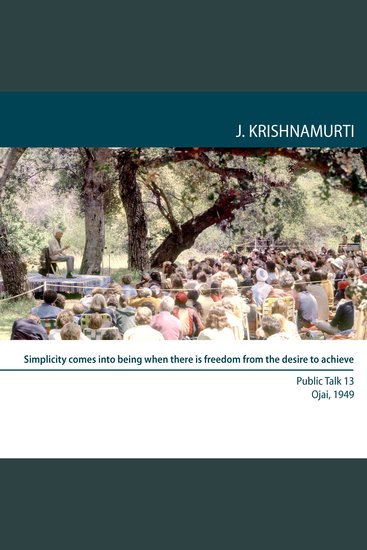
    Simplicity comes into being when there is freedom from the desire to achieve 
    • One who is sincere can never be simple because he who is trying to be sincere always has the desire to pattern or approximate himself to an idea. 
    • Self-knowledge can be discovered more fully, deeply, widely, only when there is passive awareness, which is not the exertion of will. 
    • In the search for self-knowledge we get caught in self-consciousness. Being caught we make the thing in which one is caught the most important thing. 
    • To go beyond self-consciousness there must be freedom from the desire to achieve a result, because the achievement of a result is what the mind wants. 
    • Q: Would you please explain what you mean by dying daily? 
    • Q: How does a truth when repeated become a lie? What really is a lie? 
    • Q: I think I can help, but whatever I say or do to another is interpreted as interference and as domineering. Why does this happen to me? 
    • Q: What is aloneness? Is it a mystical state?
    Show book
  • The Drive for Dollars - How Fiscal Politics Shaped Urban Freeways and Transformed American Cities - cover

    The Drive for Dollars - How...

    Eric A. Morris, Brian D. Taylor,...

    • 0
    • 0
    • 0
    The story of the interplay between finance, freeways, and urban form in the twentieth century and their enduring impact on American cities and neighborhoods in the twenty-first. 


    American cities are distinct from almost all others in the degree to which freeways and freeway travel dominate urban landscapes. In The Drive for Dollars, Brian D. Taylor, Eric A. Morris, and Jeffrey R. Brown tell the largely misunderstood story of how freeways became the centerpiece of US urban transportation systems, and the crucial, though usually overlooked, role of fiscal politics in bringing freeways about. The authors chronicle how the ways that we both raise and spend transportation revenue have shaped our transportation system and the lives of those who use it, from the era before the automobile to the present day. They focus on how the development of one revolutionary type of road—the freeway—was inextricably intertwined with money. With the nation's transportation finance system at a crossroads today, this book sheds light on how we can best fund and plan transportation in the future. The authors draw on these lessons to offer ways forward to pay for transportation more equitably, provide travelers with better mobility, and increase environmental sustainability and urban livability.
    Show book