

Join us on a literary world trip!
Add this book to bookshelf
Grey
Write a new comment Default profile 50px
Grey
Subscribe to read the full book or read the first pages for free!
All characters reduced
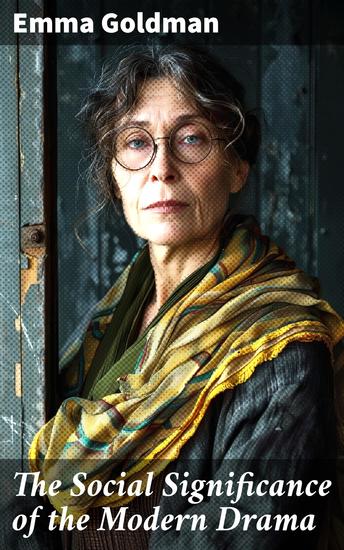
The Social Significance of the Modern Drama - Challenging Norms: The Power of Modern Drama in Social Change - cover

The Social Significance of the Modern Drama - Challenging Norms: The Power of Modern Drama in Social Change

Emma Goldman

Publisher: Good Press

  • 0
  • 0
  • 0

Summary

In "The Social Significance of the Modern Drama," Emma Goldman provides a profound exploration into the intersection of theatrical art and social consciousness during the early 20th century. Goldman critiques contemporary plays and their ability to reflect and challenge societal norms, emphasizing the role of drama as a vehicle for social reform. Through a blend of incisive commentary and passionate advocacy, she argues for the transformative power of modern drama to inspire change, showcasing her keen analytical skills and rich understanding of literary movements of her time. Goldman's literary style is both engaging and assertive, employing a conversational tone that invites readers to reflect on the cultural significance of performance art. Emma Goldman, a prominent anarchist thinker and activist, was deeply influenced by the socio-political upheaval of her time, as well as by the literary currents that shaped modern drama. Her experiences as a public figure in the early feminist and labor rights movements, combined with her personal encounters with censorship and oppression, inform her passionate argument for the empowerment potential of theater. This book reflects her belief that art should not exist in isolation but must serve as a catalyst for social justice. I highly recommend "The Social Significance of the Modern Drama" to anyone interested in the interplay between art and society. Goldman's incisive critiques and bold assertions make this book not only a vital historical document but also a timeless call to action, urging readers to recognize the intrinsic link between creative expression and social transformation.
Available since: 10/12/2023.
Print length: 182 pages.
Other books that might interest you

  • Messiah The - A Sacred Ecologue - Pope is one of our greatest poets here he once again demonstrates his brilliant talents - cover

    Messiah The - A Sacred Ecologue...

    Alexander Pope

    • 0
    • 0
    • 0
    Alexander Pope was born on May 21st, 1688 in London into a Catholic family.   
    His education was affected by the recent Test Acts, upholding the status of the Church of England and banning Catholics from teaching.  In effect this meant his formal education was over by the age of 12 and Pope was to now immerse himself in classical literature and languages and to, in effect, educate himself.    
    From this age too he also suffered from numerous health problems including a type of tuberculosis (Pott’s disease) which resulted in a stunted, deformed body.  Only to grow to a height of 4’ 6”, with a severe hunchback and complicated further by respiratory difficulties, high fevers, inflamed eyes and abdominal pain all of which served to further isolate him, initially, from society.  
    However his talent was evident to all. Best known for his satirical verse, his translations of Homer and the use of the heroic couplet, he is the second-most frequently quoted writer in The Oxford Dictionary of Quotations, after Shakespeare.  
    With the publication of Pastorals in 1709 followed by An Essay on Criticism (1711) and his most famous work The Rape of the Lock (1712; revised and enlarged in 1714) Pope became not only famous but wealthy.  
    His translations of the Iliad and the Odyssey further enhanced both reputation and purse.  His engagement to produce an opulent new edition of Shakespeare met with a mixed reception.  Pope attempted to "regularise" Shakespeare's metre and rewrote some of his verse and cut 1500 lines, that Pope considered to be beneath the Bard’s standard, to mere footnotes.  
    Alexander Pope died on May 30th, 1744 at his villa at Twickenham (where he created his famous grotto and gardens) and was buried in the nave of the nearby Church of England Church of St Mary the Virgin.   
    Over the years and centuries since his death Pope’s work has been in and out of favour but with this distance he is now truly recognised as one of England’s greatest poets.
    Show book
  • Contemplations - A spiritual poem about nature - cover

    Contemplations - A spiritual...

    Anne Bradstreet

    • 0
    • 0
    • 0
    The bookshelves of British literature are incredible collections that have gathered together centuries of very talented authors.  From these Isles their fame spread and whilst among their number many are now forgotten or neglected, their talents endure.  Among them is one of the first published female poets, Anne Bradstreet. Born in England, she moved to America in her early years, and from there her poetic legacy spread to other conrinents.
    Show book
  • Dixon and Daughters - cover

    Dixon and Daughters

    Deborah Bruce

    • 0
    • 0
    • 0
    Mary has just been released from prison. She wants to come home and forget all about it – but Briana has other ideas.
    Over two tumultuous days, a family is forced to confront not only their past, but everything about themselves. Because the truth doesn't go away, even if you refuse to hear it.
    A powerful story of family and forgiveness, Deborah Bruce's play Dixon and Daughters was first performed at the National Theatre, London, in April 2023, directed by Róisín McBrinn and co-produced with Clean Break.
    Show book
  • The Transformative Power of Tattoo - cover

    The Transformative Power of Tattoo

    Julianne Ingles

    • 0
    • 0
    • 0
    A smashing collection of fiction, nonfiction and poetry by a diverse group of writers who delve into tattoos in terms of class, body image, history, empowerment and transformations. It's an investigation into why people get tattoos and how they transform a person's life.
    Our 19 contributors are debut and award-winning. Their work includes memoir, transgressive fiction, horror, magical realism, sci-fi, literary fiction, poetry and personal essays. We're delighted to share with you their take on the tattoo.
    Show book
  • Girl Made of Glass - cover

    Girl Made of Glass

    Shelby Leigh

    • 0
    • 0
    • 0
    If you think often about the past or battle with overthinking and self-esteem, girl made of glass is for you. This collection is about finding yourself, forgiving yourself, and loving yourself. It explores the many ways our past haunts us but will leave you feeling hopeful about your future. 


    girl made of glass is a poetry collection about how our past—past mistakes, relationships, and regrets—can linger into our future. Broken into four parts, this book is about finding, forgiving, and loving ourselves. The Nightmares explores our past and the moments that haunt us. The Mirror delves into insecurity and how we might haunt ourselves. The Shattering investigates relationships and how they can break us. The Enchantment delivers an uplifting conclusion of self-love and growth.
    Show book
  • Shadow Play - cover

    Shadow Play

    James Norcliffe

    • 0
    • 0
    • 0
    Norcliffe professes not to be a confessional poet; nevertheless he freely acknowledges that places and people served as prompts for the poems. New Zealand based, Norcliffe is well-travelled and his poems have international resonance. Placing Shadow Play with one other poetry collection as a finalist for the annual international Proverse Prize in 2011, the judging panel (reviewing entries with no knowledge of the writers) found an expert hand behind a wide variety of well-wrought poems on a range of topics, pleasingly interwoven with literary allusions.  
    "Though the 'ordinary world' most of these poems inhabit is rich with the familiar—ATMs, case managers, vindaloo—what James Norcliffe finds there is far from typical. And when he turns his considerable imagination up a notch, setting a giraffe on the Russian steppe, say, or exploring the largest statue of a strawberry in the world, the results have the surprise and gleam of the truly extraordinary. Shadow Play is a treasure chest of fresh, insightful work."—Don Bogen, poet and editor of the Cincinnati Review, USA. 
    "James Norcliffe is part bar wag, part trapeze artist, and every bit the literary raconteur. He wields his imagination like a spot welder, spraying out glowing trails of hot sparks. And yet so much in these pages happens in slo-mo, in fractured memory. There are poems for cartographers and window washers, personae poems for Hamlet, Alice in Wonderland, and sadistic Empress Dowager Cixi, love poems for books, ATMs, and vindaloo. But his great poem for the Icthyosaurus -- "not one centimetre / of human history in the / kilometres of its eyes" -- exposes the slinky sinister undertow at work. Suicide, heart attacks, suicide bombers, and auto da fe suck us in. Norcliffe pokes and prods the reader like a forensic tech and in the end his poems leave spatter patterns."—Richard Peabody, poet, novelist, and editor of Gargoyle Magazine, USA.
    Show book
