Join us on a literary world trip!
Add this book to bookshelf
Grey
Write a new comment Default profile 50px
Grey
Subscribe to read the full book or read the first pages for free!
All characters reduced
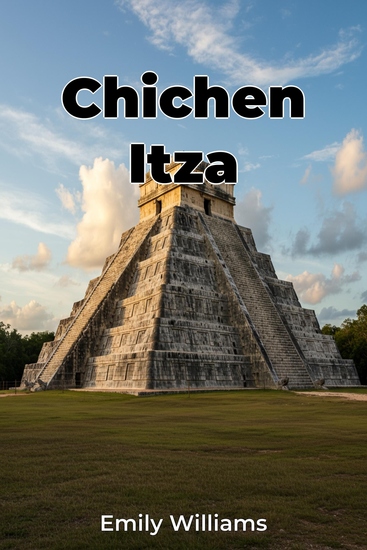
Chichen Itza - cover

Chichen Itza

Emily Williams

Translator A AI

Publisher: Publifye

  • 0
  • 0
  • 0

Summary

"Chichen Itza" explores the history, architecture, and cultural significance of this renowned Mayan city. The book unveils how the city's monumental structures, like El Castillo, reflect Mayan cosmology and astronomical knowledge. It highlights Chichen Itza's unique blend of Mayan and Toltec influences, setting it apart from other Mayan sites and offering insights into a period of cultural exchange. Unraveling the meaning behind its architecture provides a window into the Mayan worldview and their sophisticated understanding of mathematics and engineering.

 
The book adopts a comprehensive approach, integrating archaeological findings with art historical analysis to uncover deeper layers of meaning within the city's architecture. It begins by laying the groundwork with introductions to Mayan architecture, cosmology, and history. Subsequent chapters delve into structures like the Great Ball Court and the Temple of Warriors, exploring specific engineering concepts such as the structural advantages of corbel arches.

 
The book argues that Chichen Itza served as a nexus of power, religion, and scientific knowledge. The final chapters synthesize these findings, presenting a comprehensive interpretation of Chichen Itza as a reflection of the Maya’s intellectual achievements and societal organization. Supported by archaeological evidence and epigraphic studies, this book offers valuable insights for history enthusiasts, archaeology buffs, and anyone interested in understanding the lasting legacy of Chichen Itza and the Mayan civilization.
Available since: 02/19/2025.
Print length: 61 pages.


Other books that might interest you

  • Black Flora - Inspiring Profiles of Floriculture's New Vanguard - cover

    Black Flora - Inspiring Profiles...

    Teresa J. Speight

    • 0
    • 0
    • 0
    Discover the growing community of Black floriculture leading the new vanguard in flowers.Black Flora is the first book to feature profiles of contemporary Black experts innovating in the world of flowers. Author and longtime gardener, Teresa Speight, offers a beautiful intersection of flowers and community. This book is a homecoming, one that unearths the floral legacies of the past and present, while providing a source of inspiration for younger generations of plant-lovers seeking examples of successful Black floral artists and entrepreneurs. Black Flora showcases a range of floral expertise and as visionary horticulturalist and garden historian, Abra Lee, reflects in her foreword, the community represented in Black Flora has an important significance both today, and in garden history.  Both a celebration of now and a vision for the future, Black Flora honors floriculture’s creative vanguard.
    Show book
  • Prelude to Philosophy - An Introduction for Christians - cover

    Prelude to Philosophy - An...

    Mark W. Foreman, J. P. Moreland

    • 0
    • 0
    • 0
    "The unexamined life is not worth living," according to Socrates, but pursuing the examined life strikes many as daunting, unappealing and even unnecessary. Is philosophy important? Why do I need philosophy if I have the Bible? Aren't philosophers simply engaged in meaningless disputes that are irrelevant to everyday life? 


    Mark Foreman addresses these and other questions in this "prelude" to the subject. Unlike a full introduction to philosophy, this book is a preliminary discussion that dispels misunderstandings and explains the rationale for engaging in philosophical reasoning. 


    In the first half of the book, Foreman defines the task of philosophy, compares it to other disciplines and demonstrates its practical value to Christians interested in developing a more thoughtful faith. The second half introduces the listener to logic and argumentation, the essential tools of a philosopher. Concise and straightforward, Prelude to Philosophy is a guide for those looking to embark on the "examined life."
    Show book
  • Piracy and the Making of the Spanish Pacific World - cover

    Piracy and the Making of the...

    Kristie Patricia Flannery

    • 0
    • 0
    • 0
    Piracy and the Making of the Spanish Pacific World offers a new interpretation of Spanish colonial rule in the Philippine islands. Drawing on the rich archives of Spain's Asian empire, Kristie Patricia Flannery reveals that Spanish colonial officials and Catholic missionaries forged alliances with Indigenous Filipinos and Chinese migrant settlers in the Southeast Asian archipelago to wage war against waves of pirates, and even the British fleet that attacked at the height of the Seven Years' War. 


    This revisionist study complicates the assumption that empire was imposed on Filipinos with brute force alone. Rather, anti-piracy also shaped the politics of belonging in the colonial Philippines. Real and imagined pirate threats especially influenced the fate and fortunes of Chinese migrants in the islands. They triggered genocidal massacres of the Chinese at some junctures, and at others facilitated Chinese integration into the Catholic nation as loyal vassals. 


    Piracy and the Making of the Spanish Pacific World demonstrates that piracy is key to explaining the surprising longevity of Spain's Asian empire, which survived the Age of Revolutions and endured almost to the end of the nineteenth century. It offers important new insight into piracy's impact on the trajectory of globalization and European imperial expansion in maritime Asia.
    Show book
  • A Reading of the Inaugural Address of President Ulysses S Grant - cover

    A Reading of the Inaugural...

    President Ulysses S. Grant

    • 0
    • 0
    • 0
    Ulysses S. Grant (April 27, 1822 - July 23, 1885), born in Point Pleasant, OH, was the 18th president of the United States, serving from 1869 to 1877. A veteran of the Mexican–American War, in 1865, as commanding general, Grant led the Union Army to victory in the American Civil War. As president, Grant stabilized the post-war national economy, supported congressional Reconstruction and the Fifteenth Amendment, and prosecuted the Ku Klux Klan. The following is a reading of President Grant's inaugural address delivered on March 04, 1869.
    Show book
  • How to Travel - An Ancient Guide for the Modern Tourist - cover

    How to Travel - An Ancient Guide...

    Herodotus, M. D. Usher

    • 0
    • 0
    • 0
    A transporting anthology of ancient Greek and Roman travel writings that capture the thrill of exploration and discovery—from Europe to the Holy Land and Egypt to IndiaAt long last, a travel guide to the ancient world for the modern tourist—written by the ancients themselves. How to Travel gathers classic texts from Greek and Roman writers to explore what today’s readers can learn from ancient encounters with unfamiliar peoples, places, and customs.The Greek historian Herodotus (ca. 484–425 BCE) is one of the most famous travelers of antiquity. His Histories, which chronicle his and others’ encounters with foreign peoples and places, have fascinated readers for millennia, and have much to teach about the secrets of good travel. In How to Travel, Herodotus and Tacitus take us on tours of Central Asia, Egypt, and Germania, while pilgrims like Pausanias and the Christian nun Egeria guide us through Greece and the Holy Land. Readers are whisked away to India to experience the ways of forest-dwelling sages and to the far reaches of Africa. And as if Earth weren’t enough, the satirist Lucian takes us to the Moon. But this whirlwind tour of antiquity is more than a pleasure cruise. Seneca cautions travelers that, go as far as we may, we can never escape ourselves. Gratitude, Egeria says, is the traveler’s proper response for the privilege. And Homer reminds us that, ultimately, there’s no place like home.Featuring vivid new translations, an inviting introduction, and the original Greek and Latin texts on facing pages, How to Travel captures the thrill of exploration and discovery—and how new experiences, fresh vistas, and foreign cultures can change the traveler.
    Show book
  • France and England’s Most Famous Palaces: The History of the Most Famous Royal Residences in Western Europe - cover

    France and England’s Most Famous...

    Editors Charles River

    • 0
    • 0
    • 0
    When people think of the British Royal family, and more specifically where they live, the first image that often pops into mind is that of stately Buckingham Palace, with its changing of the guard and the occasional royal coach leaving or entering. Others may think of the royal country estate of Windsor Castle, a favorite of both Britain’s longest-reigning and second longest-reigning monarchs. And there was a time when both royal residences played second fiddle to a much better known home, the elegant Kensington Palace. Buckingham Palace is not different, for though it was originally built as a home of a private citizen, once a king bought it, its future was sealed.  
    	For the French, and those who study their history, Versailles is a symbol of, as Charles Dickens once put it, “the best of times…the worst of times.” It was here that the Sun King, Louis XIV, built a palace worthy of a great nation during a time when peace was, at best, short-lived. It was at Versailles that Russian Tsar Peter the Great studied the palace’s architecture and gardens so that he could recreate them in his home country. Indeed, the greatest minds and artistic geniuses of the later stages of the Renaissance came to Versailles to build and paint, and it was here that Madame de Pompadour and her successor, Madame du Barry, used their wit and beauty to charm a king into doing their bidding. However, as history constantly demonstrates, nothing good lasts forever, and so it was with Versailles.  
    	France, like all European countries, has had its fair share of palaces over time, but none suffered the rise and fall of fortune like the Tuileries. Built by a widow with a flair for architecture, it grew for more than a decade, along with the royal family that it housed. Then, during the French Revolution, it fell from grace with that family and even became a sight of execution, its famous gardens providing the background for the infamous guillotine. 
    Show book