Join us on a literary world trip!
Add this book to bookshelf
Grey
Write a new comment Default profile 50px
Grey
Subscribe to read the full book or read the first pages for free!
All characters reduced
Best Home Records - cover

Best Home Records

Emily James

Translator A AI

Publisher: Publifye

  • 0
  • 0
  • 0

Summary

Best Home Records explores the multifaceted phenomenon of home-field advantage in sports history, arguing that sustained success at home is more than luck. It examines how historical context, sports psychology, and sports sociology contribute to a team's dominance on their own turf.Did you know that home advantage isn't just about fan influence but is a cultivated aspect of team identity? The book delves into win-loss records, the impact of crowd support, and even potential referee bias.

 
The book progresses through sections that introduce the concept, provide case studies of teams with remarkable home records, and analyze common threads of success. It traces the evolution of home-field advantage across sports, from early baseball and football to modern basketball and soccer.

 
The strategic importance of establishing a strong home record is emphasized, along with its impact on team morale and player recruitment, making it valuable for sports analysts and fans alike.
Available since: 02/20/2025.
Print length: 61 pages.

Other books that might interest you

  • The Fall of Boris Johnson - The Award-Winning Explosive Account of the PM's Final Days - cover

    The Fall of Boris Johnson - The...

    Sebastian Payne

    • 0
    • 0
    • 0
    The Fall of Boris Johnson is the explosive inside account of how a prime minister lost his hold on power. Written and read by Sebastian Payne, Director of Onward and former Whitehall Editor for the Financial Times.Winner at the 2022 Parlimentary Book AwardsA New Statesman, The Times, Daily Mail and FT Book of the Year'Revelatory' - The Daily Telegraph'Delicious detail' - The TimesBoris Johnson was touted as the saviour of the country and the Conservative Party, obtaining a huge commons majority and finally 'getting Brexit done'. But, within three short years, he was deposed in disgrace and left the country in crisis.Sebastian Payne tells the essential behind-the-scenes story, charting the series of scandals that felled Johnson: from the blocked suspension of Owen Paterson, through partygate and the final death blow: the Chris Pincher allegations. This is the full narrative of the betrayals, rivalries and resignations that resulted in the dramatic Conservative coup – and set in motion those events that saw the party sink to catastrophic new lows.With unparalleled access to those who were in the room when key decisions were made, Payne tells of the miscalculations and mistakes that led to Boris Johnson’s downfall. This is a gripping and timely look at how power is gained, wielded and lost in Britain today.'Genuinely page-turning' - Andrew Marr'Entertaining and illuminating' - Tim Shipman
    Show book
  • Ideals And Ambition - Ojai 1949 - Public Talk 8 - cover

    Ideals And Ambition - Ojai 1949...

    Jiddu Krishnamurti

    • 0
    • 0
    • 0
    Ideals and ambition - 13 August 1949 
    • Q: In listening to you, I feel that the distinction or space between ideal and 
    practice is illusory. Is this so? 
    • Q: I am free from ambition. Is there something wrong with me?
    Show book
  • Bad Company - Private Equity and the Death of the American Dream - cover

    Bad Company - Private Equity and...

    Megan Greenwell

    • 0
    • 0
    • 0
    * KIRKUS BEST NONFICTION BOOKS OF THE YEAR 2025* *ONE OF AV CLUB'S BEST BOOKS OF 2025* 
    "[An] indictment of an industry that has cannily tilted the playing field in its favor. Bad Company details how clichéd abstractions like ‘consolidation’ and ‘efficiency’ have given cover to real betrayals.” - The New York Times 
    A timely work of singular reportage and a damning indictment of the private equity industry told through the stories of four American workers whose lives and communities were upended by the ruinous effects of private equity takeovers. 
    Private equity runs our country, yet few Americans have any idea how ingrained it is in their lives. Private equity controls our hospitals, daycare centers, supermarket chains, voting machine manufacturers, local newspapers, nursing home operators, fertility clinics, and prisons. The industry even manages highways, municipal water systems, fire departments, emergency medical services, and owns a growing swath of commercial and residential real estate. 
    Private equity executives, meanwhile, are not only among the wealthiest people in American society, but have grown to become modern-day barons with outsized influence on our politics and legislation. CEOs of firms like Blackstone, Carlyle, KKR, and Apollo are rewarded with seats in the Senate and on the boards of the country’s most august institutions; meanwhile, entire communities are hollowed out as a result of their buyouts. Workers lose their jobs. Communities lose their institutions. Only private equity wins. 
    Acclaimed journalist Megan Greenwell’s Bad Company unearths the hidden story of private equity by examining the lives of four American workers that were devastated as private equity upended their employers and communities: a Toys R Us floor supervisor, a rural doctor, a local newspaper journalist, and an affordable housing organizer. Taken together, their individual experiences also pull back the curtain on a much larger project: how private equity reshaped the American economy to serve its own interests, creating a new class of billionaires while stripping ordinary people of their livelihoods, their health care, their homes, and their sense of security. 
    In the tradition of deeply human reportage like Matthew Desmond’s Evicted, Megan Greenwell pulls back the curtain on shadowy multibillion dollar private equity firms, telling a larger story about how private equity is reshaping the economy, disrupting communities, and hollowing out the very idea of the American dream itself. Timely and masterfully told, Bad Company is a forceful rebuke of America’s most consequential, yet least understood economic forces.
    Show book

  • The Great Beyond - Unraveling the Mysteries of the Afterlife - cover

    The Great Beyond - Unraveling...

    John Harpoon

    • 0
    • 0
    • 0
    The concept of life after death is one of humanity’s most profound and enduring mysteries. Across cultures and time periods, people have sought to understand what happens after we take our last breath. Whether driven by religious beliefs, philosophical musings, or personal experiences, the question of the afterlife has shaped much of human thought and civilization. It has influenced not only religious teachings but also art, literature, and even scientific inquiries into consciousness and the nature of existence. 
    Throughout history, the afterlife has been envisioned in countless ways. Ancient Egyptians believed in a journey to the underworld where the soul would face judgment, while the Greeks and Romans saw it as a realm of shadows or a place of eternal bliss for the virtuous. In the East, Hinduism and Buddhism introduced the concept of reincarnation, where the soul is reborn into new lives, shaped by karma. Similarly, Christianity, Islam, and Judaism have their own distinct visions of heaven, hell, and the possibility of eternal life. 
    Despite the diversity of beliefs, there is a common thread that runs through all of them: the hope that death is not the end, but a transition to another realm or state of being. For many, the afterlife provides comfort, offering a sense of continuity after the end of physical existence. For others, it serves as a source of moral guidance, with promises of reward for virtue and punishment for wrongdoing.
    Show book
  • Georgy Zhukov: The Life and Legacy of the Soviet Union’s Greatest General during World War II - cover

    Georgy Zhukov: The Life and...

    Editors Charles River

    • 0
    • 0
    • 0
    In the warm predawn darkness of June 22, 1941, 3 million men waited along a front hundreds of miles long, stretching from the Baltic coast of Poland to the Balkans. Ahead of them in the darkness lay the Soviet Union, its border guarded by millions of Red Army troops echeloned deep throughout the huge spaces of Russia. This massive gathering of Wehrmacht soldiers from Adolf Hitler's Third Reich and his allied states – notably Hungary and Romania – stood poised to carry out Operation Barbarossa, Hitler's surprise attack against the country of his putative ally, Soviet dictator Joseph Stalin.  
    Of the Soviet generals, none played as crucial a role in the war as Georgy Konstantinovich Zhukov, one of the most highly decorated army officers in Russian military history. At critical stages during the Second World War, it seemed as if it was Zhukov alone who stood between Russian defeat and German victory. Zhukov was ultimately involved in all the major battles on the Eastern Front, including Moscow, Leningrad, Stalingrad, Kursk, Bagration, and the final assaults into Poland and Germany to capture Berlin.  
    Stalin came to depend on Zhukov’s ruthless military skills for victory, but in the cut-throat Soviet Union, that was always a double-edged sword, because it seemed that Stalin envied Zhukov and feared him as well. Zhukov, who could be as aggressive and blunt as Stalin, was one of the few people prepared to stand up to the Soviet dictator and argue with him, and as many Soviet politicians and generals learned to their detriment, going toe to toe with one of the most brutal leaders of the 20th century was a highly risky venture. However, the mutual understanding they forged as they confronted the Germans may have played the biggest role in Hitler’s demise. 
    Show book
  • The Assassination of Julius Caesar - A People's History of Ancient Rome - cover

    The Assassination of Julius...

    Michael Parenti

    • 0
    • 0
    • 0
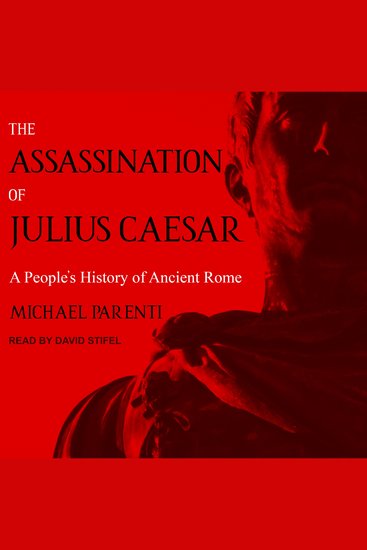
    "A provocative history" of intrigue and class struggle in Ancient Rome—"an important alternative to the usual views of Caesar and the Roman Empire"—Publishers Weekly. 


    Most historians, both ancient and modern, have viewed the Late Republic of Rome through the eyes of its rich nobility—the 1 percent of the population who controlled 99 percent of the empire's wealth. In The Assassination of Julius Caesar, Michael Parenti recounts this period, spanning the years 100 to 33 BC, from the perspective of the Roman people. In doing so, he presents a provocative, trenchantly researched narrative of popular resistance against a powerful elite. 


    As Parenti carefully weighs the evidence concerning the murder of Caesar, he adds essential context to the crime with fascinating details about Roman society as a whole. In this book, we find reflections on the democratic struggle waged by Roman commoners, religious augury as an instrument of social control, the patriarchal oppression of women, and the political use of homophobic attacks. The Assassination of Julius Caesar offers a whole new perspective on an era thought to be well-known.
    Show book