Join us on a literary world trip!
Add this book to bookshelf
Grey
Write a new comment Default profile 50px
Grey
Subscribe to read the full book or read the first pages for free!
All characters reduced
Archery Precision - cover

Archery Precision

Emily James

Translator A AI

Publisher: Publifye

  • 0
  • 0
  • 0

Summary

Archery Precision explores the multifaceted world of archery, blending historical context with scientific precision. It delves into the techniques required for accurate shooting and the underlying scientific principles governing arrow flight, appealing to both sports enthusiasts and history buffs. The book uniquely combines the historical journey of archery with the physics and biomechanics that dictate its accuracy. Did you know that understanding aerodynamics is essential for predicting arrow trajectory, or that proper stance and muscle activation are vital for consistent performance?

 
The book progresses systematically, beginning with the fundamentals of archery equipment and its historical evolution. It then examines the biomechanics of shooting, detailing stance, draw, and release techniques with anatomical insights. The science of arrow flight, including aerodynamics and the impact of wind, is explained in an accessible manner. Finally, the book applies these principles to various archery disciplines, showcasing how a comprehensive understanding enhances performance across different styles.

 
What sets Archery Precision apart is its balanced approach. It offers a comprehensive perspective by combining historical insights with rigorous scientific analysis and practical guidance. This book provides valuable insights into the science behind the sport, offering a deeper understanding of the factors that contribute to accuracy and performance.
Available since: 03/10/2025.
Print length: 81 pages.
Other books that might interest you

  • Anger Management - How to Achieve Self-Control Master your Emotions and Take Control of your Anger in Every Situation - cover

    Anger Management - How to...

    Ivy Spencer

    • 0
    • 0
    • 0
    If You Want To Live A More Successful, Healthier, And More Enjoyable Life, You Need To Learn How To Overcome Negative Emotions. 
    No matter how bad rage looks or feels, keep in mind that it is a perfectly valid feeling and a natural part of life, just like any other emotion. Simply put, there are things in this world that make you unhappy to the point of being angry. It's how you express the emotion of anger, however, that can be considered "appropriate" or "inappropriate." As you're probably already aware, when you allow any emotion to get the best out of you, you end up needlessly harming yourself and the people around you. If you regularly find yourself in frustration, then it's time to learn a more constructive way to deal with your fury. 
    Strong and raw emotions like anger often rob us of the joy that we might otherwise enjoy. Anger burns-not only emotionally, but also psychologically and physically. 
    Unfortunately, many people are hanging on to their frustration and trying to deal with it in less than ideal ways.  
    No wonder too many people are struggling with jobs and relationships that aren't as successful or as happy as they could be.This audiobook takes you through a series of highly effective thinking processes that can defuse and re-channel your rage. Unlike the traditional rage self-help book, this book uses a step-by-step experience-based approach.This audiobook helps you deal with your anger issues by starting at the beginning with how you choose to judge the stimuli or feedback you receive from the world. 
    Yes, there's such a thing as positive anger. By channeling this powerful emotion to more product releases, not only do you get out of the risk of reacting to the worst possible pay, but you also make great progress in other areas of your life.
    Show book
  • Minoans and Mycenaeans The: The History of the Civilizations that First Developed Ancient Greek Culture - cover

    Minoans and Mycenaeans The: The...

    Editors Charles River

    • 0
    • 0
    • 0
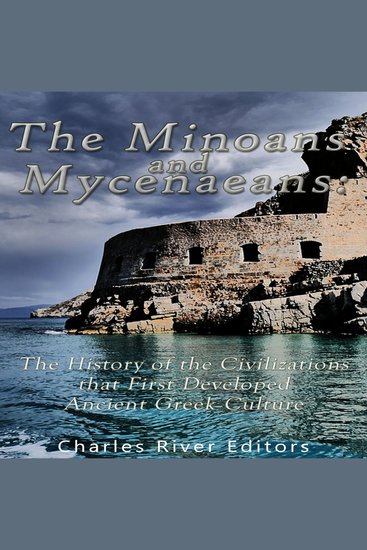
    Nearly 2,500 years after the Golden Age of Athens, people across the world today continue to be fascinated by the Ancient Greeks. But who did the Ancient Greeks look up to? The answer to that question can be found in Homer’s The Odyssey, in which Odysseus makes note of “a great town there, Cnossus, where Minos reigned.” It was perhaps the earliest reference to the Minoan civilization, a mysterious ancient civilization that historians and archaeologists still puzzle over, but a civilization that renowned historian Will Durant described as "the first link in the European chain.” 
    Nearly 2,000 years before Homer wrote his epic poems, the Minoan civilization was centered on the island of Crete, a location that required the Minoans to be a regional sea power. And indeed they were, stretching across the Aegean Sea from about 2700-1500 BCE with trade routes extending all the way to Egypt. 
    The Minoans may have been the first link in the “European chain”, leading to the Ancient Greeks and beyond, but questions persist over the origins of the civilization, the end of the civilization, and substantial parts of their history inbetween, including their religion and buildings.  
    In the wake of the Minoans, a Greek culture flourished and spread its tentacles throughout the western Mediterranean region via trade and warfare. Scholars have termed this pre-Classical Greek culture the Mycenaean culture, which existed from about 2000-1200 BCE, when Greece, along with much of the eastern Mediterranean, was thrust into a centuries long dark age. However, before the Mycenaean culture collapsed, it was a vital part of the late Bronze Age Mediterranean system and stood on equal footing with some of the great powers of the region, such as the Egyptians and Hittites. At the same time, the Mycenaeans had more in common with their neighbors from the island of Crete.
    Show book
  • Dispersals - On Plants Borders and Belonging - cover

    Dispersals - On Plants Borders...

    Jessica J. Lee

    • 0
    • 0
    • 0
    A prize-winning memoirist and nature writer turns to the lives of plants entangled in our human world to explore belonging, displacement, identity, and the truths of our shared future 


    A seed slips beyond a garden wall. A tree is planted on a precarious border. A shrub is stolen from its culture and its land. What happens when these plants leave their original homes and put down roots elsewhere? 


    In fourteen essays, Dispersals explores the entanglements of the plant and human worlds: from species considered invasive, like giant hogweed; to those vilified but intimate, like soy; and those like kelp, on which our futures depend. Each of the plants considered in this collection are somehow perceived as being "out of place"—weeds, samples collected through imperial science, crops introduced and transformed by our hand. Combining memoir, history, and scientific research in poetic prose, Jessica J. Lee meditates on the question of how both plants and people come to belong, why both cross borders, and how our futures are more entwined than we might imagine.
    Show book
  • Ludwig van Beethoven: A short biography - 5 Minutes: Short on time - long on info! - cover

    Ludwig van Beethoven: A short...

    5 Minutes, 5 Minute Biographies,...

    • 0
    • 0
    • 0
    Ludwig van Beethoven, legendary composer: Life and works in a short biography! Everything you need to know, brief and concise. Infotainment, education and entertainment at its best!
    Show book
  • The Beautiful Death of Ozzy Osbourne - cover

    The Beautiful Death of Ozzy...

    Keith Kahn-Harris

    • 0
    • 0
    • 0
    Pioneering metal writer Keith Kahn-Harris presents a moving, visionary exploration of Ozzy Osbourne, and of metal music and culture: the potent legacy Ozzy left us. 
    What is a ‘good death’? 
    How about this: After years of terrible health, you gather friends and admirers for one last, glorious party. A couple of weeks later, you slip away, surrounded by your loving family. Then, the world comes to mourn. That is how Birmingham’s favourite son, Ozzy Osbourne, died. 
    By his death in June 2025 – at an age few believed he’d reach – Ozzy was much-loved, far beyond the metal world. Once a feared, demonic figure to some (and a joke to others), his Back to the Beginning farewell concert at Villa Park raised millions for charity. 
    In concise, arresting chapters moving from Death to Life via Art, Politics, Sex, Bodies, Voice, Family, Myth and more, Kahn-Harris explores how Ozzy – of all people! – attracted such generosity of spirit. The answer, he finds, is deeply embedded within the story and culture of metal – and has lessons for us all. 
    This biography uses music criticism to explore heavy genres and styles, weaving social history with vivid stories that circle back to dying, family and myth. Latest and popular in its scope, it argues that metal’s culture—at its best—can turn even death into a communal act of meaning. 
    For fans of Howard Jacobson (Shylock is My Name), and Jessica Cohen (What Makes an Apple?). 
    HarperCollins 2026
    Show book
  • 101 Why Do We Call It That - Origins of Everyday Words & Phrases Book - cover

    101 Why Do We Call It That -...

    Dean Stratton

    • 0
    • 0
    • 0
    This audiobook is narrated by an AI Voice.  
    Discover the hidden stories behind the words we use every day. 
    Why Do We Call It That? is a fascinating journey through language, uncovering the quirky, surprising, and often hilarious origins of the terms, phrases, and idioms we take for granted. Perfect for word lovers, trivia buffs, teachers, writers, or anyone who enjoys a good story about language. 
    What’s Inside: 
    Everyday Words Unpacked: Learn why we call it a “sandwich,” where “deadline” came from, and why a “computer bug” has nothing to do with insects. 
    Idioms & Expressions Explained: Dive into phrases like “break the ice,” “spill the beans,” and “under the weather.” 
    Cultural & Historical Insights: Explore how wars, inventions, myths, and mishaps shaped the words we speak today. 
    Engaging Examples & Anecdotes: Each entry comes alive with storytelling, humor, and unique perspectives that make learning memorable. 
    Why You’ll Love It: 
    Makes a thoughtful gift for teachers, writers, linguists, or curious friends. 
    Great conversation starter for dinner parties, classrooms, or book clubs. 
    Clear, well-researched, and fun—a book that informs as much as it entertains. 
    Whether you’re curious about why we “kick the bucket” or how “Google” became a verb, this book reveals the surprising histories that shaped our everyday speech.
    Show book