Join us on a literary world trip!
Add this book to bookshelf
Grey
Write a new comment Default profile 50px
Grey
Subscribe to read the full book or read the first pages for free!
All characters reduced
Up the Country': Letters Written to Her Sister from the Upper Provinces of India - cover

Up the Country': Letters Written to Her Sister from the Upper Provinces of India

Emily Eiden

Publisher: e-artnow

  • 0
  • 0
  • 0

Summary

The author of the letters Emily Eden and her sister Fanny accompanied their brother George Eden, the Governor-General of India, in his 2-year trip across India. George and Emily kept a journal which she sent as a series of letters to another sister in England. This volume covers the period from October 1837 to 1840 when George Eden went on tour in the upper provinces meeting local rulers and potentates with a caravan of staff, followers, and soldiers, which often numbered up to 20,000 people. The journal about this trip is an interesting look at life in the English upper classes in India before the mutiny and before Victoria was proclaimed Empress.
Available since: 11/24/2023.
Print length: 445 pages.

Other books that might interest you

  • 12 Laws of Being Human - cover

    12 Laws of Being Human

    Manhardeep Singh

    • 0
    • 0
    • 0
    What does it really mean to be human? Embrace these 12 Laws of Being Human to harness your innate power and become unstoppable.The audiobook is narrated with to-the-point language and tone with the intent to reach the listener in a clear way.12 Laws of Being Human will help you:Understand your impact on the whole worldHave awareness of how each one of us is connectedBe unstoppable in the face of challengesBecome resilientDefine who you want to be12 Laws of Being Human is an intriguing self-realization audiobook. If you like self-improvement, therapeutic, life changing audiobooks, then you’ll love Manhardeep Singh’s indispensable work.Buy 12 Laws of Being Human and take hold of the most precious gift you have got as being human.This audiobook is skillfully narrated by Manish Dongardive. Produced and published by Echo Point Books & Media, an independent bookseller in Brattleboro, Vermont. ©2022 Manhardeep Singh (P)2024 Echo Point Books & Media, LLC
    Show book
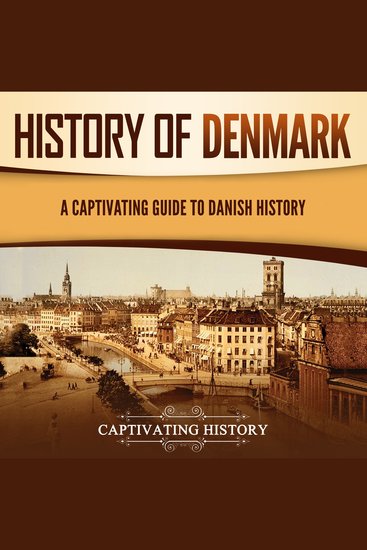
  • History of Denmark: A Captivating Guide to Danish History - cover

    History of Denmark: A...

    Captivating History

    • 0
    • 0
    • 0
    Did you know that one of Europe’s greatest queens, the incredible Margaret I, united Denmark, Sweden, and Norway in the Kalmar Union in the mid-1300s?  
    For centuries, Denmark “punched above its weight” and was a major player on the European stage. Many know about the Danish Vikings and their voyages of conquest and discovery, but Denmark is more than just those medieval raiders and traders, even though interest in their adventures is at an all-time high today. 
    Denmark became the first Scandinavian country to convert to Christianity, though this was likely as much to protect themselves from Christian kingdoms to the south and to increase their trade with Christian nations than any love for Christian beliefs.  
    Denmark has been at peace since WWII, but its position between the North and Baltic Seas makes it an important part of NATO, allowing it to once more “punch above its weight.” But despite its location, Denmark has managed to not only remain at peace but is today ranked as one of the happiest nations on Earth. 
    Discover the answer to fascinating questions like the following: Does Denmark really appear in the top three of the world’s “happiest” countries?Were the Danish Vikings only interested in conquest? And what were their relations like with Europe before the Viking Age? Who was Cnut the Great, and why was he so important in the history of countries like England, Denmark, Norway, and Sweden? Who the current Danish royal family is descended from? (Hint: it is not a Dane!) How and when did Denmark establish the wide-ranging social safety net it is so well-known for today? What role did Germany play in Denmark losing its status as an offensive military power?What was life like for Danish Jews during WWII? 
    Scroll up and click the “add to cart” button to learn more about the history of Denmark!
    Show book
  • Stand Watie: The Life and Legacy of the Cherokee Chief Who Became a Confederate General - cover

    Stand Watie: The Life and Legacy...

    Editors Charles River

    • 0
    • 0
    • 0
    Stand Watie’s life connects the traditional Cherokee homeland in Tennessee and Georgia, the fight within the tribe over leaving for the West or staying on their homeland and trying to resist, and the Trail of Tears. At the same time, his life also includes the ongoing split between mixed-blood and full-blood Cherokee in the Cherokee Nation, and the chaos of Indian Territory during the Civil War.  
    	On the surface, Indian Territory was peaceful and fairly prosperous, but old resentments simmered under the surface. The most dangerous of these was in the Cherokee Nation. Following the Cherokee removal, the leaders of the faction of the tribe that had actually signed the Treaty of New Echota suffered violence. There had been a law that giving away Cherokee land was punishable by death, and several of the leaders who signed the treaty were murdered. Stand Watie was one of the signers, and he barely escaped, but one of his brothers was executed. 
    	The Principal Chief was John Ross. He and his faction managed to retain political control of the Cherokee tribe, but there was lasting enmity between the Watie and Ross factions of the tribe. In a broad sense, the signers of the hated treaty were mixed-blood Cherokee, and the resistance had been led by full-bloods. Stand Watie headed the mixed-blood faction and John Ross the full-blood faction. Ironically, John Ross himself was mixed-blood and Watie was a full-blood, but regardless, this tribal split had important ramifications for the Cherokee in the coming war. 
    	Like the country as a whole, the Cherokee Nation was split over the question of slavery, and with an estimated 100 slaves owned, Watie was the biggest native slaveholder in the region. At the start of the war, Watie was commissioned as a colonel in Confederate service and later as a brigadier general. His 1st Cherokee Mounted Rifles Regiment fought more engagements than any other Confederate unit west of the Mississippi River.
    Show book
  • Elvis Presley: A short biography - 5 Minutes: Short on time - long on info! - cover

    Elvis Presley: A short biography...

    5 Minutes, 5 Minute Biographies,...

    • 0
    • 0
    • 0
    Elvis Presley, inventor of rock'n'roll: Life and work in a short biography! Everything you need to know, brief and concise. Infotainment, education and entertainment at its best!
    Show book
  • The Era of Liberation - 1862-1894 - cover

    The Era of Liberation - 1862-1894

    Louis Kossuth, Abraham Lincoln,...

    • 0
    • 0
    • 0
    The late 19th Century was a time of liberation. After the collapse of empires, people of all creeds demanded their equality.We begin with two speeches that represent the old order, by Bismarck. Between the two speeches he went from being Prussia’s last Minister President to being the Germany’s first Chancellor. A statesman in the oldest mold, he argues for nationalist dominance against forces temporal and religious.The counter is given by Sullivan, who excoriates the British government for the Zulu war, asking why the country supported wars of aggression in foreign lands.From there, we move to the liberation of nations and peoples. Louis Kossuth embodied Hungary’s struggle against imperial oppression, Castelar argues for a Spanish republic, and Gambetta for the education of the peasantry in France. Across Europe, a tide rose demanding the government serve the people rather than use them.In America, Lincoln defined the struggle between the Union and Confederacy as the start of universal emancipation and freedom for all men. In contrast, Chief Joseph’s speech drips with pathos, as he lays down his spear forever, desperate to find what is left of his massacred and desolate peoples in the wilderness. After the Civil War ends, Susan Anthony’s speech demands that women should have the vote, as guaranteed in the constitution for all citizens.A series of speeches by Swami Vivekananda follow, given at the first World’s Parliament of Religions. These speeches brought Buddhism and Hinduism into the Anglosphere, and began a trend of searching for spiritual liberation alongside the more material demands of the time.We finish on a lighter tone, as Mark Twain bemoans the decay of the art of lying. In an age of such seriousness, the tall tale fell out of fashion, and the simple joy of telling a fisherman’s tale was lost.
    Show book
  • Teotihuacan Empire - The City of the Gods and the Forgotten Giants of Mesoamerica - cover

    Teotihuacan Empire - The City of...

    Rolf Hedger

    • 0
    • 0
    • 0
    Teotihuacan, known as the "City of the Gods," remains one of the most enigmatic civilizations of ancient Mesoamerica. Its origins date back to around 400 BCE, when small settlements began to emerge in the Valley of Mexico. Over the centuries, these settlements merged, gradually forming what would become the largest and most influential city of its time. The exact reasons for its rise are still debated, but archaeologists believe that a combination of favorable geography, trade opportunities, and sociopolitical factors contributed to Teotihuacan’s emergence as a dominant power. 
    The valley’s rich volcanic soil provided fertile land for agriculture, supporting crops such as maize, beans, and squash. The region was also strategically located along key trade routes, allowing early inhabitants to engage in commerce with neighboring cultures. As the population grew, so did the need for organization, leading to the development of complex social structures. Unlike other civilizations that revolved around a single ruling dynasty, Teotihuacan appears to have been governed by a collective leadership, possibly a council of elites who controlled different aspects of city life. 
    One of the most intriguing aspects of Teotihuacan’s early history is the origin of its name. The Aztecs, who discovered the abandoned ruins centuries later, named it "Teotihuacan," meaning "the place where gods were born." This suggests that even in ancient times, the city held a sense of divine significance. Mythology and spiritual beliefs were deeply intertwined with its development, as seen in its grand temples and pyramids, which were aligned with celestial movements.
    Show book