Join us on a literary world trip!
Add this book to bookshelf
Grey
Write a new comment Default profile 50px
Grey
Subscribe to read the full book or read the first pages for free!
All characters reduced
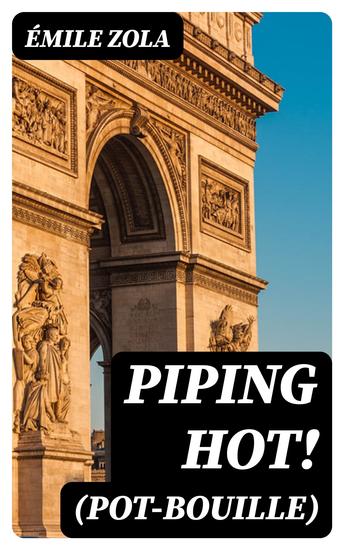
Piping Hot! (Pot-Bouille) - A Realistic Novel - cover

Piping Hot! (Pot-Bouille) - A Realistic Novel

Émile Zola

Publisher: DigiCat

  • 0
  • 0
  • 0

Summary

In "Piping Hot!" (Pot-Bouille), Émile Zola masterfully exposes the intricate and often sordid tapestry of Parisian life during the Second Empire. This novel, the tenth installment in Zola's Rougon-Macquart series, employs a naturalistic literary style that meticulously details the everyday struggles and moral complexities of a group of bourgeois residents in a French boarding house. Through a lens of social realism, Zola captures the essence of ambition, hypocrisy, and the quest for social ascent, while his vivid characterizations offer a nuanced understanding of the human condition amidst the fervent backdrop of urban modernization. Émile Zola, an influential figure in the naturalism literary movement, was deeply influenced by his personal experiences in a rapidly industrializing France. His commitment to portraying the darker aspects of society stems from a desire to unveil the underlying social injustices and human behaviors. Zola's exposure to working-class struggles and his passions for social reform led him to construct complex narratives that examine the interplay of environment and heredity on individuals' lives, culminating in the compelling characters of "Piping Hot!" This novel is a crucial read for those interested in the foundations of modern literature and social commentary. Zola's keen observations and gripping narrative not only prefigure the concerns of contemporary society but also challenge readers to reflect on their own ethical boundaries. "Piping Hot!" invites you to immerse yourself in its richly textured world, making it an essential addition to the canon of literary realism.
Available since: 06/02/2022.
Print length: 348 pages.

Other books that might interest you

  • Top 10 Short Stories The - The 1920's - The Americans - The top ten short stories written in the 1920s by authors from America - cover

    Top 10 Short Stories The - The...

    F Scott itzgerald, Sherwood...

    • 0
    • 0
    • 0
    Short stories have always been a sort of instant access into an author’s brain, their soul and heart.  A few pages can lift our lives into locations, people and experiences with a sweep of landscape, narration, feelings and emotions that is difficult to achieve elsewhere. 
     
    In this series we try to offer up tried and trusted ‘Top Tens’ across many different themes and authors. But any anthology will immediately throw up the questions – Why that story? Why that author?  
     
    The theme itself will form the boundaries for our stories which range from well-known classics, newly told, to stories that modern times have overlooked but perfectly exemplify the theme.  Throughout the volume our authors whether of instant recognition or new to you are all leviathans of literature. 
     
    Some you may disagree with but they will get you thinking; about our choices and about those you would have made.  If this volume takes you on a path to discover more of these miniature masterpieces then we have all gained something. 
     
    In this volume the Jazz Age blossoms with an exuberance of spirit and panache.  Life is for now, the future seems so very far away.  Our American authors bring the decade to life with stories that perhaps could only come to pass in this decade of the United States. 
     
    01 - The Top 10 - The 1920's - The Americans - An Introduction 
    02 - Bernice Bobs Her Hair by F Scott Fitzgerald 
    03 - Brothers by Sherwood Anderson 
    04 - The Color Out of Space by H P Lovecraft 
    05 - The Great Slave by Zane Grey 
    06 - The Golden Honeymoon by Ring Lardner 
    07 - The Most Dangerous Game by Richard Connell 
    08 - The Difference by Ellen Glasgow 
    09 - Skulls in the Stars by Robert E Howard 
    10 - The City of Refuge by Rudolph Fisher 
    11 - Spurs by Tod Robbins
    Show book
  • Tales Of Unrest - cover

    Tales Of Unrest

    Joseph Conrad

    • 0
    • 0
    • 0
    Joseph Conrad was a Polish-British writer regarded as one of the greatest novelists to write in the English language. He came to be regarded a master prose stylist who brought a non-English sensibility into English literature. He wrote stories and novels, many with a nautical setting, that depict trials of the human spirit in the midst of what he saw as an impassive, inscrutable universe.Conrad is considered a literary impressionist by some and an early modernist by others, though his works also contain elements of 19th-century realism. His narrative style and anti-heroic characters, as in Lord Jim, for example, have influenced numerous authors. Many dramatic films have been adapted from and inspired by his works. Numerous writers and critics have commented that his fictional works, written largely in the first two decades of the 20th century, seem to have anticipated later world events.Writing near the peak of the British Empire, Conrad drew on the national experiences of his native Poland—during nearly all his life, parceled out among three occupying empires—and on his own experiences in the French and British merchant navies, to create short stories and novels that reflect aspects of a European-dominated world—including imperialism and colonialism—and that profoundly explore the human psyche.
    Show book
  • The Hunter's Family - cover

    The Hunter's Family

    Robert Louis Stevenson

    • 0
    • 0
    • 0
    There is quite a large race or class of people in America, for whom we scarcely seem to have a parallel in England. Of pure white blood, they are unknown or unrecognizable in towns; inhabit the fringe of settlements and the deep, quiet places of the country; rebellious to all labour, and pettily thievish, like the English gipsies; rustically ignorant, but with a touch of wood-lore and the dexterity of the savage. Whence they came is a moot point.
    Show book
  • Imaginative Woman An - From their pens to your ears genius in every story - cover

    Imaginative Woman An - From...

    Thomas Hardy

    • 0
    • 0
    • 0
    Thomas Hardy was born in the hamlet of Upper Bockhampton about three miles east of Dorchester in Dorset, England, on 2nd June 1840.  
    Despite a fairly wide education and being an avid reader his parents thought it unlikely he would lead a successful scholarly or clerical career and he was apprenticed in 1856, at age 16, to a local architect whose speciality was in church restoration.  Hardy’s only opportunity to read was in the morning before work between the hours of five and eight.  
    On the back of a failed love affair he moved to London and spent five years working as an assistant to the architect Arthur Blomfield, also a restorer and designer of churches. Hardy though had by now become disillusioned with institutionalised forms of Christianity and abandoned any lingering hopes of ordination in the Anglican Church.  However, his writing of poetry was now flourishing, although it was still rejected for publication.  
    His novel ‘Desperate Remedies’, was published anonymously in 1871 and he now resolved to write full time though he was not yet in a position to achieve financial security or literary success. His second novel, ‘Under the Greenwood Tree’, appeared in 1872 and in 1873 ‘A Pair of Blue Eyes’, the most autobiographical of his works arrived. With ‘Far From the Madding Crowd’ in 1874, came critical acclaim, public attention and financial success. This was repeated in 1878 with ‘The Return of the Native’, and the ensuing years saw him rise to ever greater popularity.  
    His classic ‘The Mayor of Casterbridge’ arrived in 1886 and 5 years later ‘Tess of the d’Urbervilles’. The latter only saw publication after extensive alterations to its plot and the deletion of long passages to lessen the shock to the prudish Victorian audience who were dismayed by the seduction and ruin of a young girl by a rakish aristocrat.  
    ‘Jude the Obscure’, his last novel, suffered the same fate when it was published in 1895.  The uproar so disturbed him that he returned to poetry. In 1898 he had an earlier poetry collection, ‘Wessex Poems’ published. 
    Hardy spent the years between 1903 and 1908 writing ‘The Dynasts’, an epic poem on the Napoleonic Wars. 
    In his twilight years came honours and awards from the great and the good in recognition of his stature as one of the most outstanding of British authors across novels, short stories and poetry. George V conferred on him the Order of Merit in 1910. 
    From 1920 to 1927 he worked, in secret, on his autobiography, which was later published after his death as the work of his second wife, Florence Hardy.  
    Thomas Hardy OM died on the 11th January 1928. 
    His heart was buried alongside his first wife in Stinsford churchyard, Dorchester.
    Show book
  • The Red and the Black - cover

    The Red and the Black

    Stendhal

    • 0
    • 0
    • 0
    "The Red and the Black" is a psychological novel that follows the story of Julien Sorel, a young and ambitious protagonist from a provincial town in France. Set against the backdrop of the post-Napoleonic era, the novel explores themes of love, social climbing, and the clash between individual aspirations and societal expectations. Julien, a clever and ambitious young man, navigates the complexities of love and politics as he seeks to rise above his social station.
    Show book
  • The House of the Wolfings - cover

    The House of the Wolfings

    William Morris

    • 0
    • 0
    • 0
    William Morris was a British textile designer, poet, novelist, translator, and socialist activist associated with the British Arts and Crafts Movement. He was a major contributor to the revival of traditional British textile arts and methods of production. His literary contributions helped to establish the modern fantasy genre, while he played a significant role propagating the early socialist movement in Britain. Morris was born in Walthamstow, Essex to a wealthy middle-class family. He came under the strong influence of medievalism while studying Classics at Oxford University, there joining the Birmingham Set. After university, he trained as an architect, married Jane Burden, and developed close friendships with Pre-Raphaelite artists Edward Burne-Jones and Dante Gabriel Rossetti and with Neo-Gothic architect Philip Webb.
    Show book