Join us on a literary world trip!
Add this book to bookshelf
Grey
Write a new comment Default profile 50px
Grey
Subscribe to read the full book or read the first pages for free!
All characters reduced
A Room with a View - cover

A Room with a View

E. M. Forster

Publisher: Mustread Digital Books

  • 0
  • 0
  • 0

Summary

"A Room with a View" is a 1908 novel by English writer E. M. Forster, about a young woman in the restrained culture of Edwardian era England. The novel  is both a romance and a humorous critique of English society at the beginning of the 20th century.
Available since: 01/16/2023.
Print length: 276 pages.

Other books that might interest you

  • Memoirs of a Madman - cover

    Memoirs of a Madman

    Nikolai Gogol

    • 0
    • 0
    • 0
    Memoirs of a Madman or Diary of a Madman is a farcical short story by Nikolai Gogol. Along with The Overcoat and The Nose, Diary of a Madman is considered to be one of Gogol's greatest short stories. 
    The tale centers on the life of a minor civil servant during the repressive era of Nicholas I. Following the format of a diary, the story shows the descent of the protagonist, Poprishchin, into insanity. Diary of a Madman, the only one of Gogol's works written in first person, follows diary-entry format. 
    Diary of a Madman centres on the life of Poprishchin, a low-ranking civil servant and titular counsellor who yearns to be noticed by a beautiful woman, the daughter of a senior official, with whom he has fallen in love. Sophie, the daughter of his boss, with whom he has fallen in love. As he said in his first sight of her, just after being a beast of a civil servant himself, "A footman opened the carriage door and out she fluttered, just like a little bird." Nothing comes of this love he feels for her; Sophie is effectively unaware of him. His diary records his gradual slide into insanity.
    Show book
  • The Best of Thomas Hardy - cover

    The Best of Thomas Hardy

    Thomas Hardy

    • 0
    • 0
    • 0
    This collection includes two of the most notable titles from author Thomas Hardy, Tess of the d'Urbervilles and Far from the Madding Crowd. Tess Durbeyfield, the daughter of an impoverished family, must navigate a world of desire and romance once she meets Alec d'Urberville. The son of a rich widow, he takes a fancy to her and gets her a position as the poultry keeper on his family's estate. However, her good fortune is soon complicated by Alec's libertine ways, and Tess returns home shamed. Once recovered, she separates herself from the gossip by finding work at a dairy farm outside the village. There, she meets and falls for Angel Clare, the eligible youngest son of the local reverend. But as her life begins to change for the better, she is troubled by a moral dilemma: whether or not to tell Angel about her past. Gabriel Oak is a shepherd struggling to get ahead when Bathsheba Everdene moves next door. Although he loves her, she sees him as a friend and rejects him for two other suitors. After she leaves town, she and Gabriel are reunited years later, once everything has changed. In this classic novel, Thomas Hardy depicts the English countryside as idyllic but also hard and unforgiving, much like the Victorian mindsets of the day.
    Show book
  • Arch Rascal An - From their pens to your ears genius in every story - cover

    Arch Rascal An - From their pens...

    Knut Hamsun

    • 0
    • 0
    • 0
    Knud Pedersen was born in Lom in the Gudbrandsdal valley of Norway on the 4th of August, 1859 in what was then the United Kingdoms of Sweden and Norway.  He was the fourth son of seven children born to poor parents who, when he was three, were invited to an uncle’s farm to work his land. 
    When he was nine he moved away from his family to help another uncle who ran a post office.  Whilst with him he was beaten and starved which manifested in a series of chronic nervous difficulties.  The treatment endured for six years until he managed to escape back to Lom. 
    For some time he now took any job that was available to him, including store clerk, peddler, shoemaker's apprentice, sheriff's assistant, elementary-school teacher and ropemaker's apprentice.  At about the same time, with the wealth of these gained experiences, he began to explore his literary talents. 
    In 1877 he published his first book ‘The Enigmatic Man: A Love Story from Northern Norway’, others soon followed but real success only came in 1890 with ‘Hunger’, an influential work for later novelists with its internal monologue and bizarre logic.  His work is often associated with Pantheism; where nature and mankind are unified in a strong and often mystical bond.   
    His work was so influential that in 1920 he was awarded the Novel Prize for Literature. 
    Shortly after this point his works became fewer and his interests darker.  During World War II he became a fervent admirer of the Nazi’s, even meeting Hitler, even though German armies had overrun Norway.  With the war’s end he was detained on charges of treason.  His old age was apparently the primary reason given for Hamsun receiving only a fine.  Other reasons also sought to excuse his abhorrent behaviour but it was clear that whilst he was loved for his literature he was detested for his politics and morals. 
    His literary canon includes more than 20 novels, a poetry collection, short stories, plays, a travelogue, other works of non-fiction and essays. 
    Knut Hamsun died on the 19th February 1952 in Grimstad. He was 92.
    Show book
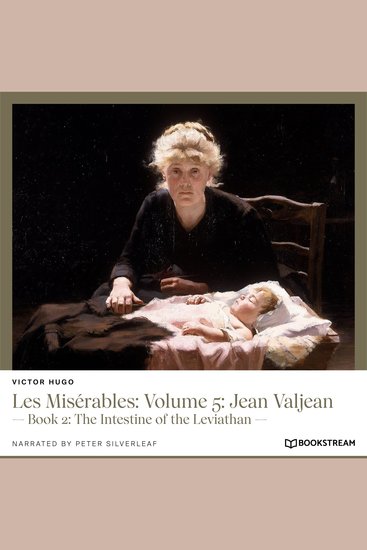
  • Les Misérables: Volume 5: Jean Valjean - Book 2: The Intestine of the Leviathan (Unabridged) - cover

    Les Misérables: Volume 5: Jean...

    Victor Hugo

    • 0
    • 0
    • 0
    Victor-Marie Hugo (26 February 1802 - 22 May 1885) was a French poet, novelist, essayist, playwright, and dramatist of the Romantic movement. During a literary career that spanned more than sixty years, he wrote abundantly in an exceptional variety of genres: lyrics, satires, epics, philosophical poems, epigrams, novels, history, critical essays, political speeches, funeral orations, diaries, and letters public and private, as well as dramas in verse and prose.
    BOOK 2: THE INTESTINE OF THE LEVIATHAN: Paris casts twenty-five millions yearly into the water. And this without metaphor. How, and in what manner? Day and night. With what object? With no object. With what intention? With no intention. Why? For no reason. By means of what organ? By means of its intestine. What is its intestine? The sewer.
    Show book
  • The Dead - cover

    The Dead

    James Joyce

    • 0
    • 0
    • 0
    Immerse yourself in the evocative world of James Joyce's "The Dead" with this captivating audiobook. Set in Dublin during the early 20th century, this poignant tale follows Gabriel Conroy and his wife Gretta as they attend a Christmas party hosted by Gabriel's aunts. 
    As the evening unfolds, Gabriel is confronted with the complexities of love, loss, and identity, culminating in a haunting revelation that forces him to confront the ghosts of his past. Joyce's lyrical prose and keen observations of human nature transport listeners to a world of longing, regret, and introspection. 
    Narrated with sensitivity and depth, "The Dead" captures the nuances of everyday life while exploring profound themes of mortality and the passage of time. Whether you're a longtime fan of Joyce's work or new to his literary genius, this audiobook offers a mesmerizing listening experience that will stay with you long after the final sentence. 
    Perfect for literature enthusiasts, book clubs, and anyone seeking a thought-provoking read, "The Dead" invites listeners to contemplate the mysteries of existence and the enduring power of memory. 
    So, if you're ready to embark on a journey of self-discovery and emotional resonance, start listening to "The Dead" today and experience the timeless beauty of James Joyce's storytelling. Start Listening to "The Dead" today!
    Show book
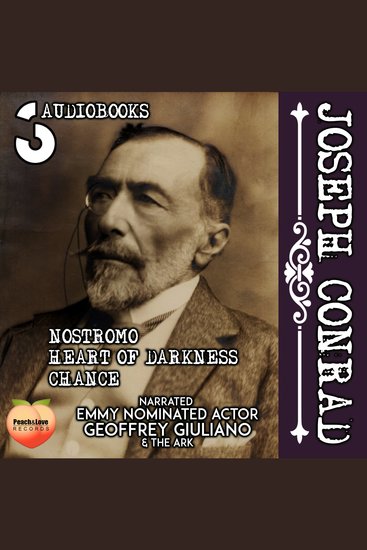
  • 3 Audiobooks Joseph Conrad - cover

    3 Audiobooks Joseph Conrad

    Joseph Conrad

    • 0
    • 0
    • 0
    Joseph Conrad, crafted a trilogy of literary works that delve into the complexities of human nature and the intricacies of colonialism. In "Nostromo," Conrad navigates the treacherous waters of political upheaval and greed in a fictional South American country. The tale follows Nostromo, a skilled and enigmatic sailor, as he becomes embroiled in the struggle for power and wealth, revealing the corrosive effects of ambition and the blurred lines between personal gain and loyalty. 
     
    "Heart of Darkness,", is a haunting exploration of the human psyche set against the backdrop of the brutal colonization of Africa. The novella follows Marlow, a sailor journeying up the Congo River, as he encounters the enigmatic Kurtz, a figure whose descent into madness and depravity serves as a reflection of the dark underbelly of European imperialism. Through vivid and often harrowing imagery, Conrad scrutinizes the moral and psychological toll of colonial exploitation, challenging readers to confront the shadows that lie within civilization's hearts. 
     
    In "Chance," Conrad shifts focus to the complexities of love, fate, and society. The novel centers on Flora de Barral, whose life is marred by her father's scandalous reputation and her own struggles for independence. As she navigates societal expectations and personal desires, Conrad weaves a narrative that illuminates the interplay between individual choices and the unpredictable twists of destiny. With his intricate prose and keen observations, Conrad crafts a tale that underscores the fragility of human connections and the role of chance in shaping lives. 
     
     Conrad demonstrates his profound understanding of human psychology, his critique of colonialism's ethical dimensions, and his exploration of the capricious nature of fate.
    Show book