Join us on a literary world trip!
Add this book to bookshelf
Grey
Write a new comment Default profile 50px
Grey
Subscribe to read the full book or read the first pages for free!
All characters reduced
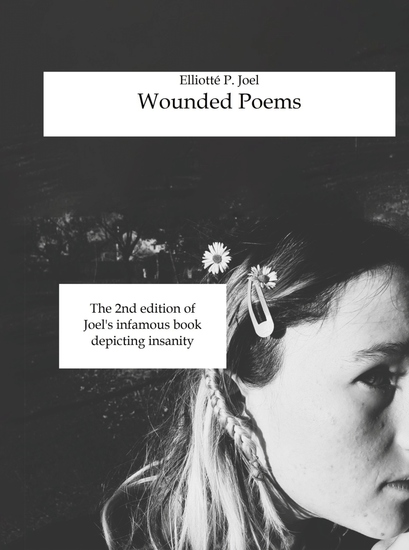
Wounded Poems - cover

Wounded Poems

Elliotté P. Joel

Publisher: Publishdrive

  • 4
  • 0
  • 3

Summary

The 2nd edition of Joel's infamous book depicting insanity
 
"Watch me be born, watch me bloom and then die, watch me resurrect." - Elliotté P. Joel on Wounded Poems"Deep poems and conceptual metaphors!" - Alisa Velaj
 
"Very interesting, refreshing, paradoxically natural!" - Ida Sieciechowicz
 
The debut poetry collection of Slovak-American author Elliotté P. Joel offers a time-lapsing observation of young poet's works captured from the age of 15 to 19. This literary work established a unique and novel genre of contemporary poetry - nonsensical impressionism.The prevalent subject of rejection and loss, as well as dissociation from society and the conventional way of living, can be found contrasting alongside subjects of profound love and the wandersome freedom of mind.With a vivid flow of words accompanied by almost otherworldly imagery, Joel equips her poetry with both emotional and intellectual stimulation.Despite a few obstacles that could have been a disadvantage, such as Joel having English as a second language or her being barely 20 during the time of publishing, Wounded Poems gained major success in the USA, Great Britain, Slovak Republic and Czech Republic.
Available since: 04/04/2023.
Print length: 90 pages.

Other books that might interest you

  • Fanny - cover

    Fanny

    Calum Finlay

    • 0
    • 0
    • 0
    'You're not stupid for wanting things to change, Fanny – it's just that we have to play the music that gets handed to us.'
    Meet Fanny Mendelssohn. You'll probably know of her younger brother Felix, from nineteenth-century smash hits like 'The Wedding March'. He was such a huge star that Queen Victoria requested a private concert, during which she sang her favourite of his compositions, a song called 'Italien'.
    The only problem is, that particular piece was actually composed by Fanny, though it was published under her brother's name.
    When Fanny intercepts the letter inviting Felix to play for the queen, she decides to hide it away, don her brother's clothes, and take his place at the palace…
    Calum Finlay's play Fanny is a joyful and irreverent comedy celebrating music, family and – at last – the work of a composer overlooked because of her sex. It opened at the Watermill Theatre, Newbury, in 2024.
    Show book
  • The Divine Comedy - cover

    The Divine Comedy

    Alighieri Dante

    • 0
    • 0
    • 0
    "The Divine Comedy" is an epic poem by Dante Alighieri, written in the early 14th century. Composed of three parts—Inferno, Purgatorio, and Paradiso—the poem is an allegorical account of the soul's journey towards God. Dante begins in the dark forest of human sin and error, travels up the mountain of Purgatory where souls are cleansed, and finally arrives in the heavenly spheres of Paradise. Along the way, he encounters various historical and mythological figures, each suffering or rewarded according to God's justice. The work delves into themes of divine justice, eternal damnation, and divine grace, offering a vivid tableau of medieval Christian belief and doctrine.
    Show book
  • Ghosts - cover

    Ghosts

    Henrik Ibsen

    • 0
    • 0
    • 0
    Henrik Ibsen's Ghosts is a powerful and provocative drama that dares to confront the hidden truths lurking beneath respectable society. First published in 1881, this groundbreaking play shocked audiences of its time with its fearless exploration of morality, duty, hypocrisy, and the haunting consequences of past actions. Today, it remains one of Ibsen's most compelling and widely studied works.
    
    Set in a remote Norwegian town, Ghosts centers on Mrs. Helene Alving, a widow preparing to open an orphanage in memory of her late husband, Captain Alving. To the outside world, the Captain was a pillar of the community—honorable, charitable, and morally upright. But beneath this carefully maintained façade lies a far darker truth. As the story unfolds over the course of a single day, long-buried secrets begin to surface, threatening to shatter the lives of everyone involved.
    
    Mrs. Alving has spent years protecting her son, Oswald, from the corruption and moral decay she associates with his father. Having sent him away to Paris to shield him from his father's influence, she hopes he will live a life free from the "ghosts" of the past. However, Oswald returns home carrying burdens of his own—both emotional and physical. His struggles reveal the devastating consequences of inherited guilt and societal repression.
    
    The play also features Pastor Manders, a well-meaning but rigid clergyman who represents the moral authority of society. Through his interactions with Mrs. Alving, Ibsen exposes the suffocating power of social expectations and the destructive force of blind adherence to tradition. Manders' concern for appearances over truth becomes a sharp critique of institutions that prioritize reputation above genuine compassion.
    
    Another key figure, Engstrand, a cunning and opportunistic carpenter, and his daughter Regina, who works in Mrs. Alving's household, further complicate the web of secrets. As relationships unravel and hidden connections are revealed, Ibsen masterfully builds tension toward a tragic and unforgettable conclusion.
    
    The title Ghosts operates on multiple levels. The "ghosts" are not literal spirits, but rather the lingering presence of past sins, outdated beliefs, and inherited ideologies that continue to shape the present. Ibsen suggests that individuals are haunted not only by personal mistakes but also by societal conventions that persist unquestioned across generations. These invisible forces exert a powerful influence, trapping characters in cycles of suffering and denial.
    
    At its core, Ghosts is a searing examination of truth versus illusion. Ibsen challenges the notion that maintaining appearances is more important than confronting reality. The play boldly addresses controversial themes such as venereal disease, illegitimacy, euthanasia, and the oppression of women—topics considered scandalous at the time of its release. Yet its enduring relevance lies in its exploration of universal human struggles: the tension between duty and freedom, love and responsibility, truth and comfort.
    
    Written in Ibsen's signature realist style, Ghosts strips away romanticism to reveal the stark complexities of human relationships. Its tightly constructed dialogue and psychological depth create a gripping drama that forces readers and audiences alike to question their own beliefs about morality, family, and societal norms.
    
    More than a century after its debut, Ghosts remains a timeless masterpiece—an unflinching portrayal of how the past shapes the present, and a profound reminder that the truths we avoid often return to confront us in the most devastating ways.
    Show book

  • Rhyme A Dozen A - 12 Poets 12 Poems 1 Topic ― Famous Tributes - 12 Poets 12 Poems 1 Topic - cover

    Rhyme A Dozen A - 12 Poets 12...

    Ben Jonson, Anne Bradstreet,...

    • 0
    • 0
    • 0
    ‘A dime a dozen’ as known in America, is perhaps equal to the English ‘cheap as chips’ but whatever the lingua franca of your choice in this series we hereby submit ‘A Rhyme a Dozen’ as 12 poems on many given subjects that are a well-rounded gathering, maybe even an essential guide, from the knowing pens of classic poets and their beautifully spoken verse to the comfort of your ears. 
     
    1 - A Rhyme A Dozen - 12 Poems, 12 Poets, 1 Topic - Famous Tributes - An Introduction 
    2 - To the Memory of My Beloved Master William Shakespeare and What He Hath Left Us by Ben Jonson 
    3 - In Honour of That High and Mighty Princess, Queen Elizabeth by Anne Bradstreet 
    4 - Abraham Lincoln by James Russell Lowell 
    5 - A Poem Upon the Death of His Late Highness the Lord Protector by Andrew Marvell 
    6 - The Death of Grant by Ambrose Bierce 
    7 - Lament for Thomas McDonagh by Francis Ledwidge 
    8 - Sonnet LVI Written at York on the Day of the Coronation of Queen Victoria June 28th, 1838 by Henry Alford 
    9 - To the Countess of Salisbury by Aurelian Townsend 
    10 - An Elegy on the Death of Llywelyn ab Gruyffyd by Gruffydd ap Yr Ynad Coch 
    11 - On the Death of the Late Earl of Rochester by Aphra Behn 
    12 - Chatterton in Holborn by Ernest Rhys 
    13 - Adonais; An Elegy On the Death of John Keats by Percy Bysshe Shelley
    Show book
  • The Teseida - cover

    The Teseida

    Giovanni Boccaccio

    • 0
    • 0
    • 0
    The Teseida by Giovanni Boccaccio is a grand and ambitious epic poem that weaves together classical legend, chivalric romance, and the emotional complexity of human desire. Written in the 14th century, this remarkable work stands as one of the earliest Italian epics composed in the vernacular, reflecting Boccaccio's deep engagement with classical antiquity and his emerging Renaissance vision.
    
    Set in the mythic world of ancient Greece, the poem centers on the legendary hero Theseus and the dramatic conflict between two Theban knights, Arcita and Palemone. Captured during war and imprisoned in Athens, the two cousins find their loyalty and brotherhood tested when they both fall in love with the noble Emilia. From that moment, their bond gives way to rivalry, and love becomes the catalyst for fate, honor, and tragic destiny.
    
    Boccaccio skillfully blends epic grandeur with intimate psychological insight. While battles and tournaments provide spectacle and heroic drama, the heart of the narrative lies in the emotional struggle between passion and duty. Arcita and Palemone are not merely warriors but fully realized individuals torn between friendship and romantic devotion. Emilia herself is portrayed with dignity and complexity, caught in a world where political power and personal longing intersect.
    
    Inspired by classical sources yet infused with medieval sensibilities, The Teseida bridges two literary traditions. It draws upon ancient mythology while introducing the courtly ideals and narrative structures that would shape later Renaissance literature. Its influence extended beyond Italy, inspiring Geoffrey Chaucer's Knight's Tale and contributing to the evolution of European epic and romantic poetry.
    
    Throughout the poem, themes of fortune, divine intervention, and the unpredictability of destiny unfold against a richly detailed backdrop. The gods observe and influence events, reminding readers of the delicate balance between human will and cosmic design. Yet amid this grand framework, Boccaccio's focus remains firmly on the emotional realities of love, jealousy, honor, and sacrifice.
    
    Majestic in scope yet deeply human in its portrayal of longing and rivalry, The Teseida stands as a foundational work of early Renaissance literature. It is both a celebration of heroic tradition and a meditation on the fragile nature of desire—an enduring epic that captures the timeless tensions between loyalty, ambition, and the heart's irresistible call.
    Show book
  • The Feast of Lights - cover

    The Feast of Lights

    Emma Lazarus

    • 0
    • 0
    • 0
    LibriVox volunteers bring you 9 recordings of The Feast of Lights by Emma Lazarus. This was the Weekly Poetry project for December 18, 2011.Hanukkah, or the Festival of Lights, is the Jewish festival commemorating the rededication of the Holy Temple in Jerusalem during the 2nd century BCE.This poem celebrating Hanukkah was written by Emma Lazarus, a Jewish American poet. Emma Lazarus also wrote 'The New Colossus,' a sonnet which is inscribed on a plaque on the pedestal of the Statue of Liberty.
    Show book