Unisciti a noi in un viaggio nel mondo dei libri!
Aggiungi questo libro allo scaffale
Grey
Scrivi un nuovo commento Default profile 50px
Grey
Iscriviti per leggere l'intero libro o leggi le prime pagine gratuitamente!
All characters reduced
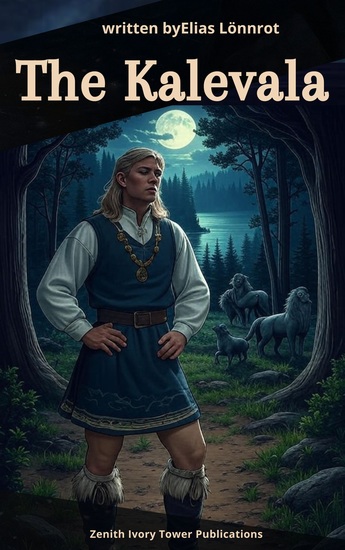
The Kalevala - The Epic Finnish Saga of Myth Magic and Heroic Legends - cover

The Kalevala - The Epic Finnish Saga of Myth Magic and Heroic Legends

Elias Lönnrot, Zenith Ivory Tower Publications

Casa editrice: Zenith Ivory Tower Publications

  • 0
  • 0
  • 0

Sinossi

An Epic Born of Ice, Fire, and Song — The Heart of Finnish Mythology Unfolds in The Kalevala.
Step into a world of creation myths, enchanted forests, celestial heroes, and cosmic battles — a poetic odyssey that shaped the soul of a nation.

The Kalevala, compiled by Elias Lönnrot in the 19th century, is one of the great epic poems of world literature. Rooted in ancient Finnish oral tradition, this masterpiece brings together songs and stories passed down for generations. From the powerful sage Väinämöinen to the tragic beauty of Aino and the forging of the magical Sampo, these mythic tales pulse with elemental power, raw emotion, and timeless wisdom.

With its rich rhythm, mystical symbolism, and sweeping scope, The Kalevala has inspired writers from Tolkien to Longfellow—and continues to captivate modern readers with its otherworldly charm and cultural significance.

"A literary treasure and cultural cornerstone of Finland." — The Finnish Literary Society
"A mesmerizing blend of myth and music. Comparable to Homer's epics." — World Literature Today
"Echoes of The Kalevala resonate in Tolkien, Le Guin, and even Marvel mythology." — Goodreads Reviewer

Perfect for lovers of mythology, epic fantasy, and folkloric heritage, this edition of The Kalevala opens a gateway to the primal legends that echo through Nordic history.

Click 'Buy Now' and journey through the enchanting, heroic, and mysterious realms of The Kalevala.
Disponibile da: 23/07/2025.
Lunghezza di stampa: 735 pagine.

Altri libri che potrebbero interessarti

  • Cumming Year The - 2024 - Double-Fisting Lesbian Holes - cover

    Cumming Year The - 2024 -...

    Kathrin Pissinger

    • 0
    • 0
    • 0
    Another Orgasmic New Year 
    It has been far too long that I got together with my girlfriend for a slutty and slippery slide into the New Year, but this time, she has planned something special: A very special maid, providing very special room service, just for me. Or wait: Make that two maids, who both can't get enough of our sputtering holes, drenching them in everything that's wet and wonderful until they're plugged with a fist. How did I manage to talk about my book in between all that? Well, you should read and see! 
    After all, it has been... what, years? Hoo boy, a long time in any case, since I published my last book, and if you're at all curious what I've been up to and what my plans are for the next year, this is the place to find out. And hey, what better way to find out than in between layers and layers of smut, right? 
    Caution: Contains orgiastic lesbian sex, fisting, urination and quite a quite a bit of anal, if I remember correctly. Which I may not, my memory got hazy after a point.
    Mostra libro
  • The Congress of Vienna - Redrawing Europe's Map - cover

    The Congress of Vienna -...

    Nova Ashford

    • 0
    • 0
    • 0
    The Congress of Vienna, held between 1814 and 1815, came at a pivotal moment in European history. The continent had just endured the upheaval caused by the Napoleonic Wars, which had left Europe in chaos and instability. Napoleon Bonaparte's rise to power and subsequent expansionist ambitions had dramatically altered the political landscape, reshaping borders and redrawing alliances. By 1814, with Napoleon's defeat and exile, Europe was left to deal with the aftermath of a decade of war and turmoil. The challenge for the leaders of the major powers was to rebuild a stable Europe while ensuring that the events which had led to war would not be repeated. 
    The immediate concern was to restore order and prevent any single nation from becoming too powerful. Napoleon’s domination of Europe, followed by his eventual fall, had created an imbalance of power that threatened the security of the continent. The leaders of the great powers—Great Britain, Austria, Prussia, and Russia—realized that to avoid future conflict, they needed to create a system that would maintain peace and stability through diplomacy and careful balancing of power. This would be achieved not by restoring the status quo exactly as it had been before the Napoleonic Wars, but by reshaping Europe in a way that would prevent any one nation from becoming overwhelmingly dominant. 
    The Congress of Vienna aimed to establish a new framework based on the principles of legitimacy and a balance of power. Legitimacy referred to the restoration of rightful monarchs who had been overthrown by Napoleon, while the balance of power involved redistributing territory and influence in a way that would prevent any single country from threatening the security of the others. It was a delicate process, as the major powers had competing interests and varying visions of what a stable Europe would look like. Nonetheless, the common goal was to create a system that could provide long-term peace.
    Mostra libro
  • Native American Plights - The Struggle Against Inequality and Racism - cover

    Native American Plights - The...

    Mark C. Royce

    • 0
    • 0
    • 0
    Are you a responsible citizen who would like to explore more about your history and the issues faced by minority groups? Are you an activist who yearns for constructive information and conversations that can build a better society for us all?  
    It’s a fact: Racial discrimination and harassment are issues that often affect Native Americans in more ways than we can imagine. The truth is that minorities form a huge part of American history. Although it is often encouraged that we should learn more about where we come from and what we’ve been through, it’s also important to learn of the influential power we played in writing the history books and most importantly, attain healing throughout the process. 
    Inside Native American Plights, you’ll discover:A comprehensive analysis of the history of Native Americans and why you should embrace it.Modern forms of racism and social injustices experienced by indigenous people and effective ways they can tackle and overcome it.How to attain healing and foster reconciliation as a Native American.Ways to secure your position in society through uprooting your identity and building an unbreakable sense of self-awareness.Ten compelling ways to dismantle discrimination against indigenous people in the most peaceful ways. 
    From now on, not only will you take pride in your history as a Native American, but you will also tap into the power to transform society into what it needs to be. No more feeling inferior, anxious about inequalities and discrimination, or even surrendering to the unfair power of racism. 
    You are about to be equipped with powerful tools that will reaffirm your importance in society while honoring the beautiful past of our ancestors! 
    Are you ready to shamelessly embrace your identity? Read Native American Plights now!
    Mostra libro
  • HOW TO DEAL WITH DIFFICULT PEOPLE - Empowering Yourself to Handle Difficult People: A Comprehensive Approach - cover

    HOW TO DEAL WITH DIFFICULT...

    Jessica Winston

    • 0
    • 0
    • 0
    First and foremost, interacting with difficult people is one of the best ways to hone important life skills such as communication, empathy, and problem-solving. When we are confronted with challenging individuals, we are compelled to engage in productive communication in order to find a solution. We need to make sure that we are actively listening to them so that we can understand their point of view, that we are asking questions to explain their worries, and that we are expressing ourselves in a clear and confident manner. When we have to deal with difficult people, it can provide us with an opportunity to practice and enhance our communication skills, which can be useful in many different aspects of our lives. 
    In addition, interacting with difficult people might help us develop empathy, which is the capacity to comprehend and identify with the emotions of another person. It is very simple for us to become preoccupied with our own feelings and disappointments when we are forced to interact with difficult people. However, taking the time to think about things from the perspective of another person might help us build empathy and compassion for that individual. Building greater relationships with other people enables us to develop empathy, which in turn can help us become better at problem solving and better negotiators. 
    In addition, engaging with difficult people can assist us in developing abilities necessary for problem-solving. When we are confronted with a challenging individual, we have the responsibility of figuring out how to resolve the conflict while still honoring our own boundaries and requirements. 
    Mostra libro
  • A Programme of Absolute Disorder - Decolonizing the Museum - cover

    A Programme of Absolute Disorder...

    Françoise Vergès, Paul Gilroy

    • 0
    • 0
    • 0
    "A complete overhaul of the Western museum tradition" —Publishers Weekly 


    "An impressive critique of the universal museum as complicit in the damages inflicted by colonial power" —Isaac Julien, artist and filmmaker 


    "Should fascinate anyone interested in social justice, post-colonialism and the arts" —Euronews 


    "Powerful and so relevant" —Diacritik 


    The Western museum is a battleground—a terrain of ideological, political, and economic contestation. Almost everyone today wants to rethink the museum, but how many have the audacity to question the idea of the universal museum itself? 


    In A Programme of Absolute Disorder, Françoise Vergès puts the museum in its place. Exploring the Louvre's history, she uncovers the context in which the universal museum emerged: as a product of colonialism, and of Europe's self-appointed claim to be the guardian of global heritage. 


    Vergès outlines a radical horizon: to truly decolonize the museum is to implement a "programme of absolute disorder", inventing other ways of apprehending the human and non-human world that nourish collective creativity and bring justice and dignity to the dispossessed.
    Mostra libro
  • Greek Made Easy - Beginner - Volume 2 of 3 - cover

    Greek Made Easy - Beginner -...

    Lingo Wave

    • 0
    • 0
    • 0
    We broke our new series on learning Greek down into different learning stages. Start with the "Lower Beginner" books followed by the "Beginner" and "Upper Beginner" books. Next, progress to the "Intermediate" series, then test and reinforce your knowledge with the "Conversations" series. 
    This audiobook is divided into units.While it provides different learning patterns and accommodates various needs, this audiobook focuses on helping you improve your ability to understand, speak, and memorise Greek.  
    In Unit 1 you will hear Greek decoded with each syllable spoken very slowly and clearly with repetition. Immediately before each sentence is spoken, you will hear the translation, so you will always understand what is being said. 
    Unit 2 focuses solely on increasing your listening ability, which will improve your abilities to engage in dialogue with a native Greek speaker. This chapter requires you to listen very carefully to nuances in the language. 
    By Unit 3 you will already notice progress in your abilities to speak and understand Greek. The spoken translation is followed by two repetitions in Greek at a completely natural speed. While you are learning to process naturally spoken Greek, Units 3 and 4 will help you memorise new vocabulary and full sentences.  
    In Unit 5 you can test yourself on how much you have learned. If you are having difficulties, we suggest you revisit the listening, speaking, or memorisation section of Units 1, 2 3 or 4, according to what you need more help with. 
    Topics covered in this book: 
    1. Asking about family 
    2. Asking about relationship status 
    3. Expressing frequency 
    4. Talking about spare time activities and hobbies 
    5. Using quantifiers/determiners 
    6. Talking about preference 
    7. Talking about abilities 
    8. Talking about location of places 
    9. Describing appearance 
    10. Talking about personality 
    ...
    Mostra libro